Five Key Points to Know Before Buying Can Sealing Machine
Don't buy a can sealing machine until you read this! Master the 5 essential secrets to boost efficiency and save…
May 22, 2026

The short answer: choose a standalone machine when demand, formats or formulations are still changing and manual handling remains practical. Choose a turnkey line when volume is stable, several operations must run at one pace, and the value of lower handling, better process control and single-source integration can justify the higher initial cost.
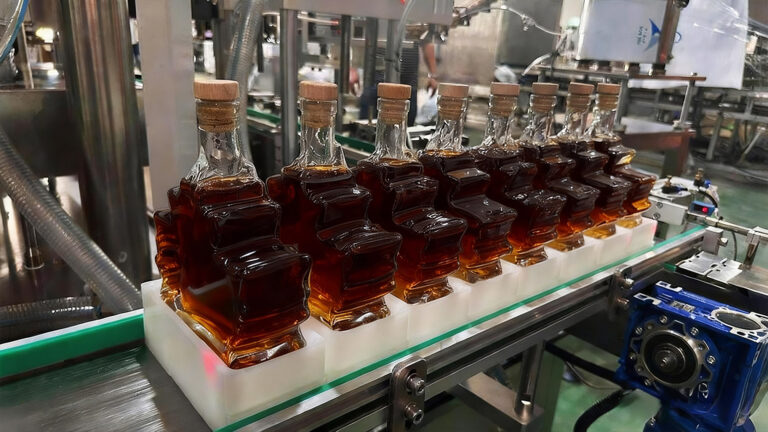
A standalone filling machine is usually the better choice for uncertain demand, frequent product changes and limited initial investment. A turnkey filling line becomes more economical when stable high-volume output, lower manual handling and unified line responsibility matter more than the initial equipment price. Compare both options using total cost per saleable bottle—not filler price alone.
A standalone filling machine performs the dosing operation as an independent workstation. It may be a semi-automatic pneumatic piston filler, an automatic inline filler or a compact monoblock that combines filling and capping. Operators may still load bottles, transfer containers or perform secondary packaging.
A turnkey filling line connects the required process stages into one engineered system. Depending on the product, that may include mixing and holding tanks, bottle feeding, filling, cap feeding, capping, sealing, labeling, coding, inspection, case packing and palletizing. The important word is not “complete”; it is integrated. Speeds, signals, utilities, change parts and fault responses must work together.
| Decision Area | Standalone Machine | Turnkey Line |
|---|---|---|
| Initial investment | Lower because fewer processes are included | Higher because infeed, downstream equipment, controls and integration are included |
| Labor | Usually requires loading, transfer or packing | Reduces direct handling, but still needs replenishment, supervision and changeover labor |
| Output risk | Often limited by the operator or the next process | Limited by the slowest module and the quality of line balancing |
| Format flexibility | Often easier for small batches and frequent changes | Can handle multiple formats, but change parts and automation level must be defined for each one |
| Downtime | A stop is usually isolated to one workstation | One blocked module can stop the entire line unless bypasses or buffers are designed in |
| Accountability | Simple for one machine; more complicated if several vendors are later linked | One integrator can own line speed, communication and acceptance criteria |
The purchase price of a standalone filler is naturally lower because you are buying fewer functions. That does not automatically mean it has the lower cost per saleable bottle. The missing functions do not disappear; they become labor, separate equipment, floor handling, work-in-process or a future integration project.
For a useful comparison, normalize both quotations to the same production boundary. If the turnkey quote ends with sealed cases on a discharge conveyor, compare it with the cost of the standalone filler plus bottle loading, cap application, labeling, inspection, case packing, controls and the people needed between those steps.
A practical total-cost calculation is:
Cost per saleable container = (annualized equipment cost + direct labor + utilities + maintenance + changeover loss + rejected product + downtime cost) ÷ saleable annual output.
This is also why a fixed online price range can be misleading. A free-flowing 20 mL liquid in one bottle is not the same capital project as a heated 180 g gel that needs mixing, insulated transfer, hot filling and nine metres of controlled cooling.
In one ordered compact workstation for two irregular bottle formats, the machine combined one-head peristaltic filling, vibratory cap feeding, pre-capping, servo capping and automatic bottle ejection. The operator still placed each bottle into a quick-change rotary fixture.
The specified filling range was 10–80 mL. Rated output was 1,000 bottles/hour at 20 mL and 800 bottles/hour at 60 mL, explicitly dependent on the operator’s loading speed. The 20 mL dosing specification was ±1%. The machine itself measured approximately 1,000 × 700 × 1,500 mm, weighed about 500 kg, used 2.5 kW and required 0.4–0.6 MPa compressed air.
Those numbers show the real appeal of a standalone machine: filling and capping were contained in a small physical and utility envelope, while format change was handled by replacing the rotary fixture. They also expose the main operating risk. The headline speed was not independent of labor; hand loading was part of the production rate.
In a completed-line record for a 180 g hot-fill gel, the specified output was 4,000 bottles/hour. The filler was only one part of the investment. The process scope included one 1,000 L steam-heated homogenizing tank, two 1,000 L electrically heated holding tanks, a 72 kW steam generator, insulated pumps and pipework, a 10-head heated filler, a 9 m cooling tunnel with three 10P (nominal 10 hp) refrigeration units, a six-head film sealer, cap-handling equipment, conveyors and operator platforms.
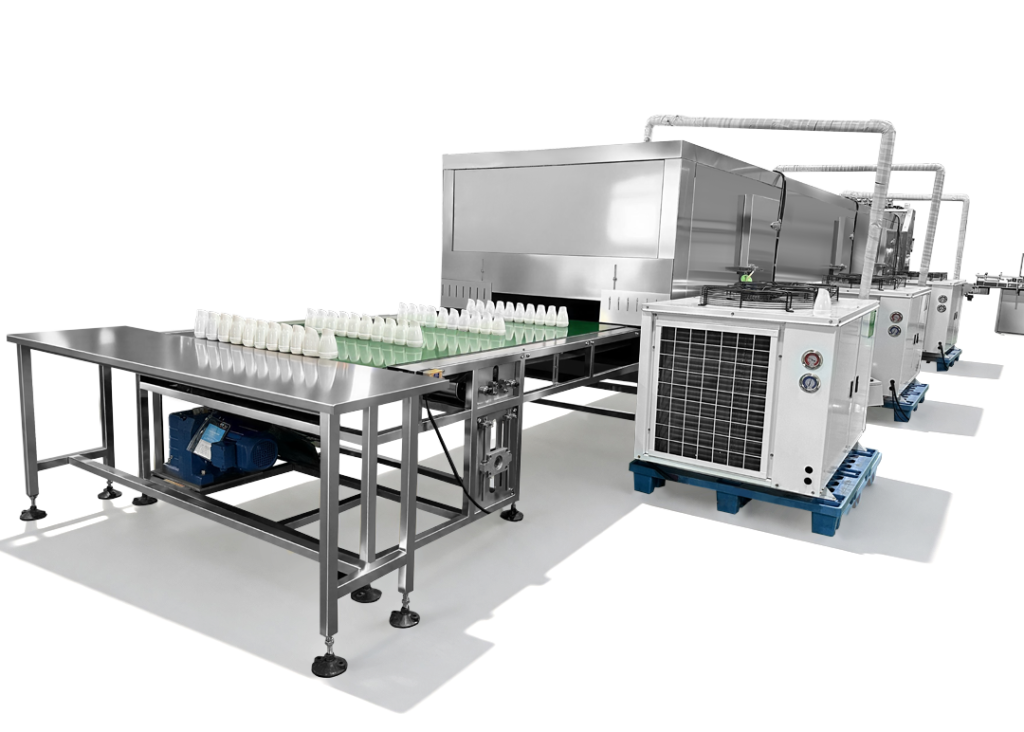
The cost lesson is straightforward: thermal processing, product transfer and cooling can equal or exceed the complexity of dosing. Comparing the price of that line with the price of a filler alone would answer the wrong question.
The same project also handled several container formats, but not every format received the same automation. One bottle-and-cap combination used automatic cap sorting and pressing; other formats still required manual cap placement followed by pneumatic pressing. One sealing station was reserved for a single container format, and space was left for a buyer-supplied induction sealer. “Turnkey” therefore did not mean that every SKU was fully automatic. The automation boundary was defined format by format.
With standalone equipment, the bottleneck is easy to see. An operator cannot feed fast enough, filled bottles accumulate on a table, or the capping process falls behind. The problem is local, and production can often continue at a lower rate.
With a turnkey line, the bottleneck is systemic. A line advertised at 50 bottles/minute is not a 50-bottle/minute line if the labeler, cap feeder or carton-packing module can only sustain 40. This is why serious line engineering works backward from the finished pack, not forward from the filler.
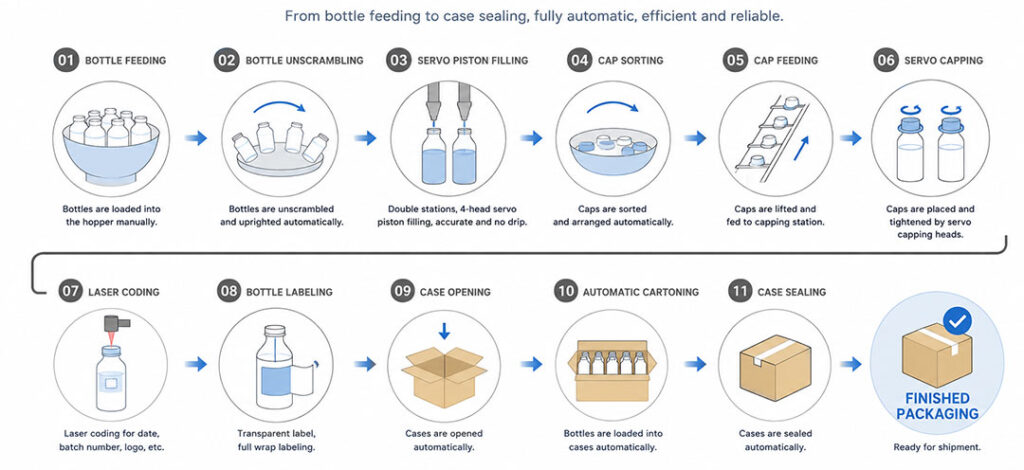
An ordered 100 mL personal-care line makes the point. Its filling and capping section was specified at 40–50 bottles/minute with ±1% dosing accuracy. The bottle hopper held about 1,000 bottles and was planned for replenishment roughly every 20 minutes. The cap hopper held about 2,000 caps, with replenishment roughly every 30–40 minutes. The system then applied a full-wrap transparent label and packed 24 bottles per case.
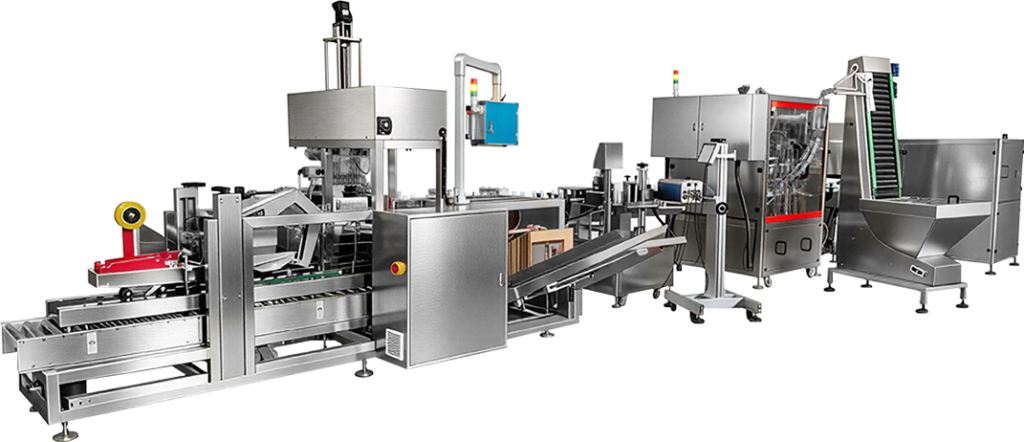
The cost lesson is straightforward: thermal processing, product transfer and cooling can equal or exceed the complexity of dosing. Comparing the price of that line with the price of a filler alone would answer the wrong question.
The same project also handled several container formats, but not every format received the same automation. One bottle-and-cap combination used automatic cap sorting and pressing; other formats still required manual cap placement followed by pneumatic pressing. One sealing station was reserved for a single container format, and space was left for a buyer-supplied induction sealer. “Turnkey” therefore did not mean that every SKU was fully automatic. The automation boundary was defined format by format.
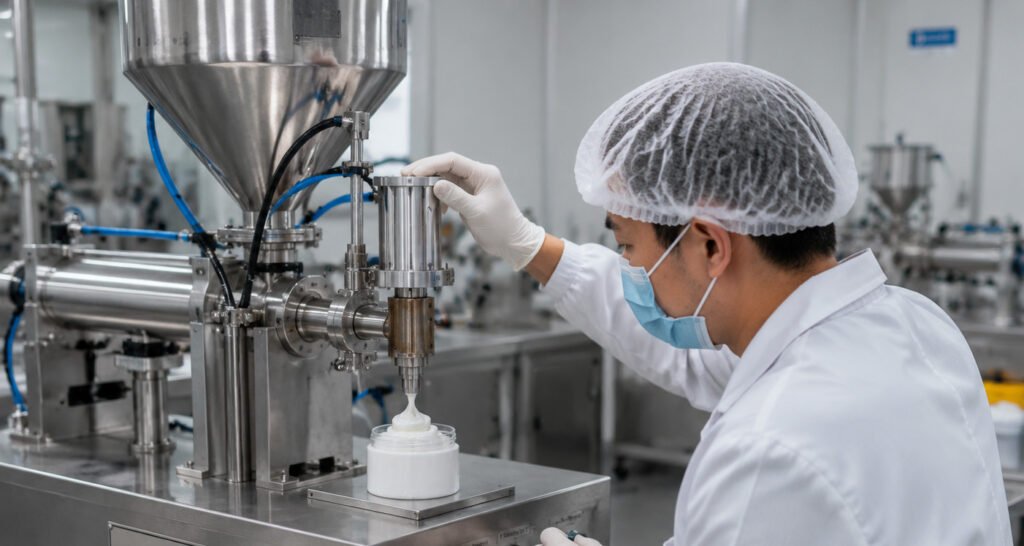
If speed is stated as “depending on manual loading,” build your production model around a sustainable operator cycle, not the machine’s fastest dry run. Include breaks, container orientation, rejected caps and material replenishment.
Moving open or uncapped containers between machines adds handling time and creates opportunities for spills, contamination and mix-ups. The risk rises with low-viscosity products, unstable containers and high-value doses.
A standalone machine that may later join a line should be specified as line-ready. Confirm conveyor height and direction, variable-speed control, upstream/downstream interlocks, spare I/O, stop and fault signals, guarding interfaces and recipe handling before purchase. Retrofitting these details later is usually more expensive than including them at build stage.
A pneumatic filler may reduce electrical equipment around the dosing point, but it does not by itself make a room or process safe for a flammable product. Product-contact compatibility, seals, ventilation, static control, electrical classification and the surrounding equipment still need a system-level review.
Ask what happens when caps run out, a label sensor faults or the carton-packing module is unavailable. Can the fill-cap module run independently? Is there accumulation between critical stations? Can product be safely discharged before a long downstream stop?
In the 40–50 bottle/minute personal-care line above, the filling and capping sections were specified so they could operate separately. That is a useful example of fault isolation: it supports commissioning, troubleshooting and limited production without requiring every downstream module to run.
A full line may need more than electrical power and compressed air. Hot-fill projects can require heating media, insulated transfer and substantial refrigeration. The 4,000-bottle/hour gel line needed three nominal 10 hp cooling units on its 9 m cooling section, in addition to heated tanks and a steam generator. If the plant cannot supply the required utilities at peak load, the nominal filler speed is irrelevant.
For every SKU, document whether bottle feeding, filling, cap feeding, capping, sealing, labeling and packing are automatic, semi-automatic or manual. Also identify the change parts, expected changeover method and storage required. A line can be “compatible” with eight containers while only one format receives automatic cap feeding.
One completed-line record for a flammable methanol application used an 800 L mixing tank, a six-head explosion-protected filler, automatic capping, labeling and coding. The filler was specified at 1,500–2,000 bottles/hour with ±0.5% dosing accuracy, approximately 4.6 kW power and 0.6–0.8 MPa air. Product-contact tanks, the filler, hopper, nozzles and related pipework were specified in SUS316 with passivation.
That is a different cost and risk category from putting a standard filler into a hazardous room. The quotation must define the product path, hazardous-area boundary, electrical protection, instrumentation and responsibility for plant-side controls. “Stainless steel machine” is not an adequate safety specification.
Choose a standalone machine when most of the following are true:
The compact 10–80 mL fill-cap workstation is a good example. At 800–1,000 bottles/hour, it can be commercially useful without the cost of automatic bottle unscrambling, conveying and case packing—provided an operator can reliably maintain the loading rate.
Choose an integrated line when most of these conditions apply:
At the high end, a completed small-dose line specification used 10–12 tracking peristaltic filling heads and 12 capping heads for a 0.2–2 mL range, with a rated output above 200 bottles/minute. Dosing accuracy was specified at ±1% at both 0.2 mL and 1.1 mL. The fill-cap-label module used 8 kW and 0.6–0.8 MPa air. At that speed, manual transfer between separate machines is no longer a realistic architecture; synchronized container control is part of the process.
The decision is not always binary. A compact fill-cap monoblock can remove the most difficult manual steps while keeping bottle loading and case packing manual. Later, an unscrambler, conveyor, labeler or packing cell can be added.
This phased route works when the first machine is designed for expansion. Before ordering, ask for:
A modular plan preserves capital flexibility without turning the first purchase into stranded equipment.
Send both suppliers the same product and packaging data, then make them answer the same questions:
Do not start with “standalone or turnkey?” Start with three numbers: required saleable output by SKU, sustainable labor per shift and the cost of a production stop. Then map every step from product supply and empty container to finished case.
If one compact workstation can meet that map, the lower-cost standalone route is often the better decision. If the map contains repeated transfers, heat-sensitive processing, hazardous materials or several machines that must hold one pace, a turnkey line usually provides the more controllable operating model.
The best choice is the smallest system that can meet the real production requirement without moving unacceptable cost or risk to another part of the factory.
If this analysis points to an integrated system, GDHP can develop a turnkey filling and packaging production line around the actual product, container, target output, plant utilities and downstream packaging scope. By planning product preparation, bottle handling, filling, capping, labeling and end-of-line packaging as one project, GDHP’s engineering team can define interfaces, responsibilities and FAT criteria before manufacturing. Share your production requirements with GDHP to receive a line-specific proposal.
No. It becomes attractive when the line runs enough saleable volume to spread the higher capital cost and when automation removes meaningful labor, handling loss or compliance risk. A lightly used line with frequent long changeovers can cost more per bottle than a well-run standalone cell.
No. The right architecture depends on the whole process. The ordered compact workstation above was rated at 800–1,000 bottles/hour, while automatic fillers can run faster. The key question is whether feeding, capping and packing can keep pace without adding excessive labor or work-in-process.
No. Even the 40–50 bottle/minute automated line required periodic bottle and cap replenishment. Operators also perform changeovers, material supply, quality checks, fault recovery and maintenance. Turnkey automation reduces repetitive handling; it does not eliminate production ownership.
Usually, but define interfaces before purchase. Mechanical height, conveyor speed, control signals, reject logic and emergency-stop behavior matter more than the brand name. If those interfaces are missing, integration can require new controls and guarding.
Compare both options at the same finished-product boundary and calculate annual cost per saleable container. Include labor, utilities, changeover loss, expected downtime, maintenance and secondary equipment—not only the filler purchase price.