Five Key Points to Know Before Buying Can Sealing Machine
Don't buy a can sealing machine until you read this! Master the 5 essential secrets to boost efficiency and save…
May 22, 2026

Pharmaceutical machinery must support a controlled, hygienic, and repeatable production environment. We engineer filling and packaging solutions with recognized compliance benchmarks in mind, including cGMP, FDA regulations, CE, and ISO 9001.
| Framework | Core Equipment Focus |
|---|---|
| cGMP / FDA Regulations | Hygienic equipment design, cleanable construction, suitable product-contact materials, and controlled manufacturing processes. |
| EU GMP Principles | Cross-contamination prevention, aseptic-processing support, and equipment suitability for pharmaceutical production areas. |
| WHO and International Practices | Consistent quality controls and inspection-ready manufacturing practices for global pharmaceutical projects. |
| ISO 9001 | Documented quality-management processes supporting consistent equipment design and manufacturing. |
| CE Requirements | Mechanical, electrical, and operational safety for machinery supplied to applicable markets. |
For pharmaceutical applications, compliance is not limited to a certificate. It must be reflected in the machine layout, material selection, safety protection, documentation, testing, and production controls. Our turnkey approach supports these requirements across preparation, filling, capping, inspection, labeling, and end-of-line packaging equipment.
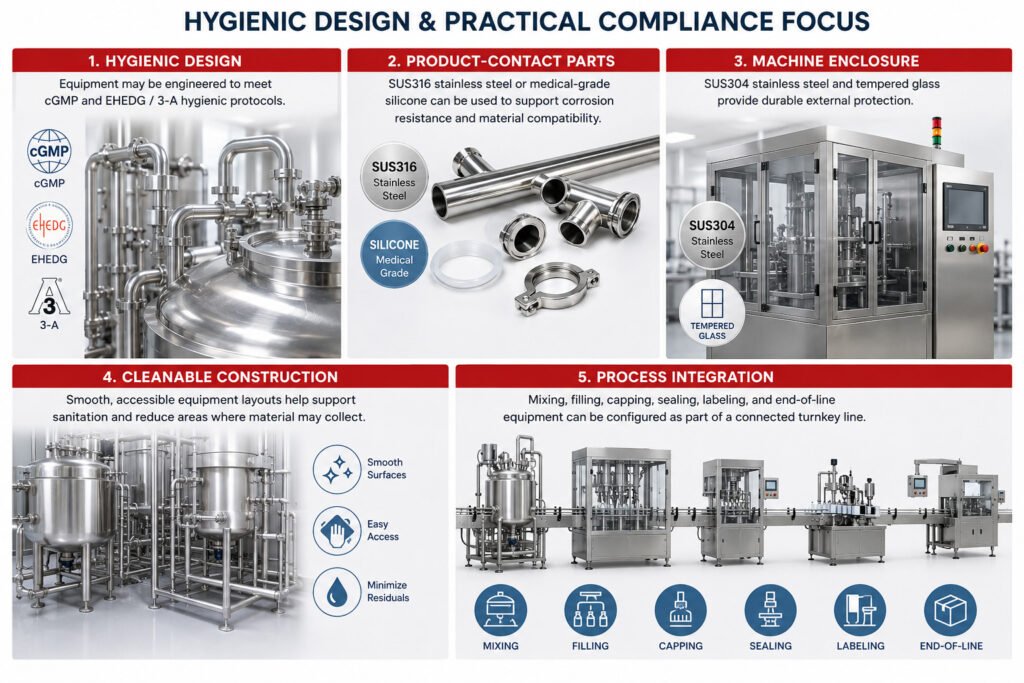
When assessing what standards pharmaceutical machinery must meet, hygienic construction is a core requirement. We design filling and packaging equipment around cleanability, product protection, and dependable operation in pharmaceutical environments.
| Design area | Practical compliance focus |
|---|---|
| Hygienic design | Equipment may be engineered to meet cGMP and EHEDG / 3-A hygienic protocols. |
| Product-contact parts | SUS316 stainless steel or medical-grade silicone can be used to support corrosion resistance and material compatibility. |
| Machine enclosure | SUS304 stainless steel and tempered glass provide durable external protection. |
| Cleanable construction | Smooth, accessible equipment layouts help support sanitation and reduce areas where material may collect. |
| Process integration | Mixing, filling, capping, sealing, labeling, and end-of-line equipment can be configured as part of a connected turnkey line. |
For pharmaceutical applications, machinery should support consistent cleaning and controlled product handling. Key engineering priorities include:
For hazardous or corrosive liquids, we can apply negative-pressure sealing arrangements to help contain volatile gases. This approach supports operator protection and controlled pharmaceutical processing without compromising the wider filling-line workflow.
When determining what standards pharmaceutical machinery must meet, material compatibility and safe containment are central to hygienic, reliable operation.
We use SUS316 stainless steel or medical-grade silicone for product-contact parts where corrosion resistance and material compatibility are required. These materials help support hygienic handling of pharmaceutical liquids and sensitive formulations.
Our machinery can use SUS304 stainless steel and tempered glass for external casings and protective enclosures. This construction supports durable equipment design for controlled production environments.
For corrosive, toxic, or volatile liquids, we provide containment-focused designs that can include:
This approach supports safer handling while helping reduce exposure risks during pharmaceutical processing and filling.
Pharmaceutical machinery must support controlled, repeatable operation and align with applicable cGMP, FDA, CE, and ISO 9001 requirements. We engineer filling and packaging systems around the approved production process, with controls matched to the specified material, capacity, and operating environment.
For liquid, paste, cream, granule, and powder applications, precision filling is essential to consistent output. Our systems can incorporate application-focused features such as:
In-line inspection supports packaging quality throughout the line. Depending on the project specification, equipment can be configured with inspection and coding functions for packaging presentation and process control, including:
For pharmaceutical machinery, the required automation level, control records, and inspection scope should be defined in the project specification and confirmed during Factory Acceptance Testing (FAT).
For flammable or volatile pharmaceutical materials, we engineer explosion-proof filling and packaging configurations to reduce ignition risk during production. Key safeguards include:
These measures support safer operation where hazardous liquids or vapors require controlled processing conditions.
Powder and granule lines require effective containment to keep material handling clean and stable. Our equipment can incorporate:
For facilities assessing what standards pharmaceutical machinery must meet, explosion protection and dust control should be considered alongside hygienic design, product containment, and operator safety.
For pharmaceutical machinery standards, we start with clear project requirements and convert them into a confirmed equipment plan. This keeps the filling, packaging, or processing line aligned with the required application, capacity, material characteristics, and hygiene expectations.
Our workflow moves from requirements assessment to scheme design and plan confirmation before production begins. The approved plan defines the machinery configuration, including relevant product-contact materials, containment features, and filling or packaging functions.
We perform Factory Acceptance Testing (FAT) before final payment and shipment. FAT verifies that the completed equipment operates in line with the confirmed project plan before it is protectively packaged and shipped.
Key FAT checks can include:
After shipment, we provide installation guidance and operator training to support correct equipment setup and use. Our service includes a one-year free warranty and lifetime technical support, helping customers maintain stable operation throughout the equipment lifecycle.
At GDHP, we build bespoke filling, packaging, and material-processing lines for pharmaceutical and related regulated applications. With more than 23 years of engineering experience, we align each project with applicable cGMP, FDA, CE, ISO 9001, and EHEDG/3-A hygienic design requirements.
Our turnkey delivery follows a structured nine-step process designed to keep technical requirements clear from planning through delivery:
FAT is performed before shipment to verify the machine against the confirmed project requirements. We also provide installation and commissioning support, operator training, a one-year free warranty, and lifetime technical support.
We configure machinery around product behavior, process risks, and production needs. Our capabilities include:
This engineering approach supports pharmaceutical machinery standards while connecting preparation, filling, capping, inspection, labeling, cartoning, and end-of-line packaging within one coordinated production line.
For an applied equipment example that connects precision dosing, contamination control, SUS316, and PLC integration, see our pharma precision filling and packaging guide.