Five Key Points to Know Before Buying Can Sealing Machine
Don't buy a can sealing machine until you read this! Master the 5 essential secrets to boost efficiency and save…
May 22, 2026

During a batch run, a powder filler can stop feeding even though the auger motor is still turning. The blockage may be a bridge above the hopper outlet, a compacted auger channel, or a crusted discharge nozzle.
That interruption changes bulk density and dose weight, creates rework, and tempts operators to open equipment before it is safe to do so. Dust is also a process-safety issue: OSHA reports that the U.S. Chemical Safety and Hazard Investigation Board identified 281 combustible-dust incidents from 1980–2005, causing 119 worker deaths and 718 injuries (OSHA). Those figures cover dust incidents broadly, not powder-filler clogs specifically.
This guide shows how to identify the failure point, verify the material and machine conditions, clear a clog safely, and build a preventive control plan. It turns powder filling machine clogging into a documented troubleshooting process for maintenance and production teams.
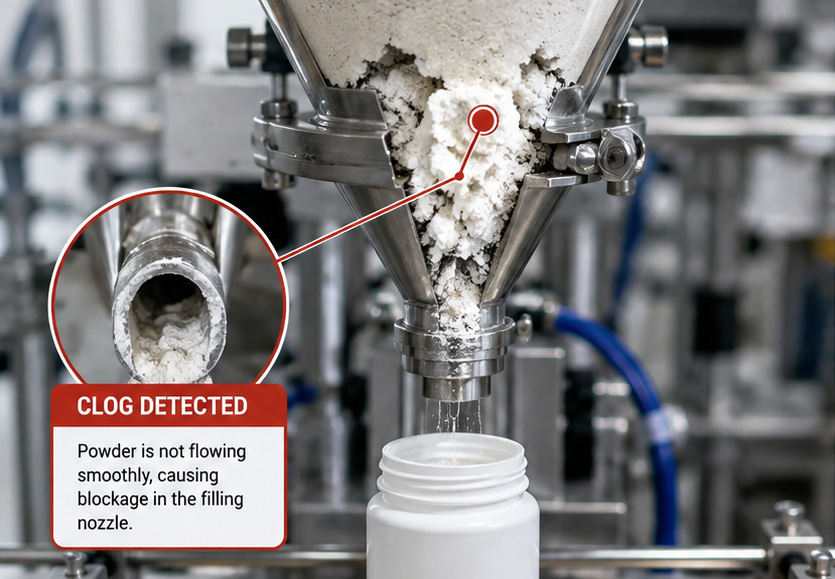
A clog is usually a material–equipment mismatch rather than a single failed part. Record where the flow stops and what changed since the last good batch. Choosing the appropriate powder filling machine is particularly important.
Hygroscopic powders take up water from the air. The result can be sticky agglomerates, a higher apparent bulk density, and a deposit that grows at the hopper throat or nozzle. Do not apply one “safe” room-humidity number to every formulation. Set a product-specific moisture and room-RH limit from development or supplier data, then log both values at the filler.
CRH values are screening references, not universal room-RH setpoints. A reported value applies only to the material and conditions tested; temperature, formulation, purity, particle state, exposure time and test method can all change caking behaviour. Use formulation-specific supplier stability data or product-specific moisture-sorption testing to establish operating limits, and record the source, test temperature and method with every value.
| Observed material behaviour | What it may indicate | What to verify before changing the filler |
|---|---|---|
| Rapid mass gain, stickiness or deliquescence after air exposure | High moisture sensitivity under the current conditions | Supplier stability or sorption data, powder moisture, room RH and temperature, and exposure time |
| Caking after storage or compression | Time, temperature or stacking pressure may contribute; RH may not be the only cause | Storage history, bulk density, compaction and sieve or particle-size data |
| Bridging without a measurable moisture change | Cohesion, particle shape or size, electrostatics or hopper geometry | Powder flow behaviour, particle-size distribution, grounding continuity and outlet geometry |
Fine or cohesive particles can form an arch over the outlet (bridging) or a channel through the centre of the hopper (ratholing). The machine may appear to have powder in the hopper while the auger is starved. A short, controlled agitator or vibrator pulse can help, but continuous vibration can compact some formulations; validate amplitude and timing with the actual powder.
Friction at the hopper wall, auger and flexible transfer hose can charge particles. Fine dust may then adhere to poorly bonded or incorrectly grounded surfaces and gradually narrow the flow path. Verify bonding continuity, suitable conductive components and ionizing equipment where the risk assessment requires them. Humidity can influence static dissipation, but it is not a substitute for a verified grounding path.
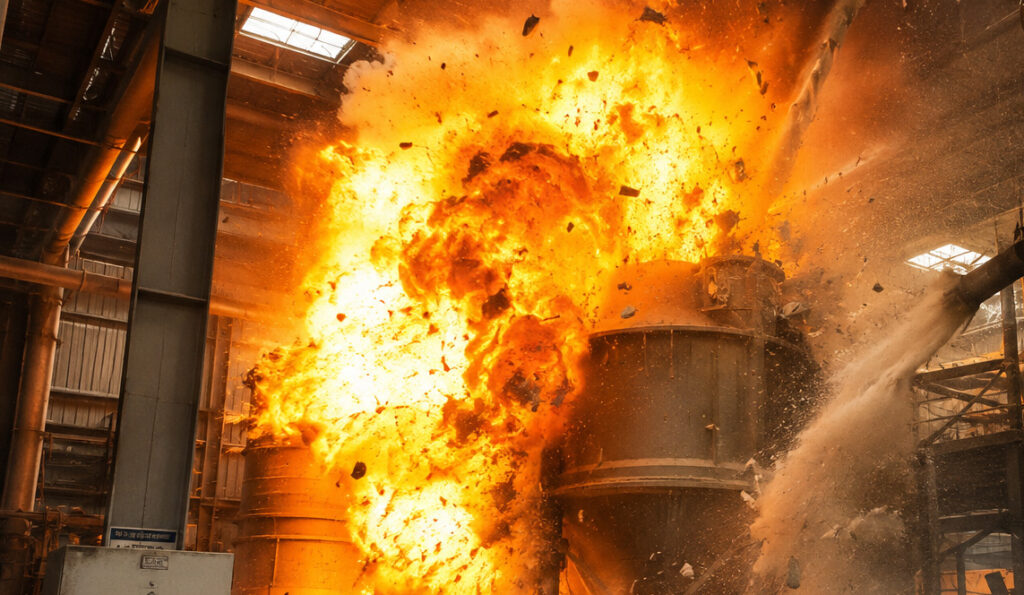
The examples below identify materials that may require combustible-dust screening; the category alone does not establish whether a specific powder is explosible. Use the current SDS and a qualified dust-hazard assessment based on the actual material. Where applicable, testing may include Kst, Pmax, minimum ignition energy (MIE), minimum explosible concentration (MEC), particle size and moisture content.
| Material group | Examples that may require screening | What the facility should verify |
|---|---|---|
| Metals and alloys | Aluminum, magnesium, zinc, titanium, iron and ferrosilicon powders | Actual particle size, composition, reactivity, ignition sensitivity and whether the material can react with water |
| Agricultural, forest and food materials | Starch, flour, sugar, milk powder, cocoa, coffee, tobacco, wood dust and plant fibres | Whether fine airborne fractions are combustible; actual moisture, particle size, concentration and ignition sources |
| Synthetic materials and plastics | Polyethylene, polypropylene, resins, rubber and other polymer powders | Static accumulation, bonding and grounding, dust collection and the actual powder ignition data |
| Coal and petrochemical materials | Coal, coke, petroleum coke, asphalt and sulfur powders | Material-specific explosibility and ignition data; do not infer risk from a generic material name |
| Pharmaceuticals and fine chemicals | APIs, intermediates, zinc stearate, antioxidants, dyes and pigments | Combustible-dust data together with toxicity, containment and cross-contamination requirements |
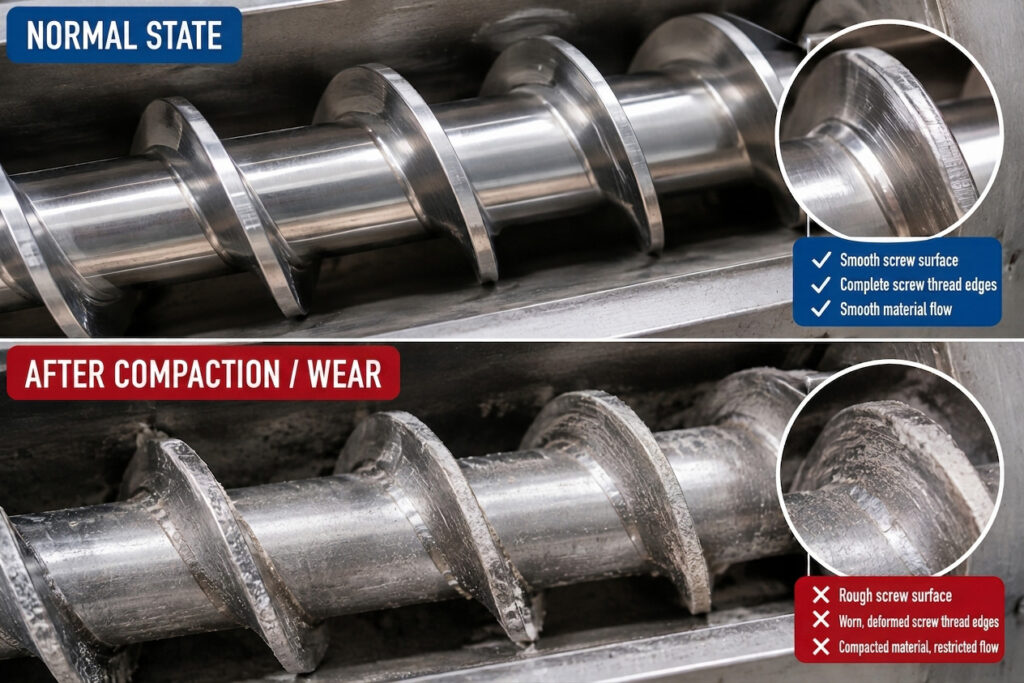
An auger diameter, pitch or flight profile that is wrong for the powder can shear, compress or starve the feed. Excessive RPM may generate heat and compaction; too little agitation may leave voids. Review screw selection, motor torque, acceleration ramps and actual fill-weight data together instead of changing RPM blindly.
A broad particle-size distribution can segregate during conveying. Fines settle into gaps between larger particles, then pack at filters, seals and narrow nozzles. Scratched stainless steel, bent flights, worn agitator edges and damaged valve seats create additional ledges where dust can collect.
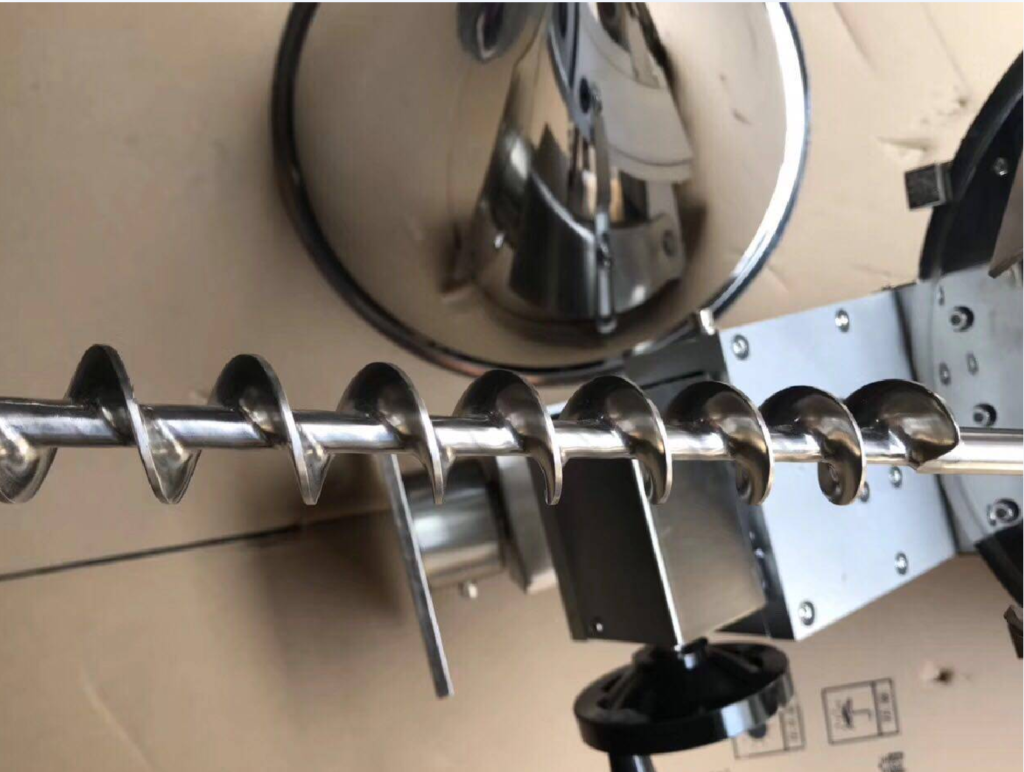
Use the machine manufacturer’s lockout/tagout procedure and the powder’s safety data sheet (SDS). Never reach into a hopper, use a metal rod, or remove a guard while the auger or vibrator can start.
After isolation, inspect from the product inlet toward the outlet: hopper throat, agitator, auger inlet, screw flights, dosing tube, valve seat and nozzle tip. The first upstream restriction is usually more informative than the largest pile of powder downstream.
Test continuity from the hopper, auger tube, transfer hose and frame to the plant earth point. Confirm ionizing bars and dust extraction are operating at their specified settings. Record the result rather than relying on a visual check.
Reassemble, load a small quantity, and run at the approved starting settings. Change only one variable—such as auger RPM, agitator pulse or feed height—between trials. Check a statistically useful set of fill weights and inspect the discharge path after the run.

Match the symptom with a confirmation test before selecting a fix. Record the result in the batch or maintenance log so repeated clogs can be trended.
| Observed symptom | Likely mechanism | Confirm | First corrective action |
|---|---|---|---|
| Powder remains above an empty outlet | Bridge or rathole | Inspect arch after lockout; compare flow with agitator off/on | Validate outlet geometry and a short, low-energy agitator/vibrator pulse |
| Dust ring grows on the nozzle | Static adhesion or fines | Check grounding continuity, ionizer status and filter loading | Restore bonding and dust capture; clean with the approved method |
| Fill weight drifts after a humid shift | Moisture uptake or density change | Measure powder moisture and bulk density; log room RH | Quarantine out-of-spec material and apply the validated storage/RH limit |
| Motor torque rises and the auger packs | Excessive RPM, wrong screw or compacted feed | Trend torque, RPM and fill weight together | Reduce stress gradually and confirm screw geometry with a product trial |
| Clog returns after changeover | Residue, wet parts or worn seal | Inspect hidden ledges and verify dry reassembly | Revise the changeover SOP and replace damaged wear parts |
Use an outlet and wall angle that support the powder’s measured flow behaviour. Select an agitator or pneumatic vibrator only after a product trial; pulse it when the machine needs feed assistance, and check that vibration does not increase compaction or segregation.
Keep hygroscopic material (Silicone Gel, Molecular Sieve, CaCl2) sealed until it is needed, minimise open exposure, and trend room temperature and RH. Use dehumidified air or nitrogen only when the process risk assessment and product compatibility allow it. The correct limit is the value demonstrated by your formulation and validation work.
Specify a documented surface-finish and cleanability requirement for the hopper, auger tube, valves and nozzles. Inspect with the appropriate roughness and visual checks; do not assume that a polished appearance proves a hygienic surface. FDA’s equipment rule is a useful benchmark for food lines, while pharma and chemical facilities should follow their applicable GMP and material-compatibility requirements.
Start with the screw geometry recommended for the powder, then establish a small design-of-experiments window for RPM, fill level, agitator timing and acceleration. Record torque, dose weight, rejects and clog location. A setting is acceptable only when it meets the approved fill-weight and safety criteria across representative runs.
Bond conductive parts, keep earth connections accessible for inspection, and position ionization and extraction where dust is generated. For powders that may be combustible, have the installation reviewed against the applicable local code and qualified dust-safety assessment before adding electrical or pneumatic devices.
Use a risk-based, validated schedule rather than a universal “clean every X hours” rule. It can also be used for checking other common faults of filling machines.
For food lines, use only cleaning compounds and compressed gases permitted by the sanitation program. For pharmaceutical or hazardous powders, follow the validated cleaning process, containment controls and SDS.
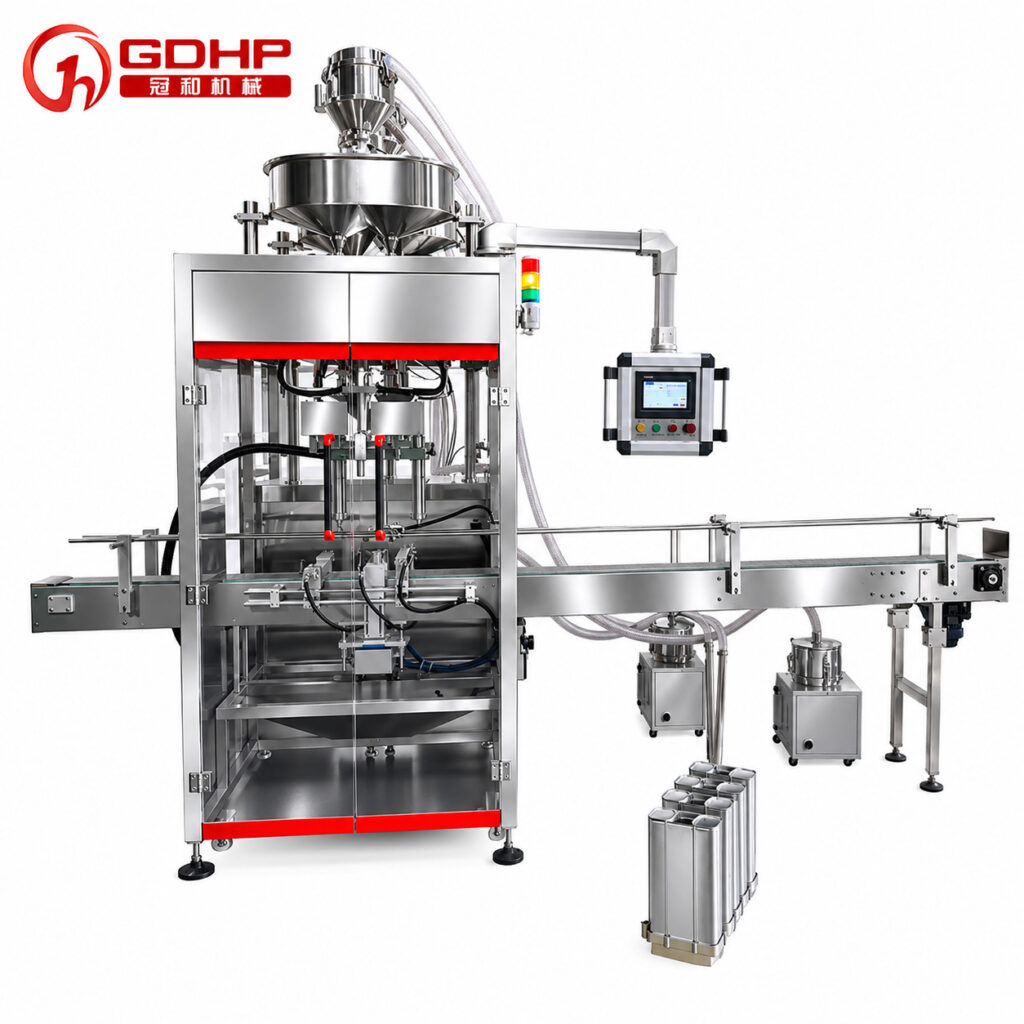
Repeated clogging indicates that your powder is not compatible with the equipment, and a complete powder filling production line needs to be designed based on material characteristics, target dosage, packaging specifications, and factory conditions. For example, All-Fill offers a broad range of auger platforms, including semi-automatic, fill-to-weight and high-speed systems; Spee-Dee focuses on servo-controlled auger fillers, checkweigher feedback, sanitary options and packaging-line integration; and GDHP focuses on customized filling and packaging lines, including the GH240FZ measuring-cup sachet machine for mainly free-flowing powders. No supplier is automatically the best fit: published speed and accuracy depend on the product and test conditions, so compare representative powder trials, changeover, dust control, service coverage and total project scope before choosing.
No. A fixed RH target can be useful for one formulation and wrong for another. Establish the limit with moisture-sorption or process data, then verify it at the hopper with a calibrated sensor. Keep hygroscopic powders sealed until use.
Only if the SDS, risk assessment and sanitation SOP permit it. Uncontrolled air can disperse combustible dust and contaminate food-contact surfaces. FDA 21 CFR 117.40(g) specifically requires gas used on food-contact surfaces to be treated so it does not contaminate food; a suitable vacuum or contained wipe may be safer.
There is no universal RPM. Speed depends on screw geometry, powder cohesion, fill level, target weight and machine design. Establish a validated operating window using torque, fill-weight repeatability and visual inspection of the discharge path.
At minimum, record product lot, moisture, bulk density, room RH, auger RPM, torque or motor load, agitator/vibrator setting, clog location, cleaning action and fill-weight results. These trends turn repeated “mystery clogs” into a solvable process problem.