
Shoe Cleaning Cream Filling: Tackling Stringing and Bubbles

Hello, I am a Senior Engineer at GDHP. With 23 years of technical expertise in the filling and packaging industry, we provide more than just equipment—we are dedicated to delivering high-stability, high-efficiency, and fully customized turnkey solutions for your business.
Table of Contents
Shoe cleaning cream filling gets difficult when the product starts setting before the nozzle has finished its job. A cream that flows when warm can thicken during transfer, leave a string on the bottle thread, or trap air as it settles. The customer sees those problems when opening the pack: residue, pits, or an uneven white surface.
That combination shaped this GDHP project. The customer’s white sneaker cleaning cream was a thick paste at room temperature and needed hot filling followed by cooling and setting. Their requirement was 3,000 bottles per hour at 240 mL, with three bottle formats spanning 100–260 mL.
We matched a GHLP-1000 rotary bottle feeder with a GHAGF-6 six-head servo heated filler and a continuous cooling tunnel. This case explains how bottle feeding, temperature control, bottom-up filling, and cooling addressed the product’s handling requirements.
Why This Cleaning Cream Needed More Than Accurate Dosing
The material had to flow during filling, then develop its final consistency in the container. That made the short journey from heated supply to cooled pack central to the machine design.
Cooling too early affects flow and leveling
As this cream cooled, it became harder to dispense and level. The engineering concern was premature thickening in the transfer path or nozzle, followed by peaks or an uneven surface in the bottle. Heating the tank alone would leave the manifold, which distributes product to the heads, and the nozzles as potential cold spots.
Temperature response is separate from shear thinning, where viscosity falls as the rate of shearing increases. The IUPAC definition of shear thinning helps distinguish these effects. For a new cream, assess its actual response to both temperature and pumping instead of assuming that all pastes behave alike.
Trapped air can show up after filling
A fast pour into a deep container can disturb the cream and introduce air. As the product sets, pockets or surface pits can remain. The customer’s concern was therefore both the dose and the finished appearance. Controlled delivery close to the rising fill level was part of the response.
A nozzle tail becomes a packaging problem
Stringing, also called tailing, is the strand that remains between the nozzle and cream when a fill ends. If it lands on the rim or thread, it creates cleanup work and can interfere with closure. The design needed a controlled cut-off as well as a suitable filling temperature.
Freshly filled cream is still sensitive to movement
While the cream remains fluid, abrupt handling can disturb its surface. Cooling then preserves that shape. Linking filling directly to controlled conveyor cooling addressed this vulnerable stage without workers carrying freshly filled containers to a separate cooling area.
The Customer Needed Speed, Three Bottle Formats, and Controlled Setting
The customer was moving beyond a semi-manual production arrangement. Alongside the 3,000-bottle/hour target, the line had to support two-shift operation, different circular bottle heights and diameters, and quick changes between formats.
Operators would still place empty bottles upright on the feeder. From there, the equipment needed to organize them into a steady sequence for filling and cooling. This retained a visual check at loading while reducing the influence of uneven manual feeding on the filler.
The finish was part of the requirement. A level white surface, clean bottle threads, repeatable dosing, and stable cooling had to be considered together. The customer also specified SUS304 stainless steel for the frame and SUS316 for product-contact parts.
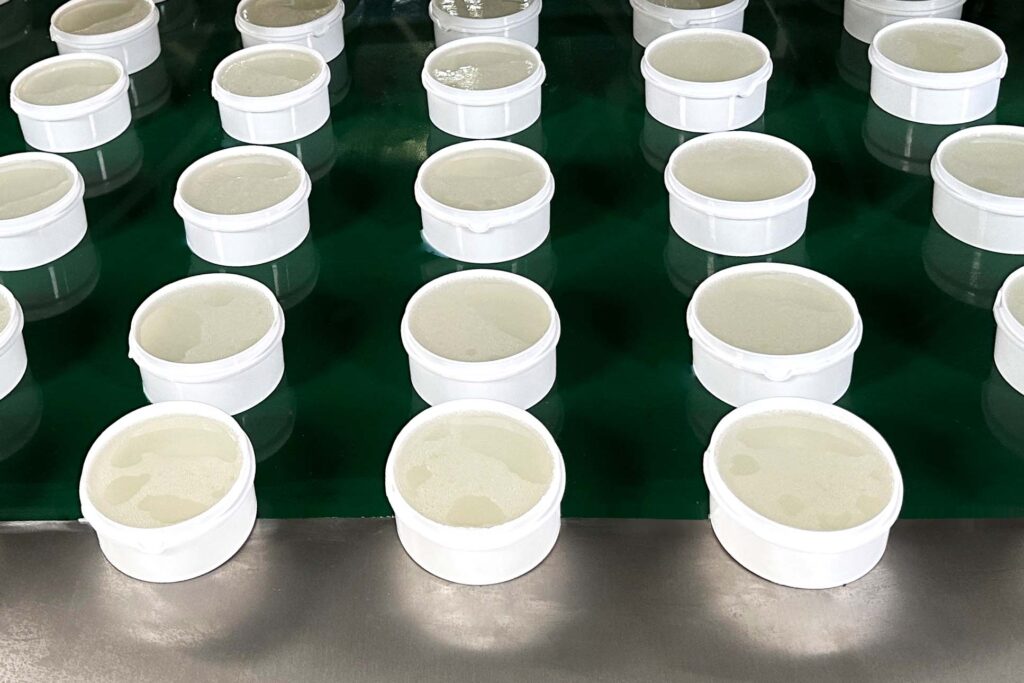
The Case Line: Rotary Infeed, Six-Head Hot Filling, and Tunnel Cooling
The process connected the customer’s manual bottle loading to automatic feeding, heated dosing, and cooling. These were the core stages of the project:
Material supply
Prepared heated cream → heated product path and distribution manifold → six filling nozzles
Container sequence
- 01 · MANUAL Place bottles upright
- 02 · GHLP-1000 Buffer and feed bottles
- 03 · GHAGF-6 Servo piston hot filling
- 04 · TRANSFER Convey filled bottles directly
- 05 · COOLING TUNNEL Cool and set the cream
- 06 · NEXT STAGE Pass to final packaging
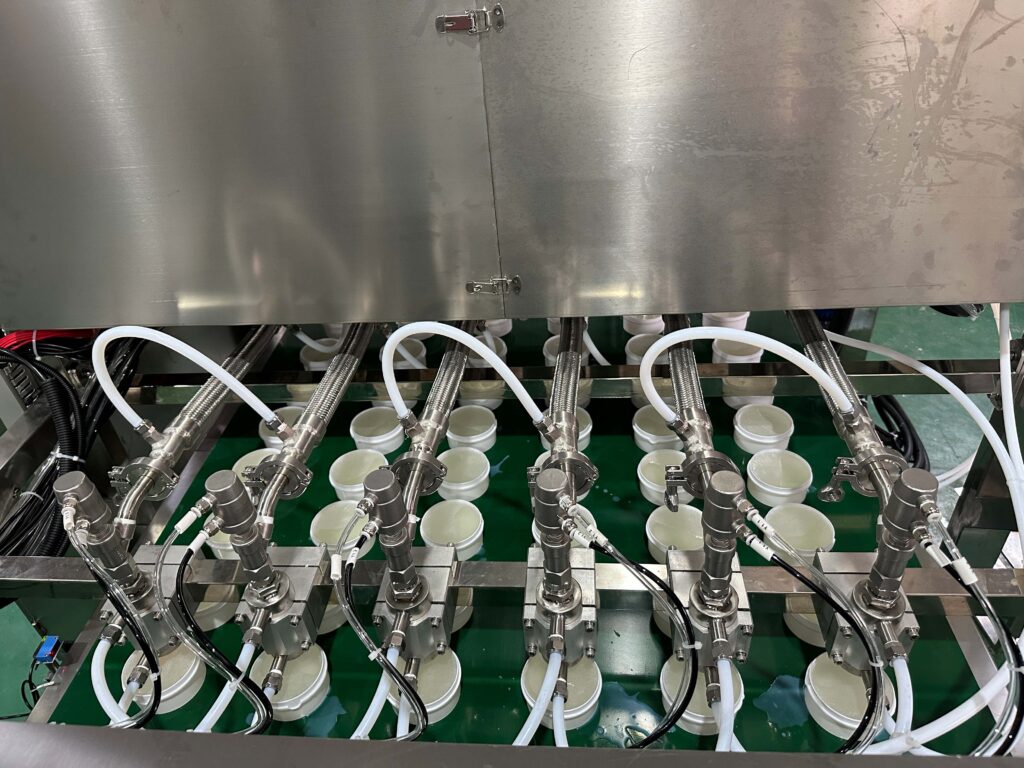
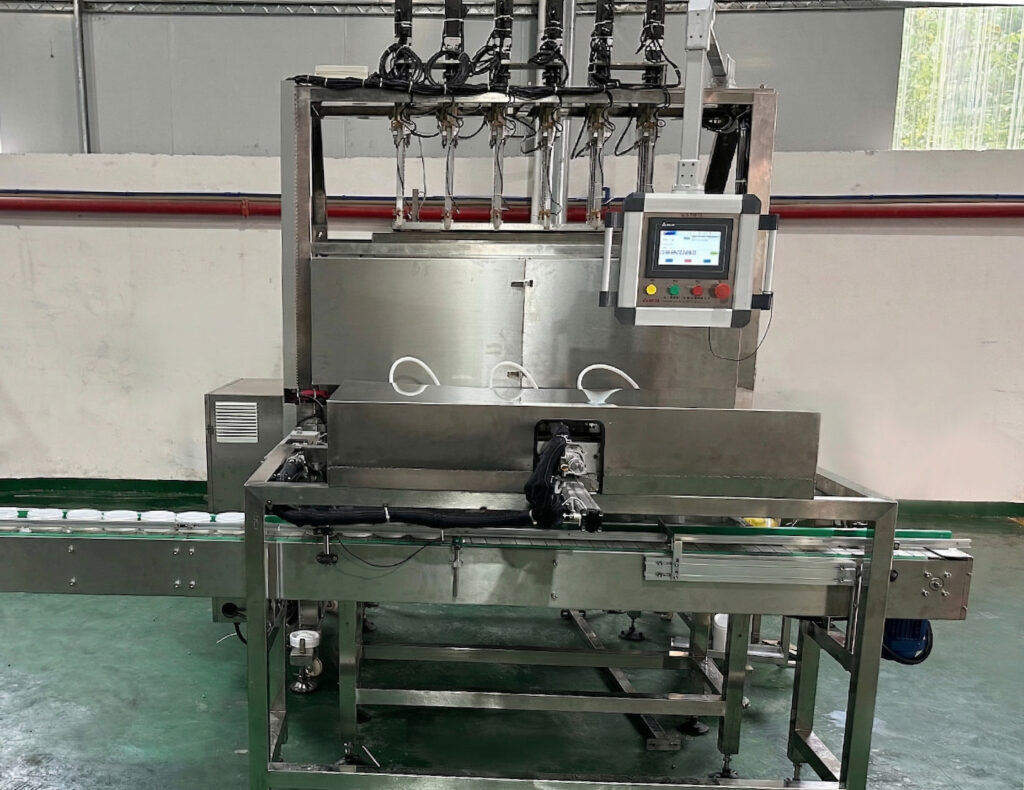
How the Actual Machine Configuration Matched the Cream
The shoe cleaning cream filling machine in this case was the GHAGF-6 automatic six-head servo-driven heated filler. Its configuration paired dose control with a heated product path and nozzle movement suited to this temperature-sensitive paste.
| Item | Case specification |
|---|---|
| Filling heads | 6 |
| Machine filling range | 50–500 mL; customer formats within 100–260 mL |
| Production capacity | 3,000 bottles/hour, based on 240 mL containers |
| Filling accuracy | ±1% |
| Construction | SUS304 frame; SUS316 product-contact parts |
| Controls | Programmable logic controller (PLC) with touchscreen operator interface |
| Air supply pressure | 0.6–0.8 MPa |
The 240 mL basis matters when comparing capacity. These are project specifications, not a promise of the same speed and accuracy for every cream, fill size, or container.
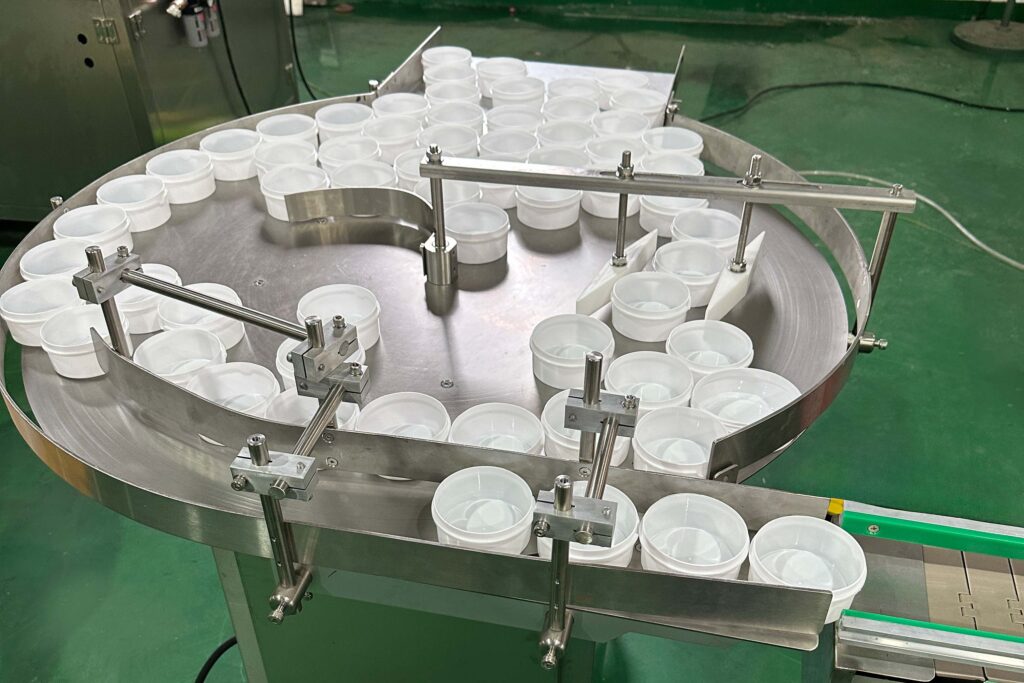
GHLP-1000: Buffering Manual Bottle Loading
The GHLP-1000 stainless steel rotary feeder accumulated upright bottles and guided them toward the filler. Its buffer helped absorb short pauses in manual loading. An adjustable exit gate and conveyor guides accommodated the different circular bottle formats without treating operator pace as the machine’s feeding rhythm.
Heated Manifold and Nozzles: Keeping the Cream Fillable
The GHAGF-6 used a heated, insulated product path with water circulation serving the manifold and nozzles. This addressed heat loss beyond the tank, where premature thickening could affect all six heads.
The project’s process description references 65–80°C, with 75°C as an example filling temperature. These are formulation-specific references, not a universal setting for sneaker cleaning cream. Holding time and the actual temperature at dispensing still need to suit the product.
Bottom-Up Filling and Active Shut-Off: Managing Air and Strings
Servo-driven pistons controlled the volume and delivery speed. The nozzles entered the bottles and rose with the fill level, shortening the product’s fall and limiting disturbance. This bottom-up motion addressed air introduced during dispensing; it did not replace control of air already mixed into the cream.
Active shut-off valves ended the flow at the nozzle to address tailing and residue on bottle threads. The arrangement combined temperature, piston speed, nozzle movement, and cut-off timing instead of expecting one anti-drip component to solve every filling defect.
Continuous Cooling: Protecting the Surface While It Sets
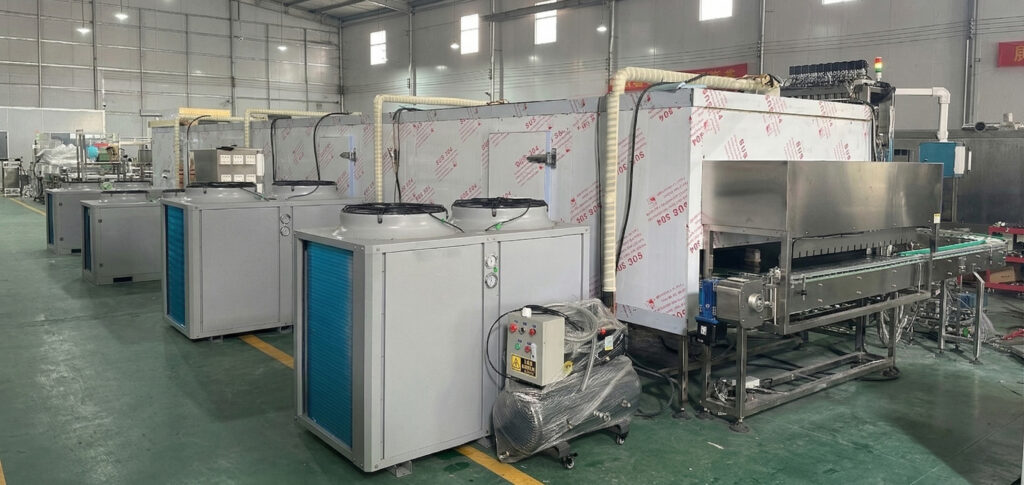
Filled bottles moved directly into the cooling tunnel without manual carrying between stages. Controlled conveying reduced handling disturbance while the cream set. The intended result was a level surface, with cooling matched to fill quantity, entry temperature, and container geometry.
A set surface alone does not confirm that the center is ready for packaging. Check the product’s interior condition and the container as well; colder or faster cooling is not automatically better.
Recipe Settings: Changing Between the Three Formats
Stored recipes recalled filling and nozzle-stroke settings through the touchscreen, while handwheels with digital scales supported repeatable guide adjustment. The project account reports format changeovers in less than 15 minutes. For a new line, agree on what the changeover includes and check the first acceptable fills after each switch.
What to Check Before Applying This Case to Your Product
Use this project as a reference for matching the equipment to the material. Agree on acceptance criteria and test your own cream, containers, and closures under the intended conditions.
- Fill quantity: check samples from each head against the specified volume or net weight. Account for product density and temperature if converting between them; recheck after a pause.
- Product and nozzle behavior: inspect air, stringing, rim residue, and any change in particle distribution during the run.
- Cooling and packaging: check surface and interior condition, container shape, condensation, and closure or seal performance.
- Sustained output: measure acceptable production through filling, cooling, and the selected packaging stages, rather than filler speed alone.
For U.S. net-content testing guidance, NIST Handbook 133 (2026 edition) describes procedures for checking packaged goods. Apply the requirements relevant to your sales market; this reference is not a certification of the filling line.
Use the hot filling machine selection guide for broader equipment questions, while keeping this cream’s processing conditions specific to its formula.
Discuss Your Shoe Cleaning Cream Filling Application
Share your cream sample or material information, bottle drawings, fill sizes, permitted temperature range, and output target. Include any stringing, foaming, or surface-setting problems you need to resolve. GDHP can use these inputs to assess the filling and cooling configuration and plan a representative product trial.
Is this solution right for you?
FAQ
What is the production efficiency of this line?
How do you ensure the shoe cream surface is level and bubble-free?
We utilize servo-driven pistons and bottom-up filling technology to map the exact velocity of the piston stroke.
The nozzles dive to the bottom of the bottle and track the rising liquid level to prevent turbulence and air pockets.
An automated cooling tunnel ensures that the liquid remains perfectly stationary during the phase transition from liquid to solid, eliminating surface ripples or imperfections.
How long does it take to switch between different bottle sizes?
The system features a “Recipe” management system in the PLC that allows operators to select pre-saved profiles on a touchscreen.
Mechanical adjustments are made using handwheels with digital scales and require no tools.
A complete changeover between bottle volumes (ranging from 100ml to 260ml) takes less than 15 minutes.
How does the equipment handle temperature fluctuations during hot filling?
The machine uses a fully insulated heated filling system that maintains thermal equilibrium across the tank, manifold, and nozzles.
A water circulation pump ensures the paste stays at the optimal flow temperature, such as 75°C, until the moment it is dispensed.
Is the equipment material corrosion-resistant?
Yes, the frame is constructed from SUS304 stainless steel, and all product contact parts are fabricated from SUS316 stainless steel.
This provides superior resistance to the surfactants and chemicals typically found in modern sneaker detergents.