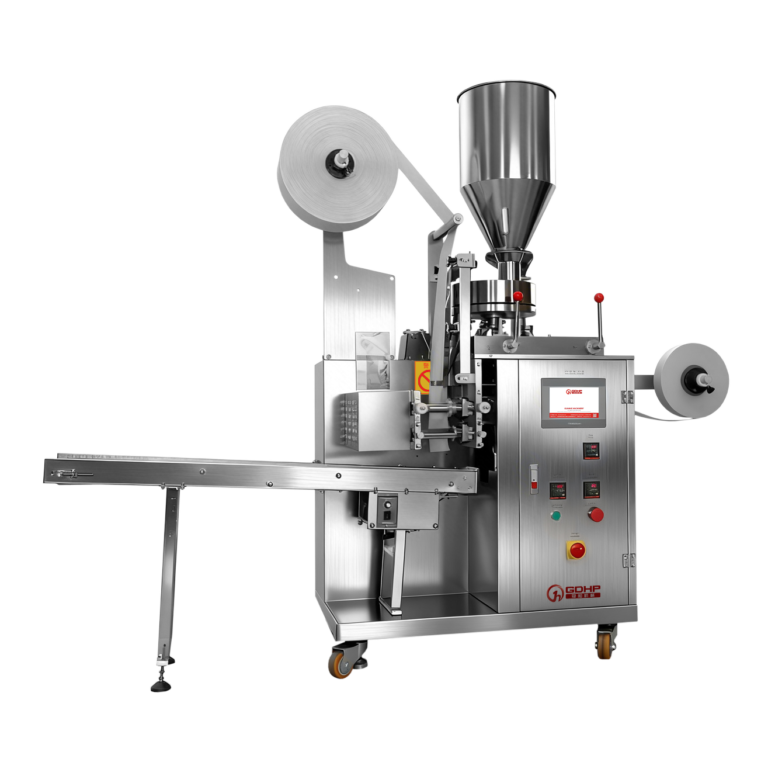
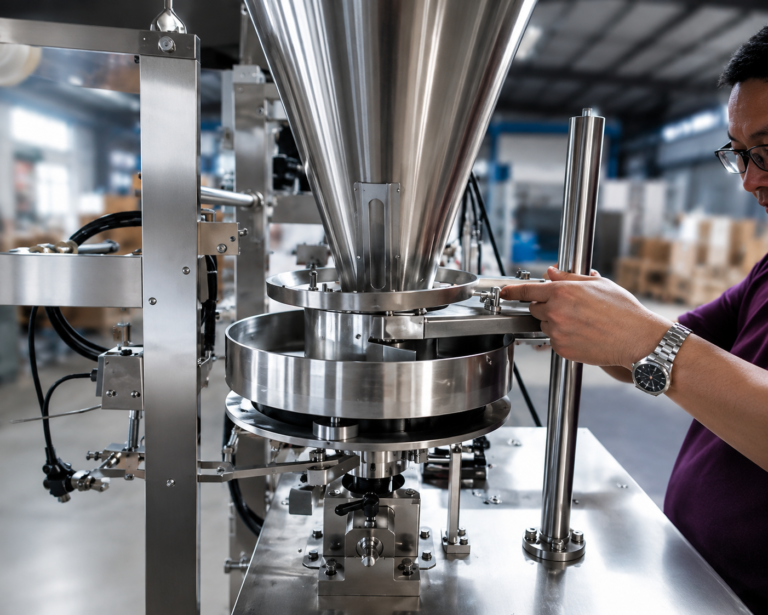
What is a FFS Machine(Form Fill Seal Machine)?
Learn how FFS machines, like those from GDHP, gain an in-depth understanding of the working principles and core advantages of…
March 27, 2026


Hello, I am a senior engineer and founder at GDHP. With 23 years of technical expertise in the filling and packaging industry, we provide more than just equipment—we are dedicated to delivering high-stability, high-efficiency, and fully customized turnkey solutions for your business.
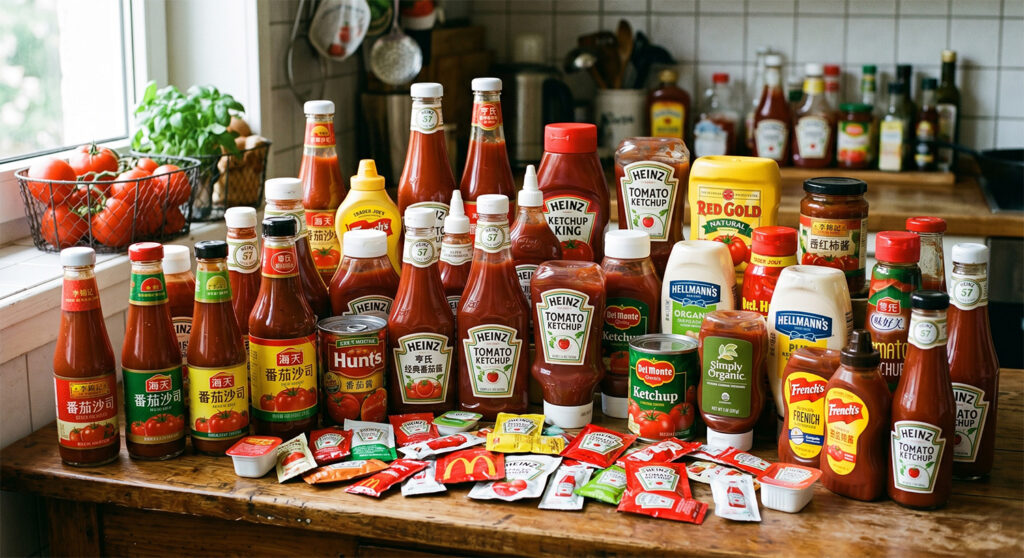
Ketchup packaging has to protect the sauce, dispense it cleanly, seal reliably, and fit the way each customer buys and uses it. A 9 g fast-food sachet, a 25 g fries dipping cup, a 500 g household squeeze bottle, and a 3 kg restaurant pack are different packaging jobs. Each needs a package structure, filling method, closure, and inspection plan matched to its own product and sales channel.
This guide compares specific ketchup products with the packages and machines commonly used to pack them. The pack sizes below are examples for equipment planning, not universal standards. Confirm the final configuration with the actual recipe, package components, target market, and production trial.
| Ketchup product and example size | Package to specify | Typical machine sequence | Checks to include in a trial |
|---|---|---|---|
| 9 g single-serve ketchup for a burger or takeaway meal | Printed rollstock made into a 3-side-seal or 4-side-seal sachet | Multi-lane sachet form-fill-seal machine, positive-displacement filler, date coder | Dose consistency by lane, print registration, clean seal area, tear opening, leak performance |
| 25 g ketchup portion for fries or a meal kit | Preformed round cup with a peelable lidding film | Cup denester, piston filler, lid placer, heat sealer, discharge and inspection | Clean, level cup rim; continuous lid seal; suitable peel force; leakage after stacking and handling |
| 500 g household ketchup for a retail shelf | Squeezable plastic bottle with a flip-top or dispensing closure | Bottle infeed, piston or other suitable positive-displacement filler, capper, labeler and coder; optional induction sealer | Fill weight, nozzle cut-off, cap fit, tamper feature, inverted leakage, bottle deformation |
| 250 g premium table ketchup | Glass bottle with a compatible screw or lug closure and liner | Bottle infeed, filler, capper, optional process-specific heating or vacuum equipment, labeler | Bottle handling, closure fit, fill level, leakage, and process performance where relevant |
| 1 kg retail refill ketchup | Premade stand-up pouch with a spout and cap | Rotary premade-pouch machine, pouch opening, filling through the specified opening, fitment or cap closing, coding | Pouch opening, clean fitment area, cap or fitment seal, upright stability, drop and leak performance |
| 3 kg restaurant ketchup for a dispensing station | Barrier bag with a tap inside a corrugated box (bag-in-box) | Bag or fitment handling, large-volume filler, fitment closing, case loading and coding | Fitment leak, bag puncture resistance, tap operation, dispensing residue, case stacking |
| 10 kg back-of-house ketchup for a high-volume kitchen | Food-contact pail with a fitted lid, or a large bag-in-box when controlled dispensing is needed | Pail filler and lid press, or a large-volume bag-in-box filling and closing system | Net weight, lid retention, transport leakage, stacking, and dispensing method |
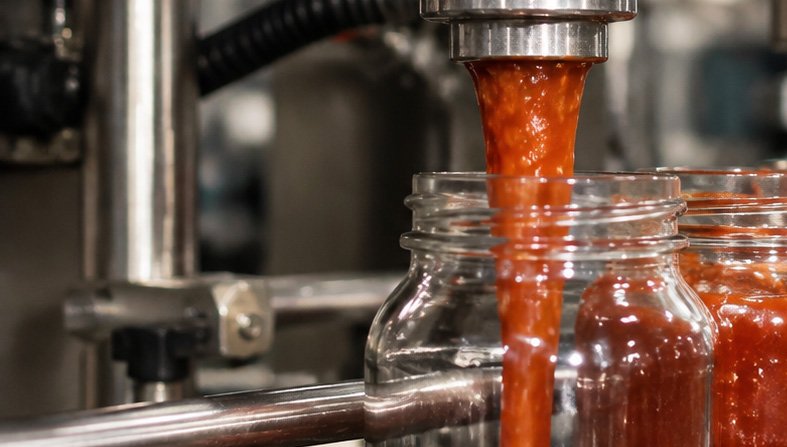
Many ketchup formulations are shear-thinning: they flow more readily while moving through a pump or nozzle than they do at rest. Recipe, temperature, particulates, and product age can all affect filling behavior. A gravity filler that works for water may not give a clean, repeatable ketchup fill.
A piston filler is a common starting point for measured portions and bottles because it dispenses a defined volume. A rotary lobe or other positive-displacement pump may suit a continuous or larger-volume line. The right choice depends on the recipe, target fill, container opening, required output, and cleaning method. Test the actual ketchup, including the lowest product temperature expected at start-up, before finalizing the pump and nozzle.
For a 500 g squeeze bottle, check nozzle insertion depth and cut-off so sauce does not string or drip onto the neck and cap. For a 9 g sachet or 25 g cup, control the end of the fill so ketchup does not land on the heat-seal area. A larger nozzle is not automatically better: it must fit the package opening and stop cleanly at the required dose.
Ketchup recipes vary in tomato solids, vinegar, salt, sweeteners, and other ingredients. Do not choose product-contact metal from the word ketchup alone. Ask the equipment supplier to confirm compatibility with the full recipe and the detergents and sanitizers used at the plant. Stainless-steel grade is one consideration; welds, gaskets, surface condition, drainability, and access for inspection also affect cleanability and service life.
In the United States, food-contact equipment must be adequately cleanable and maintained, and food-contact surfaces must be corrosion-resistant, nontoxic, and suitable for their intended use and cleaning conditions under 21 CFR 117.40. This requirement does not mean that one steel grade or a general claim of GMP compliance proves that a particular machine is suitable.
Oxygen exposure can contribute to color and flavor changes during storage, but shelf life depends on the ketchup recipe, processing, headspace, closure, package barrier, and storage conditions together. Glass provides a strong barrier through the bottle wall, while its closure and liner remain part of the complete package. Plastic bottles and flexible packs should be compared as finished package systems, not by resin name alone.
A high-barrier film cannot compensate for ketchup smeared across a seal. For sachets, cups, and spouted pouches, product on the sealing surface can create weak areas or leak paths. For bottles, a poorly applied cap, damaged liner, or incompatible closure can undermine the package even when the bottle wall is suitable.
A 9 g portion for burger restaurants, delivery orders, or airline meals can be packed in a 3-side-seal or 4-side-seal sachet. Printed rollstock is formed, filled, heat-sealed, cut, and coded on a sachet form-fill-seal line. Depending on the sachet layout and target output, the machine may use multiple lanes. A stick pack is a different, narrow format; use it only when the brand and serving method call for that shape.
During a trial, record fill consistency on every lane, film tracking, print registration, and seal performance. Inspect for wrinkles, channels, incomplete fusion, and ketchup in the seal. Test opening notches and tear behavior with the intended users. A sachet should also be checked after handling and distribution simulation, because a seal that looks acceptable on the machine may still leak after cartons are stacked or moved.
A single-serve 25 g cup for fries, salads, or meal kits can use a preformed cup with a flexible peelable lid. The line feeds cups, doses ketchup, places the lidding film, heat-seals the rim, and discharges the finished portions. Preformed-cup equipment is different from a thermoform-fill-seal line, which forms cups from rollstock before filling and lidding them.
Keep ketchup off the cup rim and check that cups arrive level, undamaged, and consistently positioned. Validate the sealing temperature, pressure, and dwell time for the specified cup and lid. The lid must resist leakage in a stack while remaining practical to peel. ASTM F2824 measures the force needed to remove an entire flexible peelable lid from a rigid or semi-rigid round cup or bowl. It can support evaluation of that package type, but the brand and supplier still need to set an acceptance range for their cup and lid.
A 500 g household bottle for supermarket shelves needs a bottle, dispensing closure, liner, and any tamper-evident feature selected as one system. A single-layer or multilayer bottle may be considered according to the shelf-life target and package test results. Do not assume that a particular resin or barrier layer is an absolute oxygen barrier.
A typical bottle line uses a bottle infeed, positive-displacement filler, capper, labeler, and date coder. Add a rinser only when the plant process requires it. An induction foil seal is optional and must be compatible with the bottle opening and closure. If one is used, specify how the line will detect a missing or poorly fused seal.
At the factory trial, check fill weight, nozzle cut-off, cap application, tamper evidence, and leakage with filled bottles. Check bottle deformation and closure usability after the intended storage and distribution conditions. A cap that feels tight on an empty bottle is not evidence that the complete filled package will remain leak-free.
A 250 g glass bottle can suit premium table ketchup or restaurant service where a rigid, reusable-feeling pack is wanted. Specify the bottle finish, closure type, liner, and any vacuum or tamper-evidence requirement together. The glass wall itself has strong gas-barrier properties, but the closure and the filling process still determine whether the finished pack meets its quality target.
The line may include bottle handling, filling, capping, and labeling. Heating, holding, vacuum capping, and cooling equipment should be included only when required by the product’s validated process. Glass also needs careful conveyor handling and breakage procedures. Check closure application and leakage on finished bottles, not just on empty components.
A 1 kg pouch for retail ketchup refills can use a premade stand-up pouch with an integrated spout and cap. A rotary pouch machine typically picks up and opens the pouch, positions it for filling, doses through the specified opening, closes the fitment or cap, and codes the finished pack. Some pouch constructions use a different filling path, so confirm the pouch drawing and fitment with the machine supplier before comparing quotations.
The fill nozzle and cutoff should keep ketchup away from the fitment sealing surface. Check pouch opening reliability, cap application, fitment leakage, pouch seams, upright stability, and drop performance. Include samples from start-up, steady operation, and after changeover in the trial. If product reaches the sealing area, correct the fill path or cutoff rather than compensating only by increasing sealing heat.
For a 1 kg pouch made for online orders, also test the filled pack inside the actual shipping case. GDHP’s sauce packaging guide discusses package protection, sealing, and filling considerations for online sauce sales.
A 3 kg bag-in-box system suits restaurant kitchens that dispense ketchup through a tap. The package includes a barrier bag, fitment or tap, and corrugated outer case. Specify how the bag is filled and closed, how the tap connects to the dispensing station, and how the case protects the bag during storage and stacking. Inspect the fitment seal, bag for punctures, tap operation, and residual ketchup after dispensing.
A 10 kg pail can be simpler for a high-volume kitchen that transfers ketchup into a sauce station. The filling line needs a pail infeed or manual loading point, a large-volume filler, and a lid press matched to the pail. Check net weight, lid retention, leakage during transport, and case or pallet stacking. Choose between a pail and a bag-in-box based on storage, dispensing, and waste handling at the customer’s site.
Specify the complete package rather than asking only for “PET,” “PE,” “PP,” or “foil.” For a flexible ketchup sachet, request the full film structure, thickness, food-contact sealant layer, print side, and target sealing window. For a 25 g cup, specify the cup resin and rim geometry together with the peelable lid. For a squeeze bottle, include the bottle wall, closure, liner, and any induction seal. For a spouted refill pouch or bag-in-box, include the pouch or bag layers, fitment, cap or tap, and outer case.
Ask suppliers for oxygen transmission rate (OTR) and water-vapor transmission rate (WVTR) data when barrier performance matters, including the test temperature and humidity. Results measured under different conditions are not directly comparable. Confirm package performance with the actual ketchup, fill weight, headspace, closure, storage conditions, and target shelf life. Track the product attributes that matter to the brand, such as color, flavor, odor, separation, and leakage.
For food-contact materials sold in the United States, verify the substances and conditions of use that apply to the package. The FDA food-contact substance resources and its food types and conditions of use references are starting points for that review. A general supplier statement that a material is “FDA approved” does not replace checking the intended food type, use conditions, and destination-market rules.
If a retail refill pouch is being designed for recycling, compare the barrier and seal requirements with the collection and recycling systems in each sales market. A mono-material design may support recyclability goals, but material composition alone does not guarantee that a pack is collected or recycled locally. The Association of Plastic Recyclers Design Guide considers package design alongside system access, acceptance, and end-market demand.
Start with one defined SKU and write down the information the supplier needs to size the line:
Then match the filling principle to the pack. A piston filler is often evaluated for measured ketchup doses into bottles, cups, and larger containers. A rotary lobe or other pump may fit a continuous or high-volume process. A sachet line adds film forming and heat sealing; a bottle line adds cap handling and application; a cup line adds denesting and lid sealing; a premade-pouch line adds pouch pickup, opening, and fitment handling. There is no single “ketchup packaging machine” that performs all of these tasks without format-specific tooling and stations.
For a small producer packing 500 g bottles, a semi-automatic filler and separate capper may fit the available output and labor plan. A brand shipping many 9 g portions may need a multi-lane sachet line. A restaurant-supply operation filling 3 kg bags or 10 kg pails needs larger-volume dosing and a compatible fitment or lid-closing station. Choose automation from the actual package and shift target, not from a broad label such as startup, mid-sized, or industrial.
For sachet applications, compare the machine layout with the required packet shape and lane count. GDHP’s VFFS machine range is one relevant internal reference when reviewing vertical form-fill-seal options. Confirm that the specific model supports the required ketchup filling method, film, seal format, and output before treating it as a match.
Machine settings alone do not prove that a package is sound. Build a trial plan around the finished package and the likely failure:
ASTM F88/F88M measures seal strength on a strip cut from flexible barrier material and can support process validation and control for flexible packs. It answers a different question from the full-lid peel test in ASTM F2824. Neither method creates a universal pass value for ketchup packaging. Set acceptance limits for the actual package with the brand, material supplier, and process owner, then pair force measurements with a suitable leak or integrity check.
Run trials at start-up, during stable production, after a film or lid roll change, and after format changeover. Record the product temperature, machine settings, packaging-material lot, rejects, and results. Request a factory acceptance test using the specified ketchup or a representative product and the actual package components wherever practical.
Hot filling is a process decision, not a default machine feature. A 500 g glass bottle with a lug closure, a 500 g squeeze bottle, and a 25 g peel-lidded cup cannot be assumed to share the same fill temperature, hold time, or cooling sequence. The product, container, closure, and target shelf life must all be suitable for the process.
Before specifying a hot-fill line, define the exact ketchup formula and package, then have a qualified food-process authority determine the applicable scheduled process and critical limits. The process may depend on formulation, equilibrium pH, fill temperature, hold time, container size and material, closure, and cooling conditions. Keep the required process measurements and production records. A filler that can handle hot product does not by itself establish a safe or validated process.
In the United States, 21 CFR Part 114 sets requirements for covered acidified foods, including scheduled processes and process controls, and contains specific exclusions. The product’s name or a single pH reading is not enough to decide whether the rule applies. Confirm the exact recipe and manufacturing arrangement with a qualified process authority. Food-contact material suitability, equipment cleanability, plant sanitation, and the scheduled process are related but separate requirements.
Machine nameplate speed is not the same as the number of acceptable packs a plant can ship. Estimate nominal capacity from the saleable shift target:
Required nominal speed = required saleable packs / (scheduled production minutes x planned availability x planned good-pack yield)
For example, if a plant needs 40,000 accepted 9 g sachets during an 8-hour shift, and uses planning assumptions of 85% availability and 98% good-pack yield, the estimate is:
40,000 / (480 x 0.85 x 0.98) = about 100 sachets per minute nominal capacity.
The 85% availability and 98% yield are illustrative inputs, not industry benchmarks. Replace them with plant records. For a multi-lane sachet machine, divide the total target by the lane count to estimate the required output per lane. Include sanitation, rollstock changes, coding, replenishment, rejected packs, and changeovers in the production plan.
During a supplier trial, compare accepted packs per minute, fill variation, seal or closure failures, start-up waste, and time to change formats. Those measures make machine quotations more comparable than nameplate speed alone.
Ketchup can dry on hoppers, pumps, valves, hoses, and nozzles. For a line that alternates between regular, spicy, and reduced-sugar recipes, map the full product path and identify which parts are removed, which are cleaned in place, and how operators inspect hidden surfaces and seals after cleaning.
Ask each supplier for the cleaning procedure, compatible detergents and sanitizers, disassembly points, inspection points, and restart checks. Do not assume that every piston filler is CIP-capable or that CIP removes the need for inspection. Under 21 CFR 117.40, food equipment must be adequately cleanable and maintained for its intended use and cleaning conditions.
During the factory acceptance test, run a normal production cycle, clean the line using the proposed plant procedure, and inspect accessible product-contact parts. Record cleaning time, labor, water and chemical use, product loss, changeover time, and the number of operators needed. Compare those operating costs with the purchase price, spare parts, utilities, maintenance, and expected package waste to estimate total cost of ownership.
The right ketchup packaging solution starts with the actual SKU: a 9 g takeaway sachet, a 25 g dipping cup, a 500 g retail squeeze bottle, a 250 g glass table bottle, a 1 kg spouted refill pouch, or a 3 kg restaurant bag-in-box. Specify the package, fill method, closure, quality checks, cleaning procedure, and saleable output as one connected system. Then confirm the choice with the actual ketchup and finished package in a production trial.
When comparing a ketchup filling machine or complete packaging line, provide suppliers with the recipe range, package drawings, target output, market, cleaning method, and acceptance criteria. This gives them enough information to propose a configuration that can be evaluated on measurable requirements rather than broad claims about speed, barrier performance, or automation.
The Technology: They use multi-layer co-extrusion. A microscopic EVOH layer is embedded in the plastic, acting as an absolute barrier against oxygen to keep the ketchup red and fresh.
The Mechanism: Steam-vacuum capping. Sterile steam is injected right before the lid is applied. As the steam cools and condenses, it creates a powerful, tamper-evident vacuum seal.
The Technique: Acidic splashes ruin heat seals. We engineer bottom-up filling nozzles and use mechanical stripping bars to squeeze the sealing zone completely dry before the heat jaws clamp down.
The Standard: Always demand an IP69K rating. This ensures the machine’s electrical panels and servos survive harsh, high-pressure chemical washdowns without short-circuiting.
The ROI: It provides automated internal washdowns. By eliminating the need to manually disassemble and scrub heavy steel parts, you drastically reduce labor costs and machine downtime.
The Strategy: No. Aim for 75% to 80% of maximum capacity. This “buffer speed” prevents violent vibrations, reduces component wear, and actually delivers higher Overall Equipment Effectiveness (OEE) over a 24-hour shift.
Precision Piston Filling: Their systems guarantee exact volumetric dosing for thick fluids, eliminating the nightmare of nozzle dripping and messy splashing.
Thermal Tolerance: GDHP equipment natively supports hot-filling (Constant 95°C), perfectly balancing product sterilization with optimal flow characteristics.
Sanitary Durability: Constructed with premium SS316L and SS304 food-grade stainless steel, their machines easily resist acidic corrosion and meet stringent GMP hygiene standards.
Seamless PLC Automation: The entire architecture—filling, capping, cooling, labeling, and packing—is fully synchronized, allowing you to switch between bottle and pouch formats with minimal downtime.
The stainless steel disc bottle feeder does more than just organize bottles.
Personnel Safety: It allows workers to stay away from the core filling zone, where gas concentrations are highest.
Static Risk Mitigation: By reducing the need for staff to move around the hazardous zone, risks from static electricity on clothing or footwear are minimized.
Beyond the 66.7% increase in output, the value lies in “invisible assets”.
Compliance: The full explosion-proof certification provides solid grounding for safety inspections by fire and health authorities.
Brand Security: Automated rejection of faulty products protects the brand’s reputation from the fallout of leaking or ineffective products.
Scalability: The modular design allows for smooth upgrades or further speed increases as market demand grows.