Best 10 Vertical Form Fill Seal Machine Manufacturers In China
Analyzes the top 10 vertical form fill seal machine manufacturer in China, their technical advantages, and how to choose the…
April 28, 2026

Small businesses often start with manual filling because it is simple and inexpensive. But labor shortages, slow output, spills, and uneven fill levels can quickly turn a low-cost process into an expensive daily problem. The right filling method depends on product behavior, order volume, staffing, and growth plans.
Manual filling commonly uses hand pumps, gravity funnels, measuring containers, or visual fill estimation. An operator places each bottle, dispenses the product, checks the level, and moves the container to the next step.
This approach can work for small trial batches. However, it relies heavily on operator consistency. Small differences in filling technique can create underfilled bottles, overfilled bottles, drips, and avoidable product loss.
Common manual filling limits include:
For products with higher material value, even small overfills can reduce margins over time.
A semi-automatic filler is a practical next step for many early-stage manufacturers. These systems may use a foot pedal, push button, piston, volumetric mechanism, or benchtop configuration. The operator still loads and removes containers, but the machine controls the dispensing cycle.
Semi-automatic filling equipment can suit businesses producing liquids, oils, creams, gels, sauces, and other products when the machine configuration matches product viscosity and container requirements.
Semi-automatic filler benefits:
We generally see semi-automatic systems make sense when production is growing, but demand is not yet stable enough to justify conveyors, automatic bottle handling, and multiple filling heads.
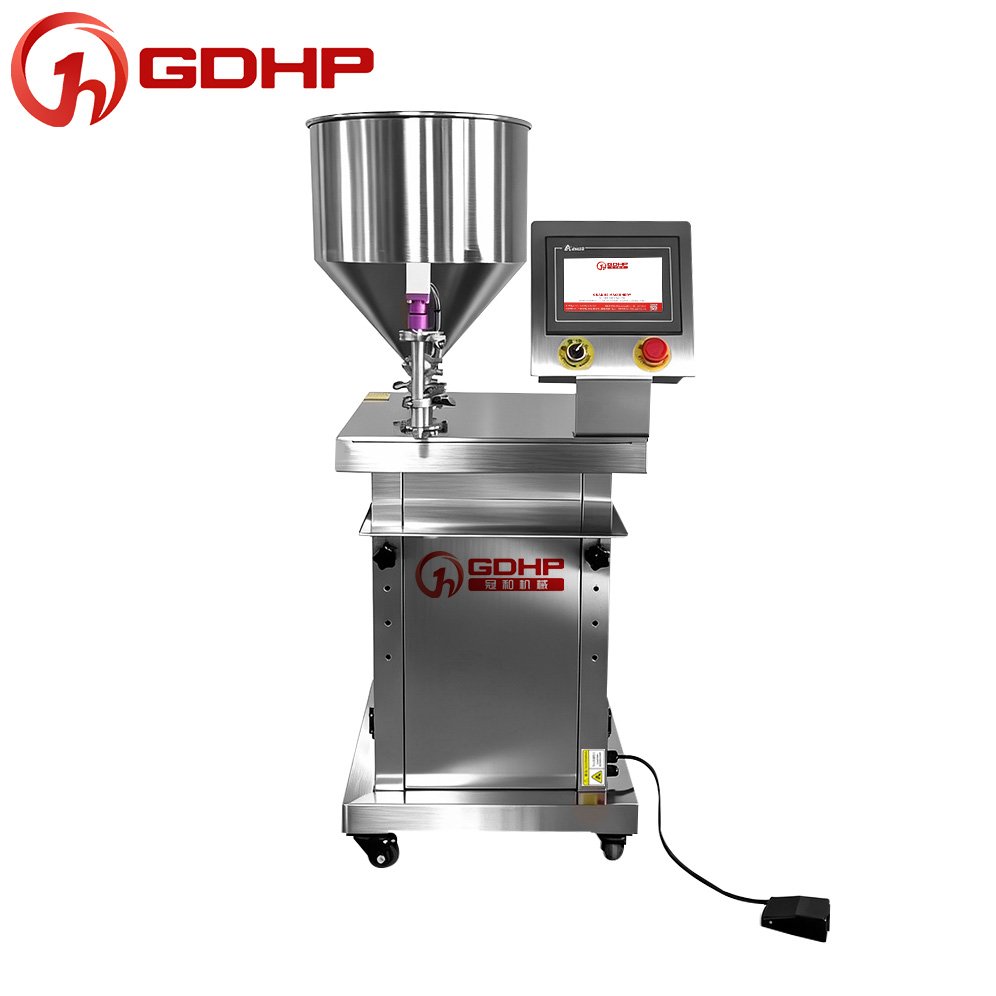
A fully automatic filling machine is designed for continuous production. Bottles move through the machine on conveyors, while sensors position containers under filling nozzles. Multi-nozzle filling heads dispense product in sequence, and PLC controls coordinate the process through a touchscreen interface.
Depending on the line design, automatic filling can connect with capping, sealing, labeling, coding, and packing equipment. This reduces manual handling between stages and supports a more consistent production flow.
Automatic filling machine advantages:
An automatic filling machine for small business operations is not automatically the best choice just because it is faster. It must fit the available space, product type, demand pattern, operator capability, and investment plan.
| Factor | Semi-Automatic Filler | Fully Automatic Filling Machine |
|---|---|---|
| Operation | Operator loads, starts, and removes bottles | Conveyor and sensors manage bottle movement |
| Labor needs | Usually requires a dedicated operator | Fewer repetitive filling tasks; staff can support quality and packing |
| Output | Moderate, operator-dependent | Higher, continuous production capability |
| Fill consistency | Improved over manual filling | Highly repeatable when properly configured and maintained |
| Flexibility | Often convenient for short runs and frequent changes | Can be configured for changeovers, but setup must match bottle and SKU needs |
| Investment level | Lower upfront cost | Higher capital investment and line-planning requirement |
| Integration | Often standalone | Can connect with capping, labeling, coding, and packing equipment |
| Best fit | Early growth and varied small batches | Stable demand, recurring production, and expansion plans |
The practical decision is simple: manual filling is suitable for limited batches; semi-automatic filling is often the best transition for growing brands; fully automatic filling becomes valuable when labor, waste, and production speed are restricting reliable growth.
At GDHP, we use actual product characteristics, container samples, and production requirements to match filling equipment to the application rather than forcing every business into the same automation level.
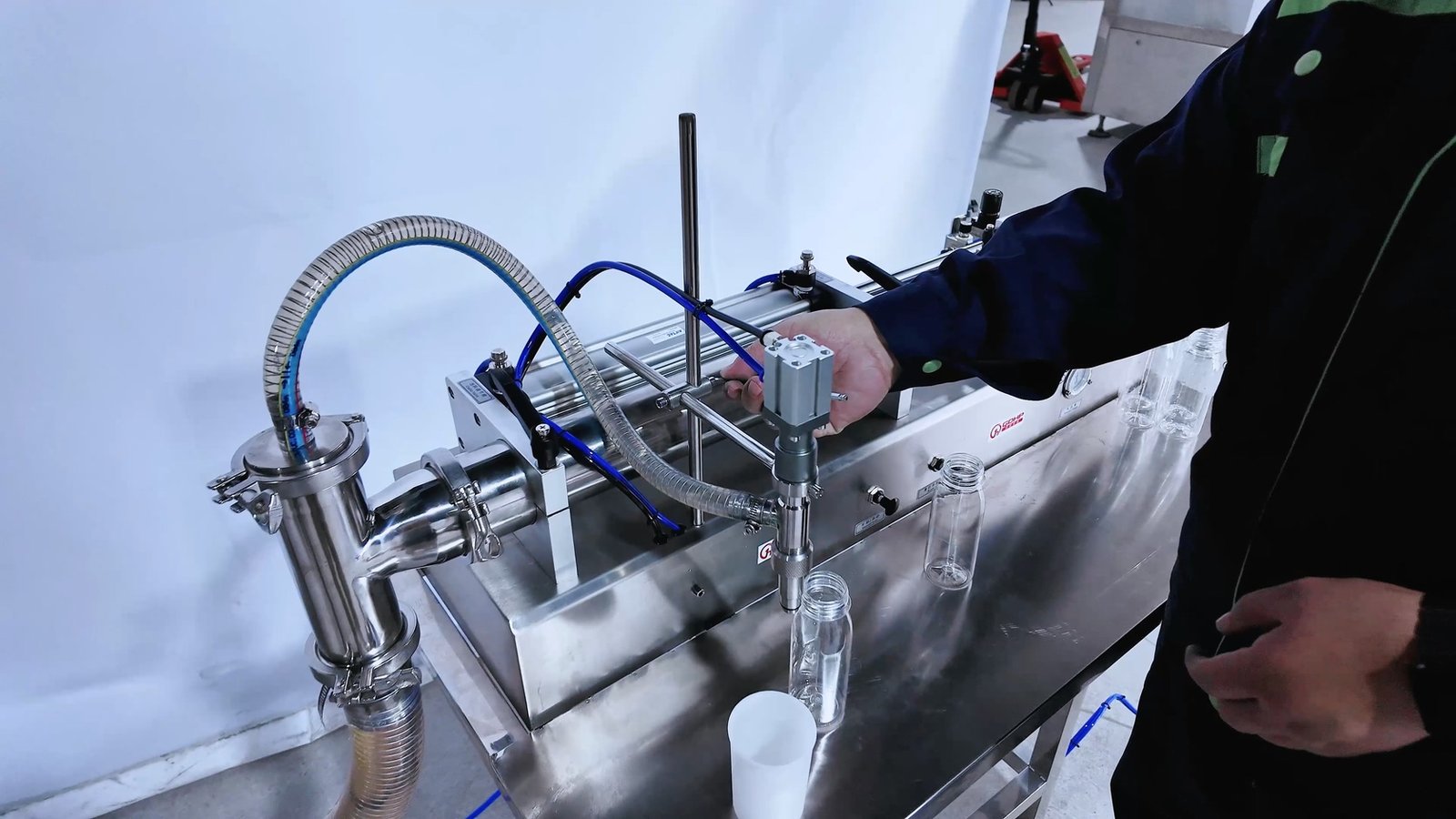
For a small business, an automatic filling machine is a capital expense, not just a machine purchase. We look at the full cost: the filler, installation, utilities, floor space, operator access, and any connected conveyor, capper, labeler, or packing equipment.
| Cost Area | What to Plan For |
|---|---|
| Equipment | Filling machine and optional integrated line equipment |
| Installation | Setup, commissioning, line alignment, and training |
| Utilities | Electrical supply, compressed air where required, and product transfer connections |
| Space | Machine footprint, conveyors, cleaning access, material flow, and safe operator access |
| Integration | Capping, labeling, coding, sealing, or packing equipment if these stages limit output |
The initial investment can feel high when production is still growing. However, the right automatic filling machine can become a long-term production asset when it reduces repetitive labor, supports stable fill volumes, and allows the business to process more orders without adding the same level of labor.
Compact filling lines generally need thoughtful layout planning. GDHP advises planning around the complete process rather than the filler alone. Small production lines may require approximately 50–100 m², while larger high-speed lines need more room. Leave practical space for:
Automation does not always mean reducing headcount. In many small factories, it means moving people away from repetitive filling into quality checks, packing, production management, or customer-facing work.
Manual filling also creates hidden cost through overfills, underfills, spills, drips, and rejected bottles. If manual overfill is around 3–5% of product volume, even a small reduction can matter when the product has a high ingredient cost. Properly selected volumetric filling equipment may help reduce overfill to below 0.5% where the product, container, and filling method allow.
Product giveaway formula:
Daily giveaway cost = Daily fill volume × Overfill rate × Product cost per mL or gram
For example, compare the current overfill rate with the verified rate achieved during sample testing. This gives a more useful figure than relying on an advertised accuracy number alone.
A faster filler does not automatically create a faster operation. We first check whether the constraint is actually filling, capping, labeling, coding, packing, or bottle supply.
| Production Stage | Common Bottleneck |
|---|---|
| Filling | Slow manual handling, inconsistent dosing, nozzle drips |
| Capping | Cap supply delays or slow cap application |
| Labeling | Bottle spacing issues or frequent label changes |
| Packing | Manual case packing or limited finished-goods handling |
| Material Supply | Delays moving empty containers, caps, or product to the line |
This is why a modular line can be a practical investment. Start with the equipment that solves the current bottleneck, then add connected equipment as demand justifies it.
Overall Equipment Effectiveness (OEE) is a simple way to measure whether automation is delivering value. It combines:
A practical payback period analysis should include labor savings, lower product giveaway, reduced waste, and added saleable output. Do not count capacity gains unless there is real demand for the extra production.
Simple ROI calculator inputs:
| Input | Use in Calculation |
|---|---|
| Daily production volume | Measures potential throughput and product savings |
| Labor rate and hours | Estimates labor reassignment or reduction in repetitive work |
| Product cost per mL or gram | Calculates overfill and spill cost |
| Current waste rate | Measures avoidable product and packaging loss |
| Expected operating days | Converts daily savings into annual value |
| Machine and installation investment | Establishes total project cost |
Payback period formula:
Payback period = Total machine investment ÷ Monthly savings and added contribution
There is no fixed payback period for food, beverage, cosmetic, personal care, or chemical businesses. It depends on product value, output, staffing, waste levels, and how well the filler fits the product. A low-volume operation with frequent container changes may benefit more from a semi-automatic machine, while a business with steady demand, high labor pressure, and costly product giveaway may justify a fully automatic filling machine sooner.
At GDHP, we use sample evaluation, custom engineering, and 3D layout planning to help turn those operating figures into a practical filling-line decision.
Purchase price is only one part of the decision; review the total filling machine cost, including change parts, integration, testing, installation, and service.
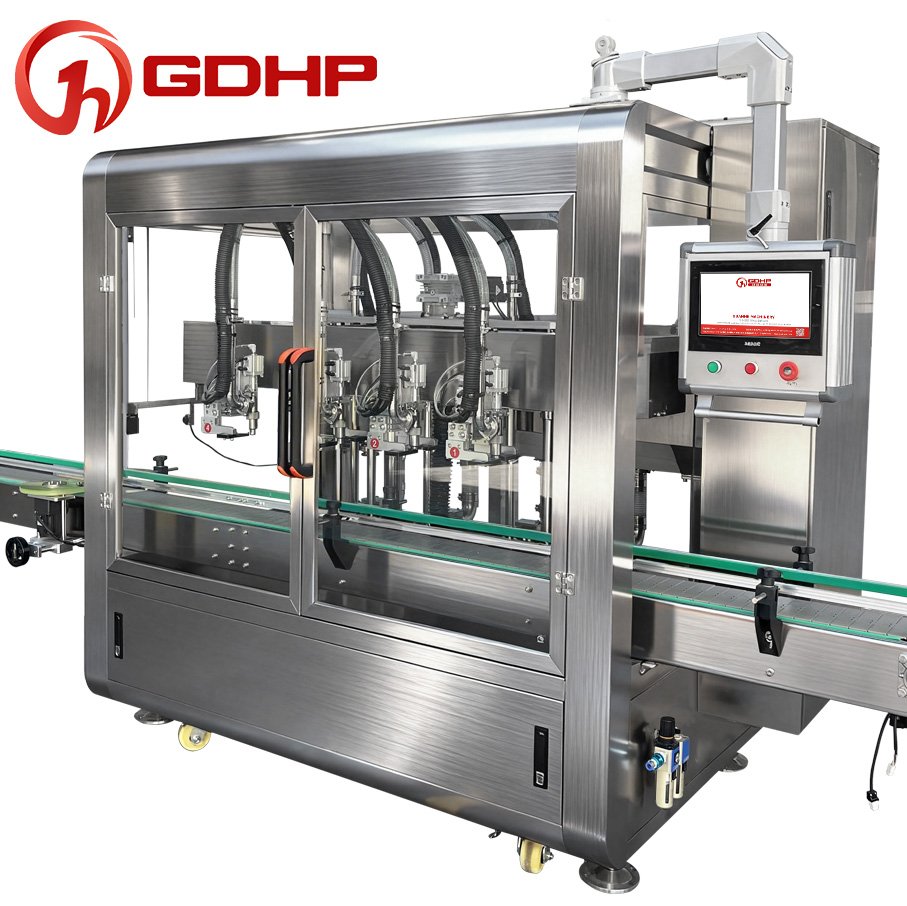
An automatic filling machine for small business must match the product first. A fast machine with the wrong pump, nozzle, or material can still create foam, drips, slow changeovers, and rejected bottles.
Viscosity means how easily a product flows. Water-like drinks, oils, thick creams, gels, sauces, and corrosive chemicals need different filling setups.
| Product type | Common filling approach | Key requirement |
|---|---|---|
| Thin liquids | Gravity or flow-meter filling | Stable flow and controlled shutoff |
| Foaming liquids | Bottom-up or diving nozzle filling | Foam control and slower nozzle withdrawal |
| Oils and similar liquids | Volumetric or flow-meter filling | Consistent volume and clean cut-off |
| Creams, gels, pastes | Piston filling | Strong product handling and anti-drip nozzle |
| Sensitive reagents | Peristaltic pump filling | Gentle handling and controlled product contact |
| Corrosive liquids | Sealed, compatible filling system | Corrosion-resistant contact parts and safety controls |
For thick or stringy products, we normally prioritize piston-style dosing and anti-drip nozzles. For foaming products, diving nozzles fill closer to the bottom of the container, which helps reduce bubbles and splashing.
The right nozzle design protects both fill accuracy and package appearance.
| Filling method | Best suited for | Practical point |
|---|---|---|
| Gravity filler | Free-flowing thin liquids | Simple option for products that flow consistently |
| Piston filler | Creams, sauces, gels, pastes | Suitable for higher-viscosity products |
| Flow-meter filler | Measured liquid fills | Supports controlled volumetric filling precision |
| Peristaltic pump | Small-volume or sensitive liquids | Product moves through tubing, supporting cleaner handling |
No one method fits every product. We review the liquid behavior, fill volume, container opening, and target output before configuring the filling system.
Small losses add up quickly when bottles are filled every day. Look for features that address common production problems:
These details help reduce spills, damaged labels, cleanup time, and product giveaway.
Hot pastes and temperature-sensitive products need more than a standard hopper. A suitable automatic filling machine may require:
For hot-fill applications, the tank, transfer path, seals, and filling components must all suit the product temperature. This avoids unstable viscosity and inconsistent fills during production.
| Factor | Pneumatic filling | Electric filling |
|---|---|---|
| Power source | Compressed air | Electrical control system |
| Operating consideration | Requires stable air supply | Requires suitable electrical setup |
| Noise | Air systems can add operating noise | Often avoids air-driven noise |
| Control | Practical for many standard applications | Supports more programmable control |
| Maintenance focus | Air lines, valves, and pneumatic parts | Motors, sensors, and electrical components |
The best choice depends on the plant utilities, required control level, maintenance capability, and production conditions. We account for air supply, electrical supply, line controls, and operating environment during configuration.
Material selection matters for sanitary products and corrosive liquids. Machine casings are commonly built with SUS304 stainless steel, while product-contact parts may use SUS316 stainless steel or medical-grade silicone tubing where stronger chemical resistance is needed.
| Application | Material consideration |
|---|---|
| Food and beverage | Sanitary, cleanable stainless-steel contact surfaces |
| Cosmetics and personal care | Smooth product-contact parts that support cleaning |
| Pharmaceutical and IVD | Materials suited to hygienic handling and process needs |
| Corrosive chemicals | SUS316 stainless steel parts or compatible tubing and seals |
A low-cost machine can become expensive if the product attacks seals, metal parts, or tubing. Product compatibility should be confirmed before production.
Food, cosmetics, pharmaceutical, IVD, and chemical businesses may need machinery designed around specific hygiene, safety, or market requirements.
Key considerations include:
For hazardous liquids, equipment design may include negative-pressure sealing to help contain toxic gases, along with explosion-proof components matched to the operating risk.
A flexible filler should handle planned bottle and fill-volume changes without turning every SKU change into a long stoppage. Review:
Container changeover downtime matters most for businesses with frequent runs of different bottle sizes, caps, or products. A simpler semi-automatic setup can be practical for very short, varied batches. An automatic system becomes stronger when repeat demand and longer runs justify the setup time.
Do not size an automatic filling machine only for today’s output. Leave room for conveyors, cap handling, sealing, labeling, coding, packing, cleaning access, and safe operator movement.
Compact production lines may need approximately 50–100 m², while larger high-speed lines can require around 200–500 m². The exact footprint depends on the product, container handling, and level of automation.
At GDHP, we use product samples and 3D layout planning to help match the machine to real floor space. With more than 23 years of manufacturing experience, we focus on a filling system that fits current production without blocking sensible future expansion.
A faster automatic filling machine can create a new production line bottleneck if capping, labeling, or packing cannot keep pace. We plan each station as one connected system, not as separate machines.
Inline capping and labeling keep filled containers moving with less manual handling. Depending on the product and package, a modular packaging line can include:
Key point: The filler is only as productive as the slowest downstream station.
| System | Best Fit | Main Strength | Planning Consideration |
|---|---|---|---|
| Monoblock filling system | Limited floor space | Filling and capping in one compact unit | Less room for separate process changes |
| Inline filling system | Growing product lines | Flexible layout and easier expansion | Requires more conveyor and access space |
A monoblock unit can be a practical choice for a compact automatic bottling line. An inline system is often better when we expect to add labeling, inspection, coding, or end-of-line packing later.
We match filler output with capper, labeler, and packing capacity. If a filler runs ahead of the capper, bottles accumulate on conveyors, increasing the chance of jams, handling damage, and downtime.
| Line Station | What to Check |
|---|---|
| Filling | Fill volume, product behavior, nozzle count |
| Capping | Cap type, torque needs, cap feeding rate |
| Labeling | Bottle shape, label position, application speed |
| Packing | Case size, pack pattern, manual or automatic handling |
For many small businesses, the sensible route is to begin with filling and build outward as demand becomes stable:
This modular packaging line approach protects the initial investment while leaving room to scale capacity.
Sensors, conveyor timing, and touchscreen settings help each machine operate as one line. Bottle sensors can control product flow between stations, while reject systems can remove containers that do not meet the set process conditions.
At GDHP, we use custom engineering and 3D layout planning to align filler, capper, labeler, and packing equipment around the actual product, container, and available factory space.
A smooth deployment starts with real production data, not a catalog speed claim. We review the product, container, target output, and future SKU plans before configuring an automatic filling machine.
| Deployment Step | What We Confirm | Why It Matters |
|---|---|---|
| Requirements review | Product viscosity, foaming, fill volume, bottle sizes, target bottles per hour | Matches the filling method and nozzle design to the product |
| Custom configuration | Filling heads, conveyors, capping, labeling, controls | Builds a practical line instead of an oversized system |
| Sample testing | Actual liquid, bottles, caps, and labels | Confirms filling performance with the real package |
| Factory Acceptance Testing (FAT) | Fill consistency, speed, nozzle action, changeovers, safety functions | Checks the machine before it leaves the factory |
| Layout planning | Floor space, utilities, material flow, cleaning access, safety space | Avoids installation delays and blocked operator access |
| Installation and commissioning | Conveyor height, power supply, compressed air, line timing | Helps each machine work as one line |
| Training and support | Cleaning, changeovers, troubleshooting, daily checks | Supports reliable operation after start-up |
We first define the details that affect automatic filling machine performance:
This review prevents a common small-business mistake: buying a filler that works for one product but cannot handle future containers or production needs.
Real production data becomes a workable line layout. The configuration may include filling, conveying, capping, sealing, coding, labeling, and packing equipment based on the required process.
For compact projects, we plan equipment placement carefully. Small filling lines generally need about 50–100 m², while larger high-speed lines need more space. Operator access, cleaning routes, product movement, and room for later expansion all matter.
Sample testing should use the actual product and packaging whenever possible. It verifies practical issues that are difficult to judge from specifications alone, including:
Before shipping, Factory Acceptance Testing (FAT) verifies the agreed machine setup at the factory. We check filling performance, line speed, nozzle operation, changeover steps, and safety functions. FAT gives the buyer a clear checkpoint before final acceptance.
Installation requires more than placing the automatic filling machine on the floor. The site must be ready for electrical supply, compressed air where required, conveyor alignment, cleaning access, and safe material flow.
A typical manufacturing lead time is 30–60 days after deposit, followed by shipping, installation, and production ramp-up. We provide door-to-door or remote installation support and operator training for:
GDHP supports turnkey filling projects with custom engineering, free sample evaluation, 3D layout planning, FAT, training, a 1-year free warranty, and lifetime technical support. With more than 23 years of manufacturing experience, we focus on building filling lines around actual product and factory conditions.
Before shipment, use our factory acceptance test checklist to confirm output, fill accuracy, container changeover, safety, and training.
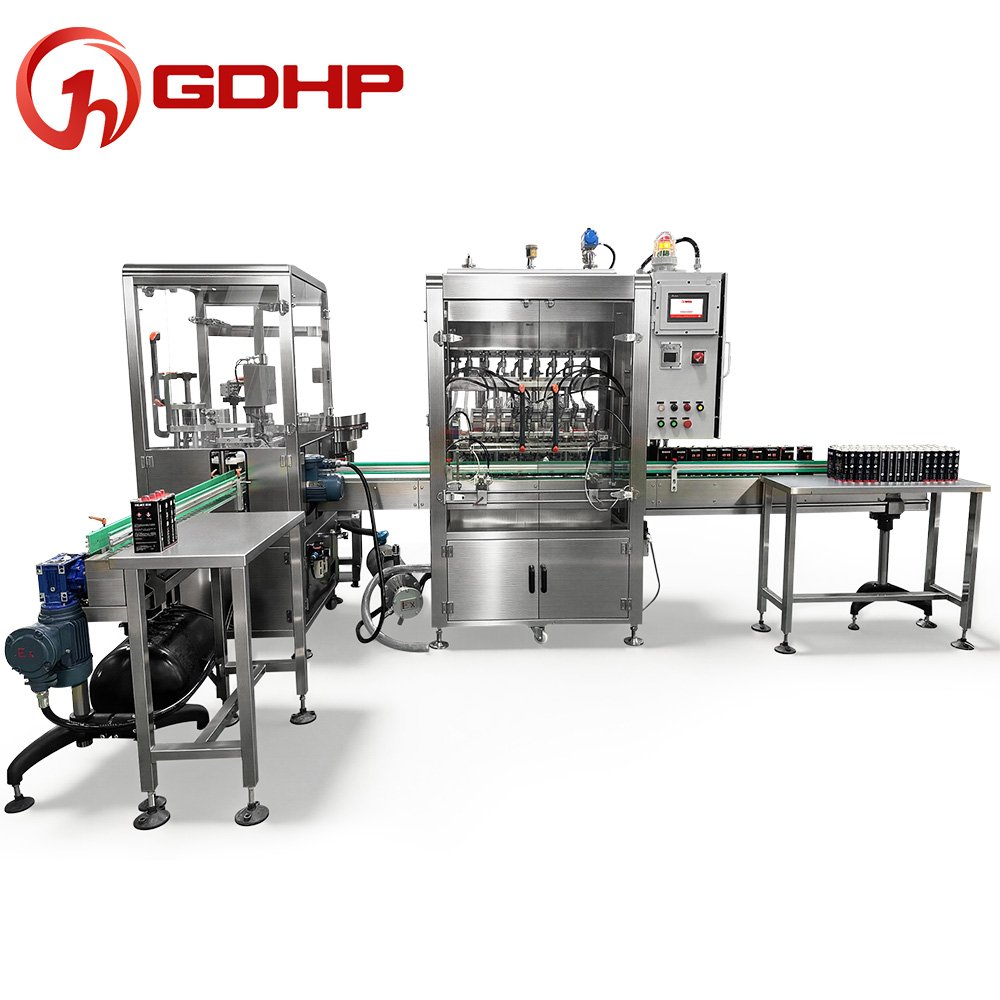
Buying an automatic filling machine for a small business makes sense when manual work is holding back orders, consistency, or growth. We use this checklist to match the right level of automation to real production needs—not just today’s workload.
| Readiness Area | What to Review | Automation Signal |
|---|---|---|
| Monthly demand | Track whether current manual labor hours can keep pace with confirmed orders. | Repeated backlogs or delayed deliveries indicate a capacity gap. |
| Output threshold | Compare current bottles per hour with peak-season production requirements. | A large gap between actual and required output supports semi-automatic or fully automatic filling. |
| Labor pressure | Review overtime, staffing shortages, repetitive-task fatigue, and unplanned absences. | High dependence on several operators increases the value of automation. |
| Fill consistency | Record underfills, overfills, customer complaints, spills, and rejected bottles. | Frequent variation points to a need for controlled volumetric filling precision. |
| Waste and spills | Calculate lost product, damaged labels, rejected containers, and cleanup time. | Rising product giveaway and waste can weaken margins faster than expected. |
| SKU growth | Review future bottle shapes, fill volumes, caps, pouches, and product types. | Multiple formats require flexible changeovers and suitable bottle-guiding systems. |
| Budget readiness | Include equipment, installation, utilities, training, maintenance, and line integration. | A realistic budget should cover the full operating line, not only the filler. |
| Growth forecast | Use expected demand over the next 12–24 months. | Choose capacity that supports growth without creating an oversized, underused line. |
Use the results above to guide the next step:
Key takeaway: An automatic filling machine is worth the investment when labor, waste, and missed output are becoming more expensive than the machine, installation, and ongoing support required to run it properly.
After calculating readiness, use our automatic filling machine buying guide to compare filling technology, capacity, containers, and project acceptance requirements.
Yes—when manual or semi-automatic filling is limiting output, creating costly spills, or tying up staff in repetitive work. For lower and variable demand, a semi-automatic filler can be the more practical first investment.
The right decision depends on: stable order volume, product behavior, labor pressure, available floor space, and planned growth.
There is no single bottle-per-hour number that fits every business. We review your required output, filling volume, product viscosity, bottle format, shift pattern, and downstream packing capacity.
A fully automatic filling machine makes more sense when demand is consistent and operators can no longer keep up without overtime, delays, or quality issues.
Payback depends on labor savings, product giveaway reduction, waste reduction, and added output. Use this simple payback period analysis:
Payback period = Total machine investment ÷ monthly savings and added gross profit
Include:
A realistic ROI calculation should use your own daily volume, labor rate, product cost per mL or gram, and current waste rate.
Yes, many systems can be configured for different containers and fill volumes. However, every format change may require adjustments to guides, nozzles, molds, settings, or conveyor components.
Before purchase, we review all planned bottles, caps, pouches, and product sizes. This helps control container changeover downtime and prevents a machine from being too limited for future SKUs.
Thick products need a filling setup matched to their viscosity, temperature, and flow behavior. The right solution may include suitable dosing components, anti-drip design, and heated or insulated tanks for hot-fill materials.
For difficult products, actual sample evaluation is important. It confirms whether the product fills smoothly without bubbling, stringing, clogging, or inconsistent dosing.
Automatic filling machines are designed for repeatable volumetric filling precision, but actual accuracy depends on the product, fill volume, viscosity, nozzle setup, and machine configuration.
We verify filling performance with real product samples during Factory Acceptance Testing (FAT). This gives the buyer a practical check of fill consistency, nozzle behavior, speed, and changeover operation before shipment.
Not always. A standalone automatic filler may be enough at the start. But if capping, labeling, or packing cannot match filler output, the production line bottleneck simply moves downstream.
A modular packaging line lets a business begin with filling and add:
Routine maintenance protects filling accuracy, hygiene, and uptime. Daily work normally includes cleaning product-contact parts, checking nozzles, inspecting seals and tubing, and confirming safe operation.
Preventive maintenance should also cover moving parts, sensors, conveyor alignment, and control systems. Operator training, spare parts planning, and technical support reduce avoidable stoppages.
Yes. Filling equipment can be engineered to support cGMP, CE, FDA-related, EHEDG/3-A hygiene, and international explosion-proof requirements where applicable.
For hazardous or corrosive products, suitable designs may include sealed negative-pressure systems, explosion-proof motors, anti-static gas pipes, and protected enclosures. Compliance needs must be defined early because they affect machine design, materials, controls, and validation requirements.