What Can Filling Machines Fill Besides Food?
Filling machines are used far beyond food and beverages. They can dose cosmetics, pharmaceuticals, IVD reagents, household chemicals, lubricants, pesticides,…
August 17, 2026

Viscous liquid filling machines, also called viscous filling machines or paste filling machines, are used for products that move more slowly than water-like liquids. Typical applications include sauces, honey, syrups, creams, lotions, gels, shampoo, balm, sealants, and other thick or semi-solid products. The manufacturers below publish equipment for these applications, from bench-top piston fillers to automatic filling and capping lines. This is an editorial overview, not a market-share ranking.
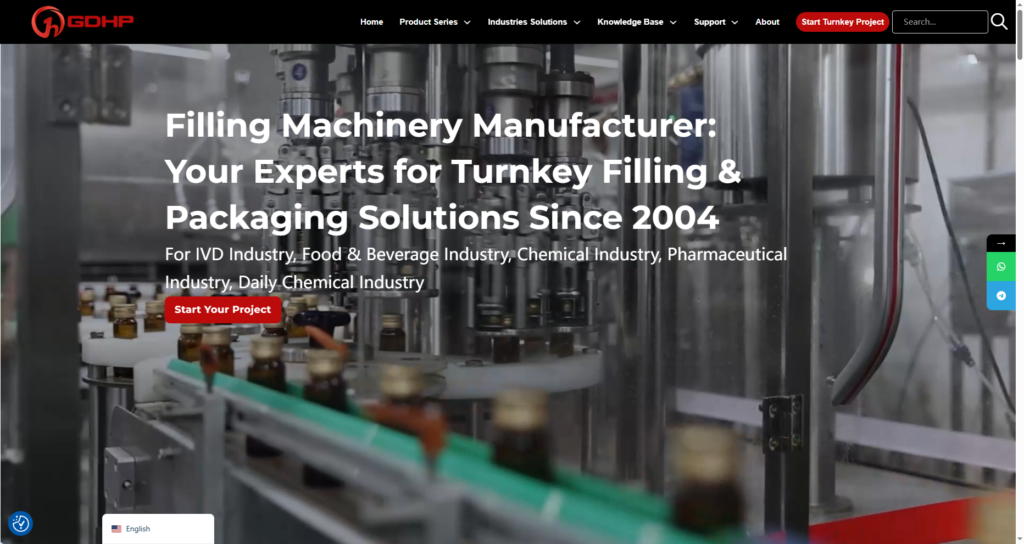
GDHP is a Guangzhou-based filling and packaging machinery manufacturer whose website describes more than two decades of experience and projects in over 50 countries. Its portfolio covers pre-treatment and blending, filling and capping, labeling, sealing, washing, mixing, conveyors, and end-of-line packing, so the company can supply a complete line instead of only a filler. The main sectors listed by GDHP are food, cosmetics and daily chemicals, pharmaceuticals and IVD, and chemical products. The published service process runs from product and container review through line design, manufacturing, factory acceptance testing, export packing, installation, commissioning, and after-sales support. GDHP also presents customized and non-standard equipment for products or containers that do not fit an off-the-shelf machine.
GDHP groups viscous projects under automatic liquid and paste filling lines for sauces, oils, creams, lotions, emulsions, balms, household chemicals, and industrial chemicals. Its published line concept emphasizes smooth filling, anti-drip control, and reduced bubbles and stringing, with the final pump, nozzle, hopper, and heating configuration matched to the formulation. For heat-sensitive or solidifying products, GDHP publishes a balm hot-filling machine with a cooling tunnel for balms, body butters, and cleansing pastes. Its automatic liquid and paste filling lines can be integrated with capping, labeling, and other downstream equipment.
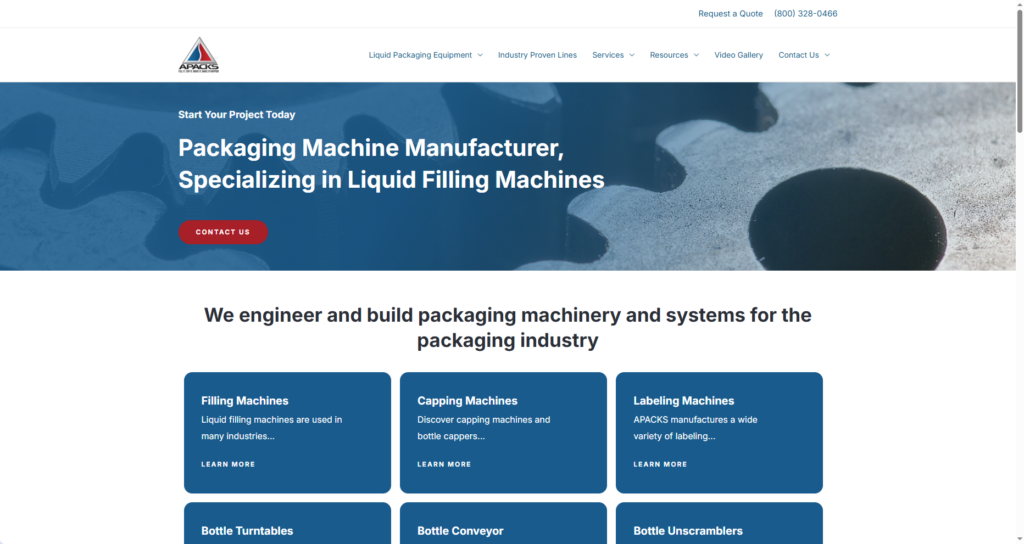
APACKS designs and builds packaging machinery in La Porte, Indiana, and says it began manufacturing its own equipment there after initially working with selected equipment partners. Its portfolio includes liquid fillers, bottle rinsers, capping machines, cap sorters, conveyors, bottle loading and accumulating turntables, labelers, induction sealers, coding, case packing, and palletizing equipment. The company offers pre-sales consultation, project management, custom engineering, machine integration, installation, training, customer service, and planned maintenance. This combination allows APACKS to supply a stand-alone filler, upgrade an existing line, or coordinate a turnkey packaging system for a growing producer.
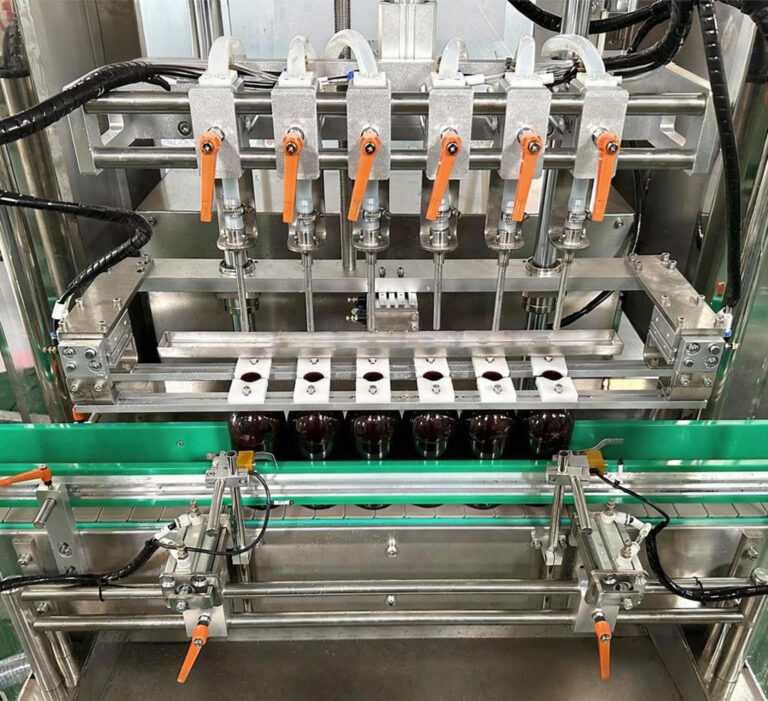
APACKS’s entry-level benchtop piston filler is a semi-automatic volumetric machine for liquids, creams, gels, and food products from water-thin to highly viscous. The published configuration is available with one or two heads, selectable piston volumes, a covered stainless-steel cone hopper, pneumatic operation, quick-release nozzles and feed piping, and bottom-closing positive shut-off nozzles for drip control. APACKS lists speeds up to 30 bottles per minute and describes the machine as suitable for food and pharmaceutical work, washdown areas, and selected hazardous environments. The company also offers automation upgrades and larger piston-filler configurations within its broader liquid-filling range.
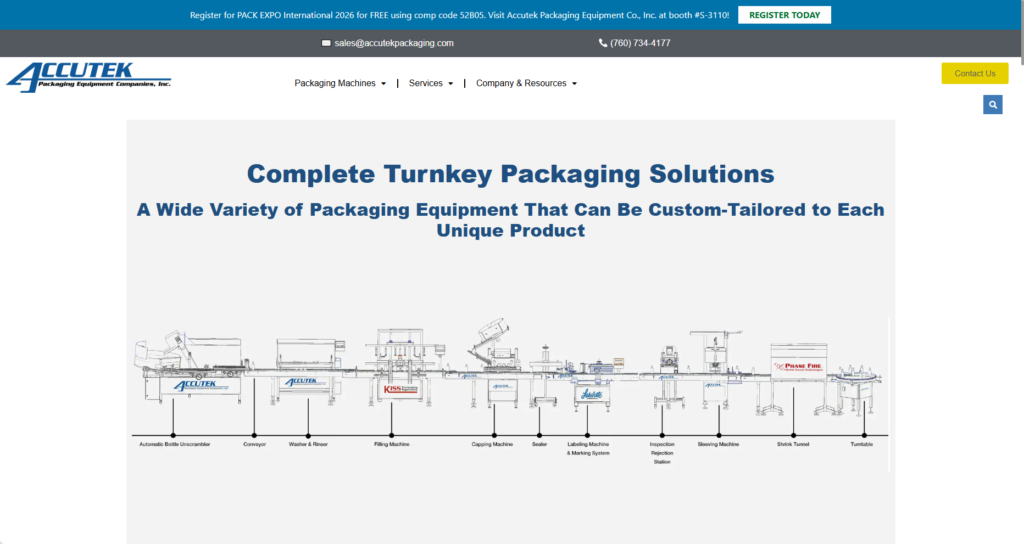
Accutek Packaging Equipment is a US packaging-machinery supplier focused on liquid filling, capping, labeling, and complete packaging-line applications. Its public equipment catalog is organized around different product-flow and dosing behaviors rather than one universal filler design. The company lists solutions for food and beverage, pharmaceutical, cosmetic, chemical, and general industrial packaging, allowing a project to combine a filler with bottle handling, closures, labels, and conveying equipment.
Accutek’s piston filling machines use a volumetric piston principle to draw a repeatable chamber volume and discharge it through the filling nozzles, making the category relevant to thicker liquids and products that need repeatable volume dosing. Accutek also publishes pump, overflow, gravity, and net-weight filling technologies, so viscous applications can be matched to the product’s flow behavior and the required dosing method. The company presents piston filling as one part of a wider liquid-packaging platform rather than as a single-purpose paste machine.
Tenco is an Italian manufacturer that has made filling and dosing equipment since 1989. Its website describes an approach based on tailor-configured machines, Italian manufacturing, and solutions that can scale from small laboratories to larger production lines. In addition to filling, Tenco supplies dosing, capping, labeling, rinsing, and automation equipment for food, beverage, cosmetics, pharmaceuticals, chemicals, and herbal products. The company lists both automatic and semi-automatic machines and designs them for bottles, jars, vials, and containers in different shapes and sizes.
Tenco explicitly covers liquids, semi-liquids, and viscous products such as oil, sauces, honey, syrups, creams, shampoos, gels, solvents, and pharmaceutical solutions. Its range includes the Enolmaster vacuum level filler, the Flowmaster vacuum filler for preserving liquids in glass jars, and the Flexflow flow-meter dosing machine with a screw electric pump. This gives Tenco several dosing principles for viscous products, from compact bench-top equipment to in-line systems, while the final configuration is adapted to the product and container.
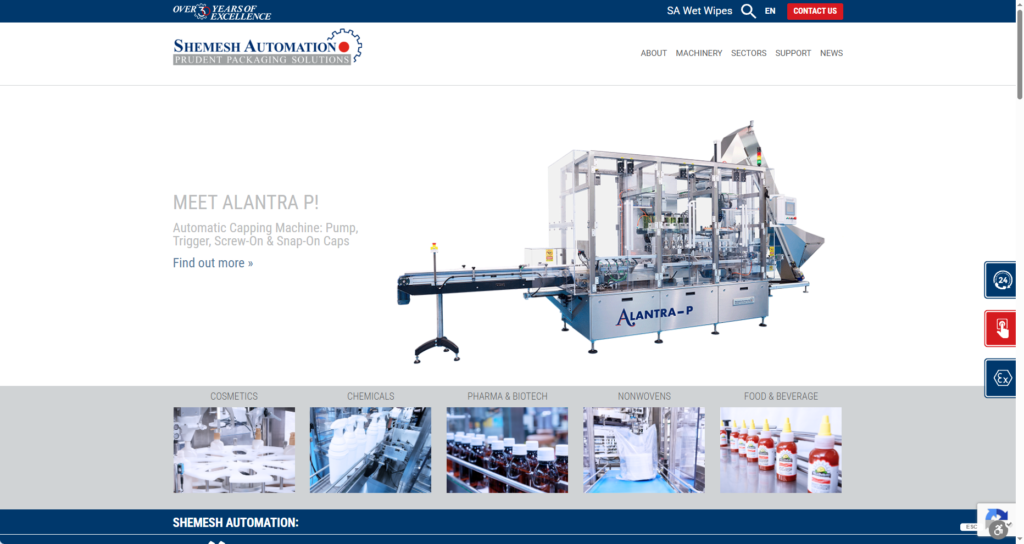
Shemesh Automation develops automated packaging lines for food, chemicals, cosmetics and personal care, pharmaceuticals, and other sectors, with published contact locations in the United States and United Kingdom. Its equipment range includes container feeding, rinsing, liquid and solid filling, capping, sealing, labeling, conveyors, case packing, and robotic palletizing. Shemesh also supplies monoblocks and complete turnkey systems that connect filling with downstream packaging, which is useful when a viscous product needs coordinated bottle handling, closure application, inspection, and discharge.
Shemesh’s chemical-liquid information covers liquids and oils with the viscosity commonly encountered in chemical production and lists viscous filling, capping, over-capping, sealing, labeling, discharge, and quality-control monoblocks. Published standard options include speeds up to 180 containers per minute, 304 or 316L stainless-steel construction, FDA-approved piping where applicable, Siemens PLC/HMI and motors, Festo pneumatics and servo systems, Banner sensors, and CE marking. Its automatic piston and monoblock systems are also shown for sauces, honey, oils, cosmetics, and personal-care products, making Shemesh a line-integration choice for higher-throughput viscous filling.
VKPAK is a Shanghai-based manufacturer of liquid filling and packaging equipment. Its published range includes automatic and semi-automatic liquid fillers, capping and labeling machines, bottle unscramblers and rinsers, tube filling and sealing equipment, and turnkey liquid packaging lines. VKPAK organizes applications around food, chemicals, household products, personal care, and pharmaceuticals, and presents both standard models and customized head counts, fill ranges, and product-contact configurations.
VKPAK’s automatic servo-driven piston filler is published for paste, semi-paste, chunky, and other viscous products, including sauces, honey, cosmetics, daily chemicals, and food products. The listed design supports one to 16 heads, 304 stainless-steel framing, optional 20- to 200-liter top or jacketed hoppers with heating and mixing, a rotary valve for viscous transfer, anti-drip nozzles, diving nozzles for foaming products, PLC/HMI control, and optional CIP connections. Published models include fill ranges from about 100 ml to 5,000 ml, with model-specific speeds and accuracy depending on the configuration.
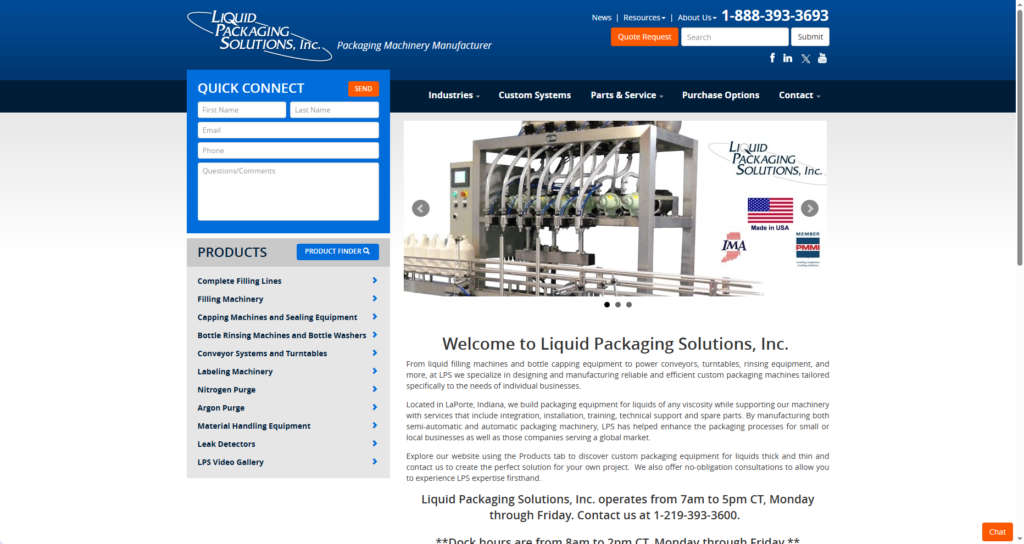
Liquid Packaging Solutions (LPS) describes itself as a US manufacturer of packaging equipment made in its Indiana location. Its product range includes bottle cleaning, liquid filling, capping, conveyors, loading and accumulating turntables, nitrogen or argon purge equipment, and complete packaging systems. LPS states that it works with start-ups, small businesses, and larger packaging companies, and offers design, manufacture, integration, installation, training, parts, and after-sale service. Its industry pages cover food and beverage, honey, cleaners and chemicals, oils and lubricants, personal care and household products, pharmaceuticals, nutraceuticals, and bottled water.
LPS publishes semi-automatic tabletop and automatic piston fillers for high-viscosity liquids, semi-solids, and products with particulates. Its piston description explains that the piston retracts to draw product into a fixed-volume cylinder and then pushes the measured charge through the nozzles, so the same mechanism supports accurate dosing and the movement of thick products. Automatic models are published with up to 12 filling heads, while tabletop models use one or two nozzles. LPS also offers pump, net-weight, gravity, and overflow filler categories for products whose flow behavior calls for another dosing principle.
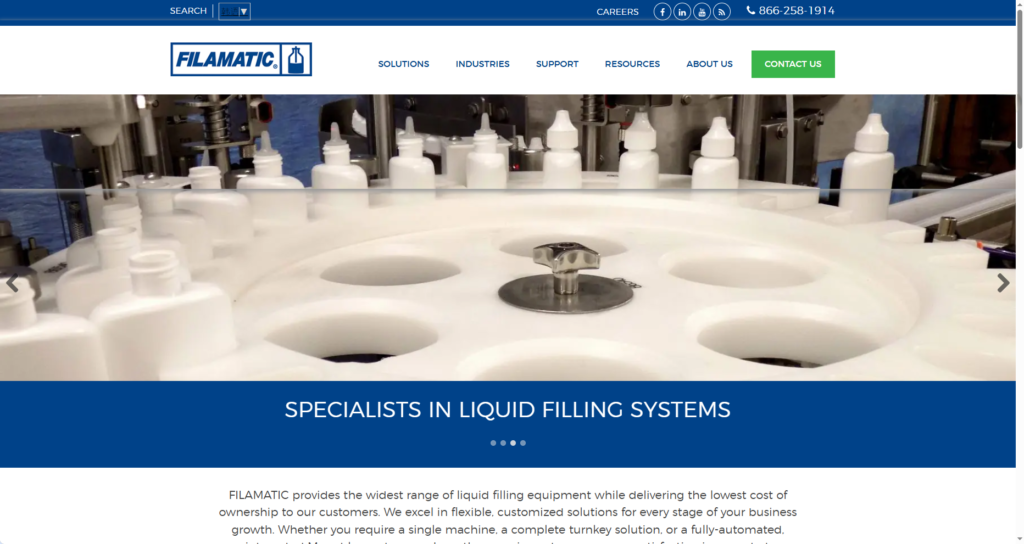
Filamatic is a Baltimore-based liquid filling and bottling equipment manufacturer that says it has supplied more than 25,000 machines worldwide. Its portfolio spans handheld and semi-automatic fillers, inline systems, monoblocks, integrated fill-cap-label lines, hazardous-environment solutions, and auxiliary bottle-handling equipment. The company lists pharmaceutical, cosmetic, food and beverage, university, natural-products, industrial, personal-care, and hazardous applications. It also provides customer and technical service, after-sales programs, qualification and validation support, training, and spare-parts support for regulated or continuously operating lines.
Filamatic’s DFS Dockable Lobe Filling System handles water-thin through viscous products and is listed for pharmaceutical, diagnostic, cosmetic and personal care, specialty chemical, food, and household applications. The system uses interchangeable wetted parts, bottom-up nozzle movement, multiple rotary lobe-pump sizes, three frame sizes, up to 12 pumps, and published rates from 10 to 200 containers per minute. For products that must be liquefied before filling, the H-CE Molten Products Filler handles 1 to 1,100 ml fills at up to 300 cpm and product temperatures up to 200 F, with a surge tank or recirculating product manifold. Applications listed by Filamatic include lip balm, lipstick, candle wax, petrolatum products, sauces, and other molten materials.
Shanghai Npack Automation Equipment Co., Ltd. was established in 2012 and focuses on liquid bottling equipment. Npack says it is an SGS-audited custom manufacturer and lists CE, SGS, and RoHS-related documentation, along with a product portfolio covering bottle sorting and rinsing, filling, capping, labeling, pouch and tube equipment, monoblocks, and robotic or end-of-line systems. Its published bottling solutions include oil, wine, sauce, cosmetics, and daily chemical lines. Npack also states that a large share of its equipment is exported to Europe, the United States, and Australia.
Npack’s piston-filler family includes manual, semi-automatic, automatic inline, horizontal, rotary multi-head, and tracking configurations. Npack describes the piston and cylinder as a volumetric system for viscous liquids and products containing particles, with applications in sauces, jams, honey, creams, gels, cosmetics, pharmaceuticals, chemicals, paints, and coatings. The company presents the machines as heavy-duty equipment for repeatable dosing across multiple shifts, while servo control, head count, and bottle-handling style can be selected for different production levels.
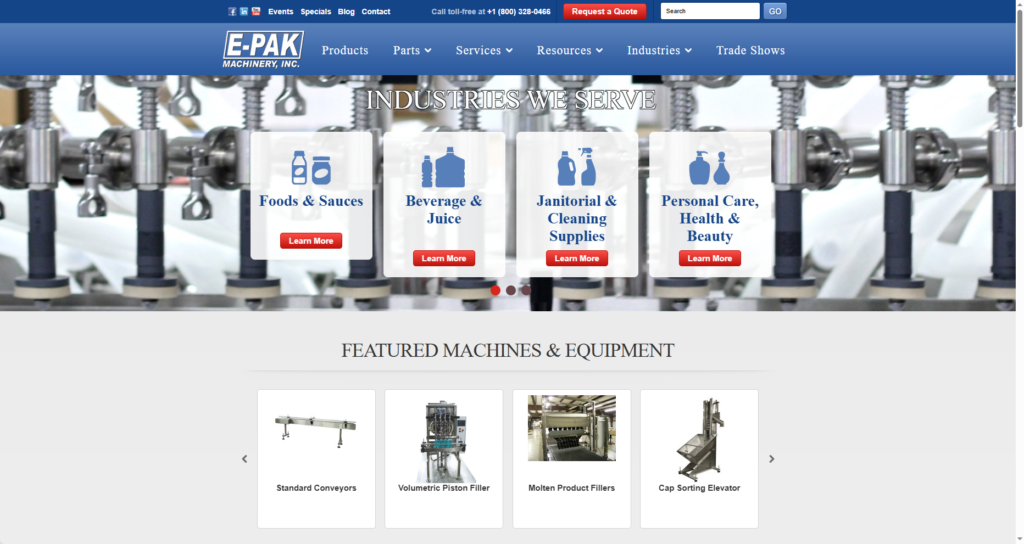
E-PAK Machinery supplies bottling equipment from entry-level machines to complete turnkey packaging lines. Its catalog includes liquid fillers, bottle cleaning, capping, cap feeding, conveyors, labeling, bottle handling, molten-product systems, parts, field service, installation, and leasing options. The company organizes applications for acids and corrosives, food and sauces, candles and lip balms, cosmetics, cleaning products, personal care, pharmaceuticals, paints, sealants, and petroleum products. This broad catalog lets a viscous-filling project combine a filler with the upstream and downstream equipment needed for a production line.
E-PAK’s piston fillers use a volumetric system and dedicated air cylinder, with stainless-steel construction and food-grade product-contact parts. The company lists them for foamy, thick, chunky, water-thin, and viscous liquids, and publishes features such as individually actuated heads, quick changeover, easy cleanout, custom manufacture, and automated operation. E-PAK also offers pump, net-weight, pressure, molten, gravity, and overflow filling categories, so products such as sauces, liquid soaps, sealants, personal-care creams, lip balms, and other semi-solids can be assigned to different filling technologies within the same supplier network.
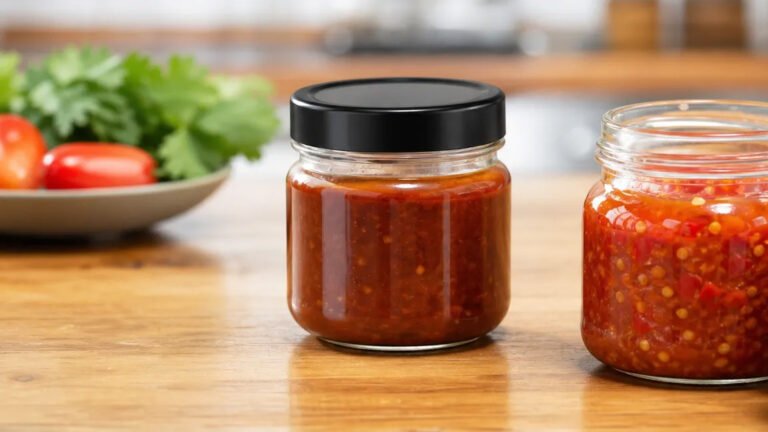
Typical products include sauces, honey, syrups, jams, creams, lotions, gels, shampoo, balms, ointments, toothpaste, adhesives, lubricants, and other pastes.
A piston filler is commonly used because its metering cylinder delivers a controlled volume of thick product.
A piston filler dispenses the volume held in a cylinder, while a pump filler moves product through a pump and controls the dose during transfer.
Yes, if the hopper, valves, pipes, and nozzles have passages large enough for the product’s largest particles.
Yes, heating can reduce viscosity and improve the filling of balms, creams, waxes, and other temperature-sensitive pastes.
Dripping or stringing usually comes from residual nozzle pressure, delayed shut-off, trapped air, or unsuitable nozzle geometry.
Bubbles and foam are reduced through gentle product transfer, controlled pump speed, suitable nozzle movement, and limited air entrainment.
No, because the usable range depends on the product, temperature, pump, nozzle, fill volume, and filling speed.
Cleaning uses CIP systems or removable product-contact parts such as nozzles, hoses, valves, pistons, and pumps.