Ketchup Packaging Guide Materials Formats and Machinery
Ketchup Packaging Guide covers materials formats machinery and how to choose the right solution for safe efficient food packaging
April 23, 2026

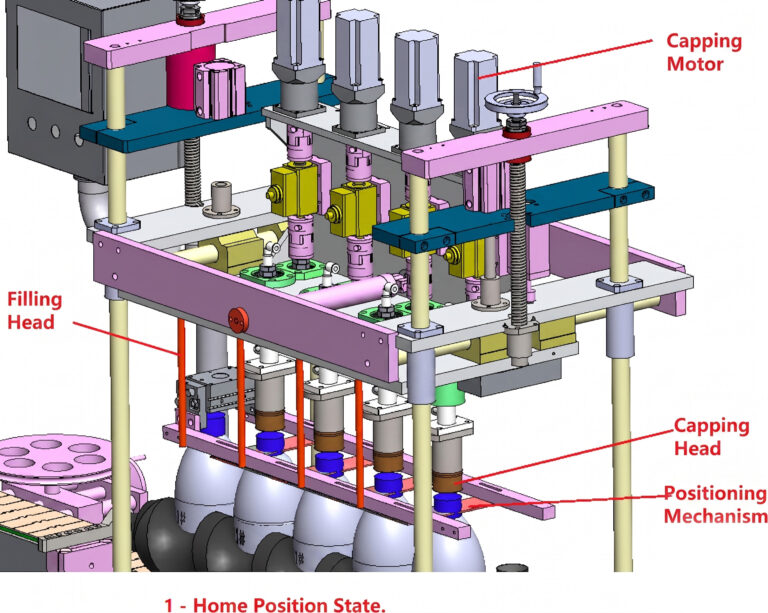
An automatic filler may still leave you handling every container. In one GDHP configuration for dry granules, the equipment automatically weighed and dispensed the product, while an operator positioned the containers and moved them to the lid-pressing station. Automatic dosing did not mean automatic container handling.
If that handling work limits your shift output, buying a faster dosing unit may leave the bottleneck untouched. Product mismatches can create similar problems: a narrow passage can damage sauce particles, while inconsistent powder feeding can interrupt a run. You need to know which part of the process the proposed machine actually solves.
To choose a filling machine, match your product, container, required output, and filling tolerance before deciding how much to automate. This guide compares the technologies, explains their limits, and provides a product-testing checklist you can use when reviewing suppliers.
For thin liquids, start with gravity, flowmeter-controlled, or suitable pump filling. For thick pastes, evaluate piston or other positive-displacement systems, which move a defined amount of product mechanically. For powders, compare auger and weighing systems; for free-flowing granules, also consider volumetric cups.
Viscosity means resistance to flow. Dosing means measuring the amount dispensed into each container. Use the table to make a shortlist, then test it with your actual product and packaging.
| Product or application | Technologies to evaluate | Supporting features to consider | Main selection check |
|---|---|---|---|
| Thin, free-flowing liquids | Gravity, flowmeter-controlled, or suitable pump filling | Controlled flow, appropriate shutoff nozzles | Foaming, conductivity where relevant, temperature, and required accuracy |
| Oils, syrups, and lotions | Piston, gear pump, or rotary lobe pump filling | Stable product supply and compatible seals | Viscosity variation, abrasiveness, and cleaning requirements |
| Thick creams and smooth pastes | Piston or suitable positive-displacement pump filling | Assisted feeding, shutoff nozzles, optional heating | Reliable hopper discharge and clean cutoff |
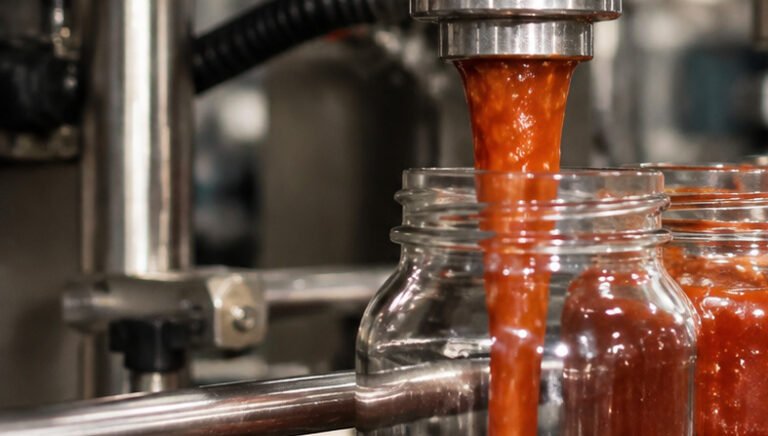
| Sauces containing particles | Piston or suitable rotary lobe pump filling | Large product passages and gentle agitation | Particle size, particle damage, and ingredient separation |
| Powders | Auger or suitable weighing systems | Dust extraction, hopper agitation, moisture control | Flowability, bulk density, dust, and bridging |
| Free-flowing granules | Weighing or volumetric cup systems | Controlled feeding and suitable discharge chutes | Granule consistency, breakage, and target quantity |
| Small liquid doses with strict contamination controls | Peristaltic or other suitable precision dosing systems | Compatible tubing and an appropriate hygienic process | Dose repeatability, tubing behavior, and cleaning or sterilization requirements |
Before comparing machines, prepare a short specification covering the product, container, filling quantity, and production target. This gives suppliers a common basis for their proposals.
Product names alone are insufficient. Two products sold as “sauce” can require very different filling systems: one may be smooth and pourable, while the other contains fragile pieces in a thick base.
Provide the following information where available. If a property is unknown, send a representative sample and ask the supplier how it will be evaluated:
Temperature deserves particular attention. A product may flow easily during a warm trial but become difficult to feed after cooling in the production hopper. The equipment specification should describe the conditions the machine will encounter throughout a normal run.
List the smallest and largest target quantities, together with the expected container sizes. Include samples or drawings showing the opening, height, diameter, and closure.
If one machine must handle several products, identify the most difficult combinations. A small dose of thin liquid and a large dose of thick cream may require different pumps, nozzles, or change parts.
Separate essential requirements from occasional formats. This helps determine whether a flexible machine is practical or whether a dedicated setup would be easier to operate.
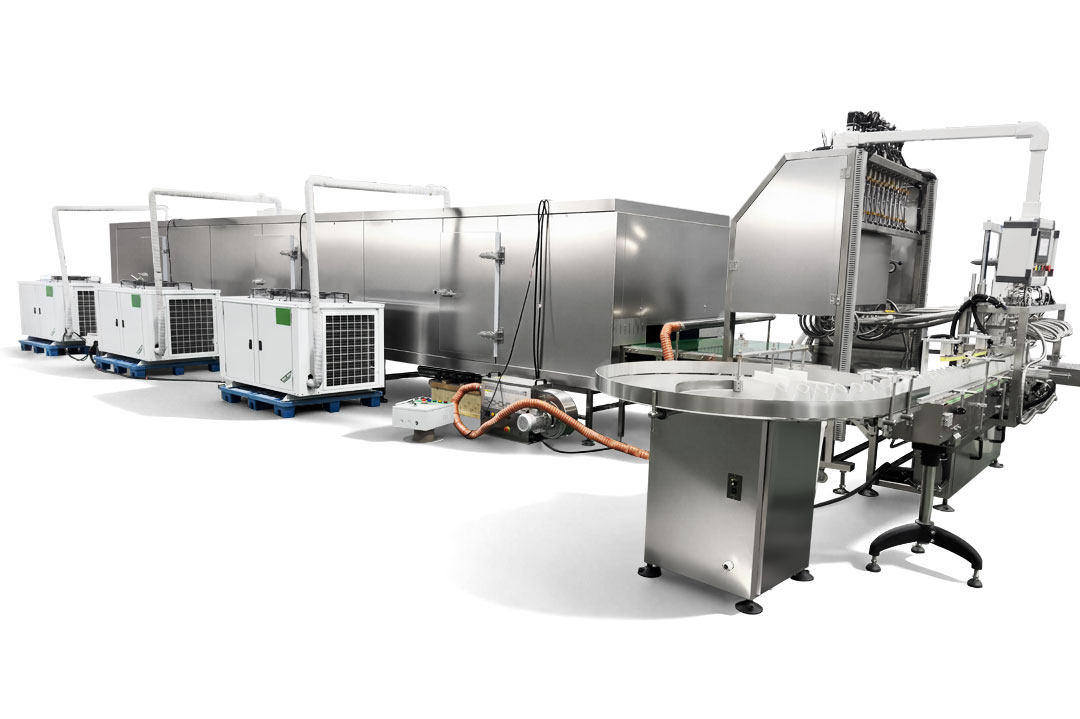
Balm filling and cooling equipment illustrates why processing temperature belongs in the product specification.
The product determines more than the dosing mechanism. It also influences hopper design, transfer equipment, nozzle movement, temperature control, and cleaning access.
Thin liquids
If your product is thin, free-flowing, and compatible with the equipment, start by evaluating gravity filling for its simple product path. Flowmeter-controlled filling measures passing liquid to control the dose; a suitable pump system may also fit your quantity and speed requirements. If the product foams, include foam-control features in the comparison instead of choosing solely on maximum speed.
Gravity filling can provide a straightforward solution, but repeatability depends on controlling the conditions that affect flow. Product level, valve timing, nozzle condition, and temperature changes can all matter.
Vacuum or negative-pressure filling may suit certain applications, but container strength and the required filling method must be checked.
Medium- and high-viscosity liquids
Oils, syrups, lotions, and honey need a system that can feed and dispense the product consistently.
Piston, gear pump, and rotary lobe pump systems are candidates, but their suitability depends on the material. Abrasive ingredients can wear moving parts. Shear-sensitive products—formulations whose structure can change under mechanical forces—need a pumping action that preserves their texture.
For products that thicken or solidify as they cool, a heated or insulated product path may be useful. Heating must remain within the formulation’s acceptable processing conditions.
Foaming liquids
Detergents and some personal-care products can foam when they fall into an empty container or pass through the system too aggressively.
Bottom-up filling can help by lowering the nozzle into the container and raising it as the liquid level increases. Controlled flow profiles can further limit splashing and turbulence.
The complete product path should be assessed. Air entering through a poor connection or an unsuitable transfer arrangement can create problems that nozzle movement alone will not solve.
Oxygen-sensitive liquids
For products affected by oxygen exposure, consider closed product storage and transfer, suitable inert-gas arrangements, and coordination between filling and closure application.
Vacuum treatment or nitrogen flushing may be appropriate for some products and containers. Selection should follow the product’s sensitivity and packaging requirements, with performance assessed during testing.
Corrosive liquids
Check every wetted component, meaning every part that touches the product: tanks, pumps, valves, nozzles, tubing, and seals.
Chemical-resistant plastics such as polytetrafluoroethylene (PTFE) and polyvinylidene fluoride (PVDF), suitable stainless steels, and other compatible polymers may be options. No single material is appropriate for every acid, alkali, or solvent. Compatibility depends on the chemical, concentration, temperature, and exposure conditions.
A corrosion-resistant pump does not by itself establish that the complete machine is suitable for a hazardous area.
Smooth pastes
If your cream or paste will not flow reliably under gravity, prioritize a piston or suitable positive-displacement system because it mechanically moves the product. Check assisted feeding at the same time: the filling mechanism still needs a steady supply and a clean cutoff at the nozzle.
For products that string or drip, nozzle design and shutoff behavior are important. Temperature control may help some formulations, but it should be tested rather than assumed to solve the problem.
Products containing particles
Sauces with fruit pieces, seeds, meat, or vegetables require sufficient clearance throughout the product path. A large nozzle will not prevent damage if the upstream valve or pump has a narrower restriction.
Review the largest particle size and its ability to deform without breaking. Test the product after filling to check both quantity and particle condition.
Separation is a different issue. If oil rises while heavier ingredients settle, the filling mechanism may dispense inconsistent mixtures even when the total quantity is correct. Suitable agitation or another product-management method may be needed.
For example, a sauce containing fragile pieces and a separate liquid phase requires two checks: whether the filling path preserves the pieces, and whether the hopper supplies a representative mixture. Increasing the nozzle diameter addresses only part of that problem.
Very thick or bridging products
Dense pastes may form an arch above the hopper outlet, leaving the dosing mechanism without a reliable supply.
Possible solutions include an appropriate agitator, bridge breaker, forced-feed arrangement, or pressure-assisted hopper. Controlled heating may also help when the product permits it.
Test these features together. Excessive agitation can change product texture or introduce air, while inadequate feeding can cause incomplete doses.
An auger—a rotating metering screw—is a common powder-dosing mechanism. Powder behavior determines the required screw geometry, hopper arrangement, and control method; a twin-screw system is not a universal requirement. If the powder bridges, forming an arch above the outlet, solve the feeding problem before assuming a larger dosing screw will help.
Dusty or lightweight powders may need enclosed discharge, a filling spout positioned close to the container opening, and suitable extraction. Extraction must be balanced so it controls escaping dust without removing an unacceptable amount of product.
Hygroscopic powders may require controlled humidity, sealed storage and feeding, and suitable agitation or lump management. Aggressive stirring is not always beneficial.
Poor-flowing powders may need hopper geometry changes, agitation, or assisted feeding. The objective is a consistent supply to the metering mechanism.
Products with variable bulk density, meaning a changing mass of powder in the same space, need particular attention when dosing by volume. If you sell by weight and that density varies, prioritize evaluating weight feedback or a weighing-based method because equal volumes may contain different masses.
Free-flowing granules should also be evaluated separately from cohesive powders. Weighing and volumetric cup systems may offer useful alternatives.
For a more detailed comparison, see our powder filling machine buying guide.
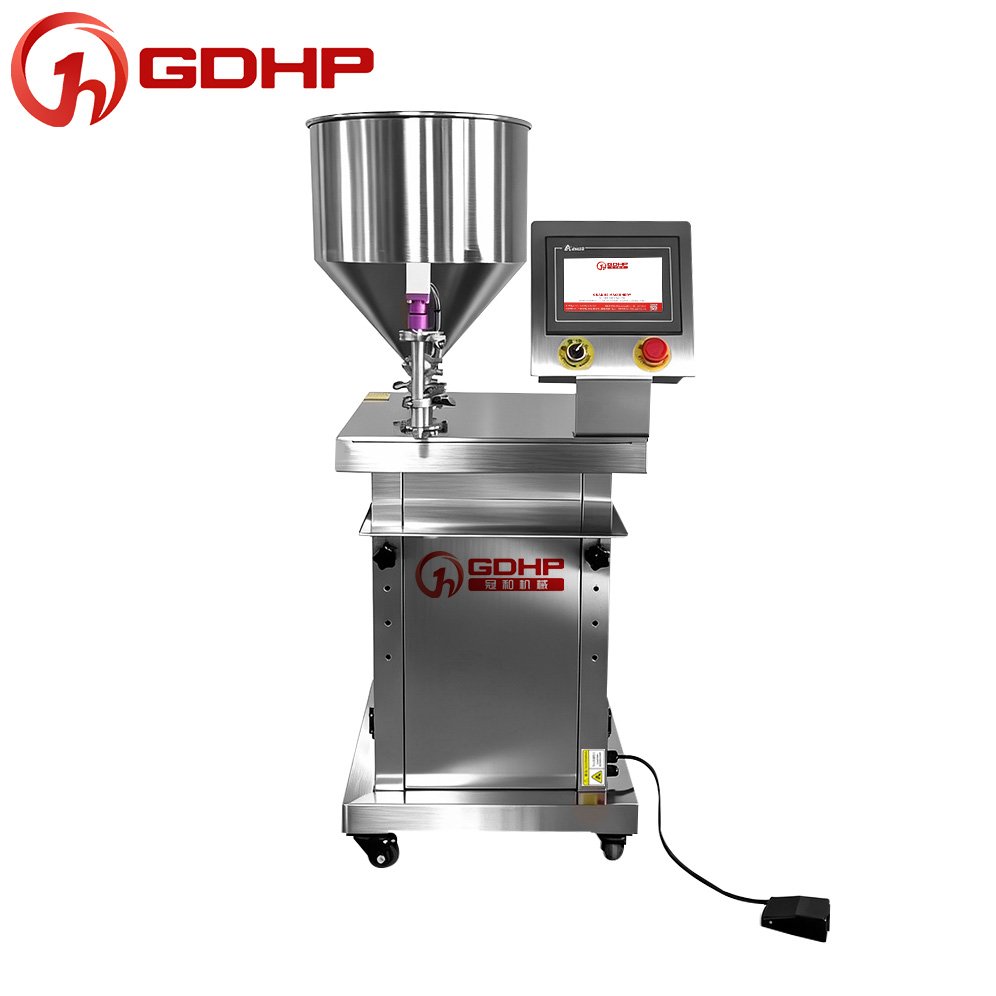
A semi-automatic filling machine with a hopper and foot-pedal control. Confirm the dosing system against your product properties.
Once the product requirements are clear, compare technologies against the same operating conditions.
| Technology | Why it fits | Choose it for evaluation when… | Avoid or check carefully when… |
|---|---|---|---|
| Gravity filling | Controls product flow, commonly through valve timing | Thin, free-flowing liquids | Product head, viscosity, foaming, and valve repeatability |
| Piston filling | Displaces a defined volume through a cylinder | Liquids, creams, pastes, and suitably sized particles | Valve clearance, seals, feeding consistency, and cleaning |
| Gear pump filling | Meters product through controlled pump operation | Compatible liquids, oils, and some viscous products | Abrasiveness, particle content, wear, and product compatibility |
| Rotary lobe pump filling | Uses rotating lobes to move product | Viscous or shear-sensitive products and some particulate applications | Clearances, operating speed, particle handling, and cleanability |
| Peristaltic filling | Compresses tubing to move and dose liquid | Small doses and applications benefiting from a replaceable product path | Tubing compatibility, wear, calibration, and dosing conditions |
| Auger filling | Uses screw rotation to dispense dry material | Many powders | Bulk-density variation, hopper feeding, dust, and product flow |
| Net-weight filling | Uses weight measurement to control dispensing | Liquids, powders, or granules with mass-based requirements | Vibration, settling time, cutoff control, and achievable cycle time |
| Flowmeter-controlled filling | Measures flow and controls the dispensing cycle | Compatible liquids across suitable operating ranges | Meter type, fluid properties, entrained air, and installation conditions |
| Volumetric cup filling | Dispenses a defined cup volume | Consistent, free-flowing granules | Bulk density, particle uniformity, and volume adjustment |
Use the table to eliminate unsuitable options before comparing prices. A gear pump is not a default choice for abrasive material, and a volumetric cup is a poor starting point when variable bulk density makes equal volumes unreliable for a weight-based target.
Choosing a wider nozzle without checking the upstream path. Fragile sauce pieces may still pass through a restrictive valve or pump. Check every passage, then inspect filled product for damage.
Choosing an auger only because the product is called a powder. If the material bridges or its bulk density varies, a screw change alone may leave the dose inconsistent. Evaluate feeding and the measurement method together.
Buying filling speed that the rest of the line cannot use. If container loading or capping is slower, extra dosing capacity may not increase finished output. Measure the limiting operation before adding equipment.
For additional explanations of the operating principles, review how volumetric filling machines work.
The filler must handle the packaging reliably as well as dispense the product.
| Container format | What to check |
|---|---|
| Glass bottles and jars | Stable handling, indexing forces, breakage risk, and opening dimensions |
| Plastic bottles | Rigidity, deformation, height variation, and nozzle positioning |
| Flexible pouches | Pouch opening or spout handling, support during filling, and sealing integration |
| Tubes | Tube holding, filling orientation, product cutoff, and downstream closing |
| Metal cans | Container handling, filling conditions, and compatibility with the sealing process |
| Small or irregular containers | Positioning accuracy, dedicated holders, access, and change parts |
Nozzle diameter must be evaluated against both the container opening and the product. A narrow neck can limit the available passage for a particulate product.
Check the space needed for displaced air to escape during filling. Also confirm whether product residue on the neck, rim, or sealing area could interfere with capping, induction sealing, or another closing process.
If you run several container formats, choose a setup with demonstrated format changes because adjustment work can consume the time saved by faster filling. A changeover is the work needed to switch product or packaging format. Ask the supplier to demonstrate it and record the parts, settings, and first-container checks required.
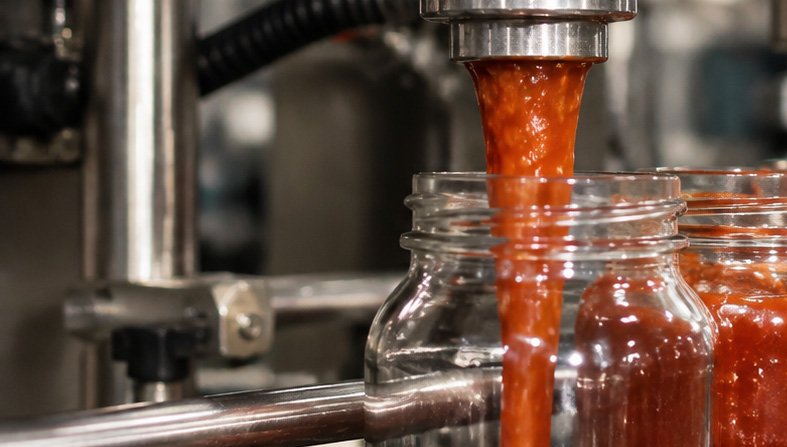
The filling nozzle and container opening must work together to control splashing and product buildup.
Choose capacity from the number of acceptable packs you need per shift. Maximum filling speed alone does not tell you whether the complete line can meet that target.
A useful starting calculation is:
Required average output = target acceptable units ÷ available production minutes
For bottles, this is commonly expressed as bottles per minute, or BPM. Other packaging formats can use containers or packs per minute.
Consider an illustrative production requirement of 12,000 acceptable bottles per day.
If six hours remain after planned cleaning and changeovers:
12,000 ÷ 360 = 33.3 acceptable bottles per minute
Suppose the line is expected to deliver acceptable output at 80% of its nominal running rate because of minor stops, reduced-speed operation, and rejects. The nominal rate required would then be:
12,000 ÷ (360 × 0.80) = approximately 41.7 bottles per minute
This example uses assumptions, not a machine performance claim. Replace them with your production data and avoid counting the same downtime twice.
Evaluate the complete line. Container feeding, capping, labeling, and packing can limit output even when the filling station has spare capacity.
| Level | Typical operator involvement | Suitable situations | Main tradeoff |
|---|---|---|---|
| Manual | Positions containers and operates the filling process | Trials, very small batches, limited initial demand | Low investment, but output depends heavily on the operator |
| Semi-automatic | Usually presents containers and starts or supports each cycle | Growing production, varied batches, controlled investment | Greater dosing consistency with continued manual handling |
| Fully automatic | Replenishes materials, supervises operation, and handles exceptions | Sustained demand and integrated production | Higher investment and greater maintenance and integration requirements |
If batches are short and an operator can comfortably handle the required containers, evaluate semi-automatic filling because it can automate measurement without the cost of complete container handling. If sustained manual handling is the limiting operation, evaluate a fully automatic line with matched feeding, filling, and closing capacity. There is no universal BPM threshold: product behavior, staffing, and downstream work all affect the result.
Plan for credible growth. Upgrade paths, space for additional equipment, and suitable controls can be more useful than purchasing unused capacity immediately.
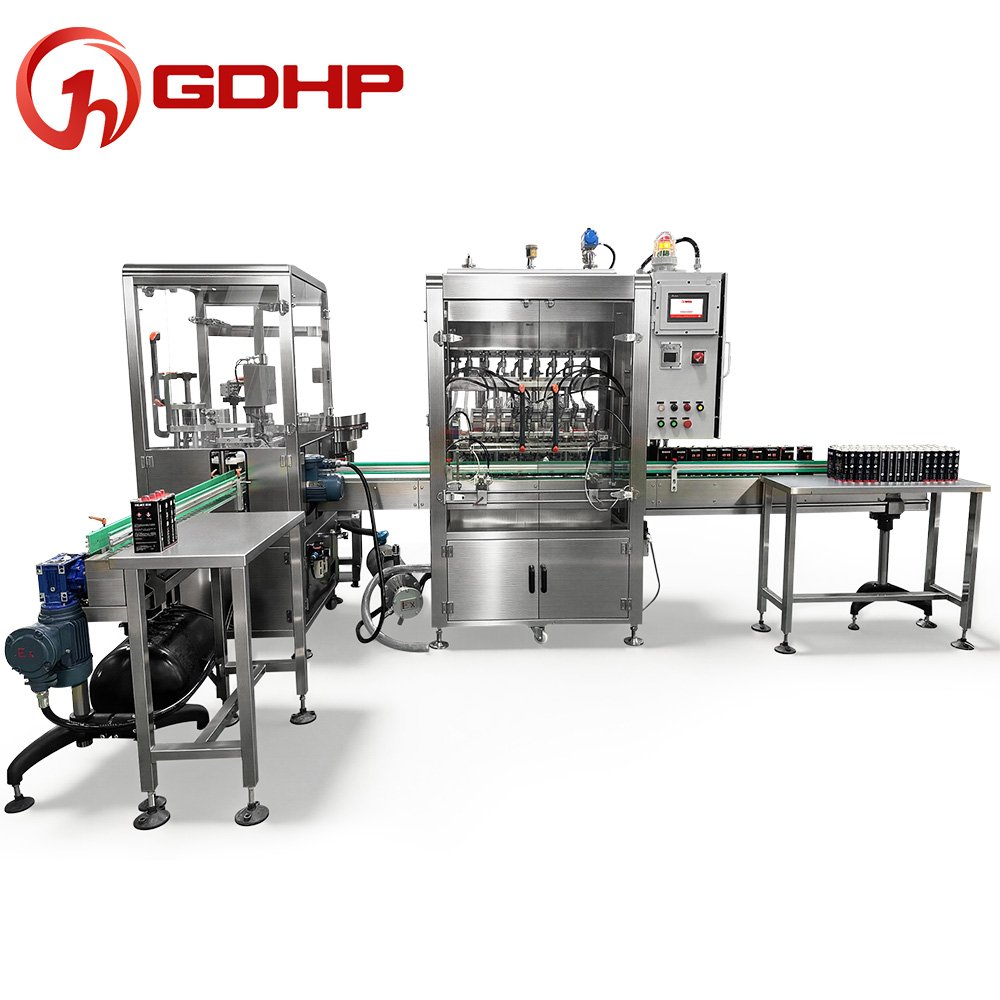
A conveyor-linked filling line: specify usable output across the complete process, including downstream equipment.
Define acceptable filling results before requesting a machine accuracy figure. Otherwise, suppliers may quote different measurements that cannot be compared fairly.
Specify the target quantity, permitted variation, measurement method, and conditions under which the machine will be assessed.
Clarify whether an accuracy statement refers to individual fills, an average, repeatability, or a percentage of a particular reference value. These descriptions are not interchangeable.
For products sold by weight, changes in density can affect how a volumetric dose translates into mass. Temperature and entrained air may also influence measurement.
Overfilling has a direct material cost. As an illustration, an average excess of 2 mL across 100,000 containers represents 200 liters of product. The financial impact depends on the product value.
Agree filling tolerances around the product, packaging, applicable requirements, and demonstrated machine capability. A single percentage should not be treated as a universal standard for every food or pharmaceutical application.
For U.S. package checking, NIST Handbook 133, 2026 edition, Chapter 1 distinguishes the average quantity in a lot from unreasonable shortages in individual packages. In general, the lot average must at least equal the labeled quantity, while separate individual-package criteria also apply. The handbook identifies exceptions and product-specific rules; its procedures are not a universal machine-accuracy specification.
For your equipment trial, this means recording individual results as well as the average. A satisfactory average alone does not tell you whether some containers are receiving unacceptable fills.
Cleaning access, drainage, seals, surface condition, and the product path matter alongside material selection.
| Application | Questions to resolve |
|---|---|
| Food and beverages | Can the system be cleaned effectively between products? How are allergens and residues managed? |
| Cosmetics and personal care | Can it handle formulation changes without difficult cleaning or excessive retained product? |
| Pharmaceuticals | What qualification, contamination-control, documentation, and process requirements apply? |
| Powders | Is dry cleaning appropriate, or is wet cleaning required? How will the equipment be dried before reuse? |
| Chemicals | Are all wetted materials and seals compatible with both product and cleaning agents? |
Clean-in-place (CIP) means cleaning equipment through an appropriate circuit without routine dismantling of that product path. It does not automatically mean the system can be sterilized in place. If frequent liquid-product changeovers make dismantling impractical, evaluate a validated CIP arrangement; for dry powders, first establish whether wet cleaning and subsequent drying are appropriate.
For powders, wet cleaning may create additional drying and moisture-control requirements. For sterile processing, neither a particular pump nor replaceable tubing alone establishes a sterile process.
Flammable liquids, hazardous vapors, combustible dusts, and corrosive chemicals require application-specific assessment.
The supplier should understand the installation environment and required equipment suitability. Review electrical components, bonding and grounding, containment, ventilation or extraction interfaces, and operator access as part of the complete system.
Compare proposals using the same product, containers, output target, and acceptance criteria. A lower purchase price may reflect a different scope.
Ask each supplier to identify what is included and what remains outside the quotation.
Relevant cost items include:
For detailed budgeting considerations, see our filling machine cost guide.
For a business with many product or packaging variants—often tracked as stock-keeping units (SKUs)—changeover can matter as much as maximum filling speed.
Evaluate product draining, dismantling, cleaning, reassembly, format adjustment, recipe selection, and restart checks. Determine whether operators can perform routine changes with available tools and training.
A fast machine that takes a long time to prepare may be less suitable for short batches than a simpler system with easier changeovers.
Check whether operators can inspect nozzles, replace seals or tubing, and reach wear components without unnecessary dismantling.
Maintenance intervals should follow the equipment instructions and operating conditions. Abrasive powders, corrosive products, and intensive cleaning may change the required inspection frequency.
Before ordering, confirm the spare-parts list, availability of consumables, troubleshooting documentation, and support arrangements.
A successful demonstration with water does not establish performance with your product.
Arrange trials using representative material and packaging. Include difficult conditions such as the smallest fill quantity, the thickest formulation, the largest particles, or the most demanding container.
Agree the test method and acceptance criteria before the trial. Use this sequence:
| Test area | What to observe or record |
|---|---|
| Sustained output | Acceptable containers produced over an agreed continuous period |
| Filling quantity | Individual measurements across the run and, where relevant, across filling heads |
| Product condition | Particle damage, separation, texture changes, or air incorporation |
| Container presentation | Positioning, stability, deformation, and handling interruptions |
| Nozzle behavior | Drips, strings, splashing, foam, and contamination of sealing surfaces |
| Product feeding | Hopper discharge, bridging, settling, and refill behavior |
| Changeover | Actual steps, required parts, elapsed time, and restart checks |
| Cleaning | Access, retained product, dismantling needs, and the agreed cleaning procedure |
| Line integration | Behavior when downstream equipment stops or containers are absent |
Ask to see results, settings, and the conditions used. A short video of a few acceptable containers offers less information than a documented continuous test.
For a structured inspection before shipment, use our filling-line factory acceptance test (FAT) checklist. FAT checks the equipment at the supplier’s facility against agreed requirements. Installation and site acceptance checks should then confirm operation with the actual utilities and connected equipment.
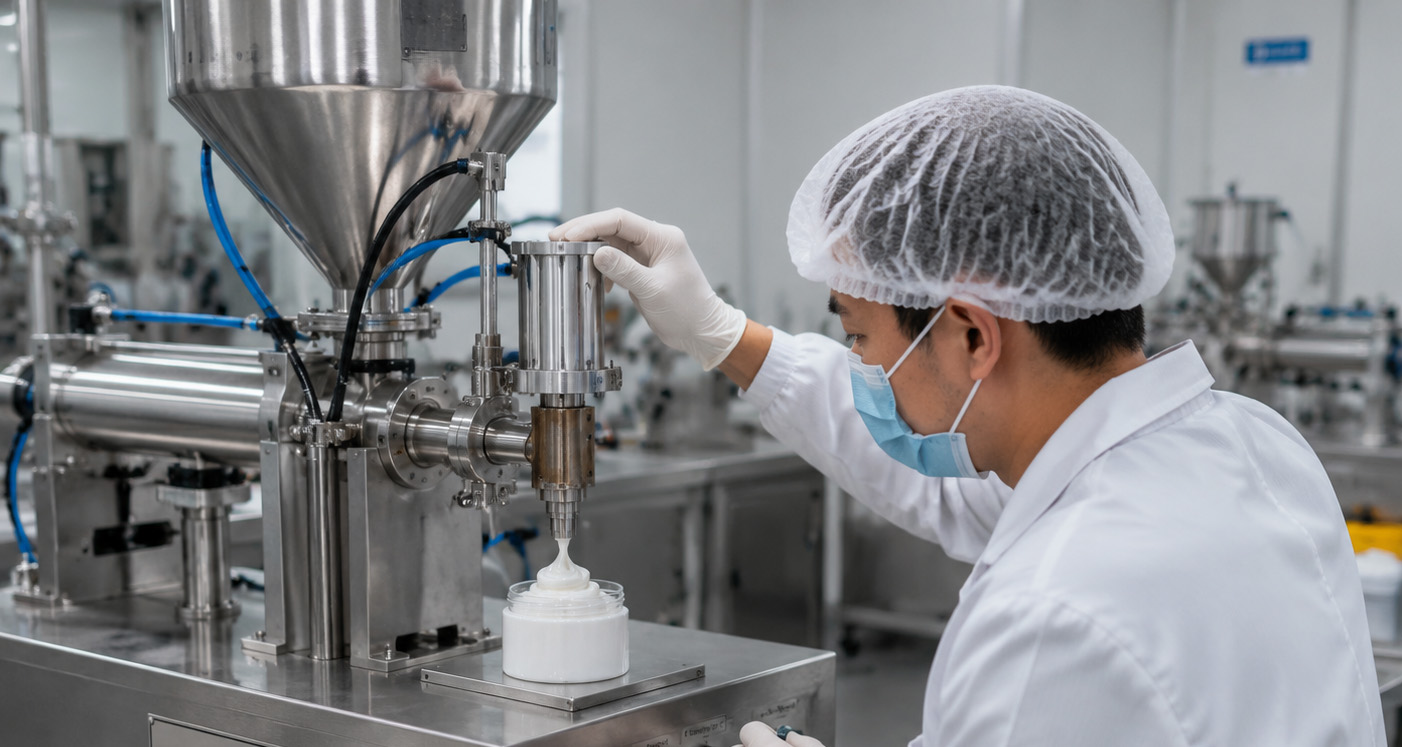
Test with your actual product and containers, and record fill results before accepting the machine.
Simple rule:
If your product flows but isn’t water-thin, and accuracy matters, go with a pump filler. If it’s thick or has particulates, go piston.
Piston filling machines are the go-to for thick, heavy-bodied products. They push product through the nozzle using a cylinder mechanism, so even chunky or sticky materials fill cleanly and consistently.
Rough price ranges:
Cost scales with speed, automation level, and material quality (food-grade stainless steel, cleanroom compatibility, etc.).
For most semi-automatic and automatic fillers:
Machines running aggressive products (acids, thick pastes) need more frequent checks on seals and nozzles.
CIP = Clean-in-Place. It means the machine can be flushed and sanitized without full disassembly. If you’re filling food, beverages, dairy, or pharmaceutical products, CIP is a practical necessity — not a luxury. It saves time, reduces contamination risk, and keeps you compliant with sanitary standards.
Yes — up to a point. A semi-automatic filler works well for small-to-medium output ranges, typically up to 20–40 BPM depending on the model. It gives you better speed and consistency than manual filling without the full capital cost of automation. Once you’re hitting consistent high volumes daily, that’s when a fully automatic inline or rotary system becomes the smarter investment.
Piston fillers are useful candidates for many liquids, creams, and sauces. Pump systems offer alternatives across a wide range of products.
Compare the actual formulation, particle content, dose range, cleaning requirements, and required speed. Trials should establish which arrangement feeds and dispenses the product consistently.
Bottom-up filling and controlled flow can help reduce splashing and turbulence. Also check the transfer system for air entry and unsuitable pumping conditions.
The required nozzle movement and filling speed should be established with the actual product.
Review storage conditions, humidity exposure, hopper sealing, feeding behavior, and cleaning practices.
Agitation, lump management, or assisted feeding may be useful, but the arrangement should be tested. Adding a more powerful agitator alone may not resolve a moisture problem.
Consider upgrading when manual container handling, staffing, or sustained output becomes a recurring constraint.
Compare total daily production, labor needs, batch sizes, changeovers, and downstream capacity. The decision should follow the production plan rather than a fixed industry-wide speed threshold.