
Disinfectant Filling Machine: Explosion-Proof Solution for Alcohol Production

Hello, I am a Senior Engineer and Founder at GDHP. With 23 years of technical expertise in the filling and packaging industry, we provide more than just equipment—we are dedicated to delivering high-stability, high-efficiency, and fully customized turnkey solutions for your business.
Table of Contents
A leading disinfectant manufacturer achieved a significant productivity breakthrough by implementing the GDHP Disinfectant Filling Machine. Filling capacity surged from 60 bottles per minute (BPM) to 100 BPM, a 66% increase in overall efficiency.Addressing the challenge of multiple product specifications, GDHP’s modular tooling design slashed changeover times from 180 minutes to just 20 minutes.The industrial-grade Ex-proof equipment provides an unbreakable safety shield, allowing the enterprise to accelerate delivery without compromising on stringent safety regulations.
What is an Explosion-Proof Filling Machine Production Line?
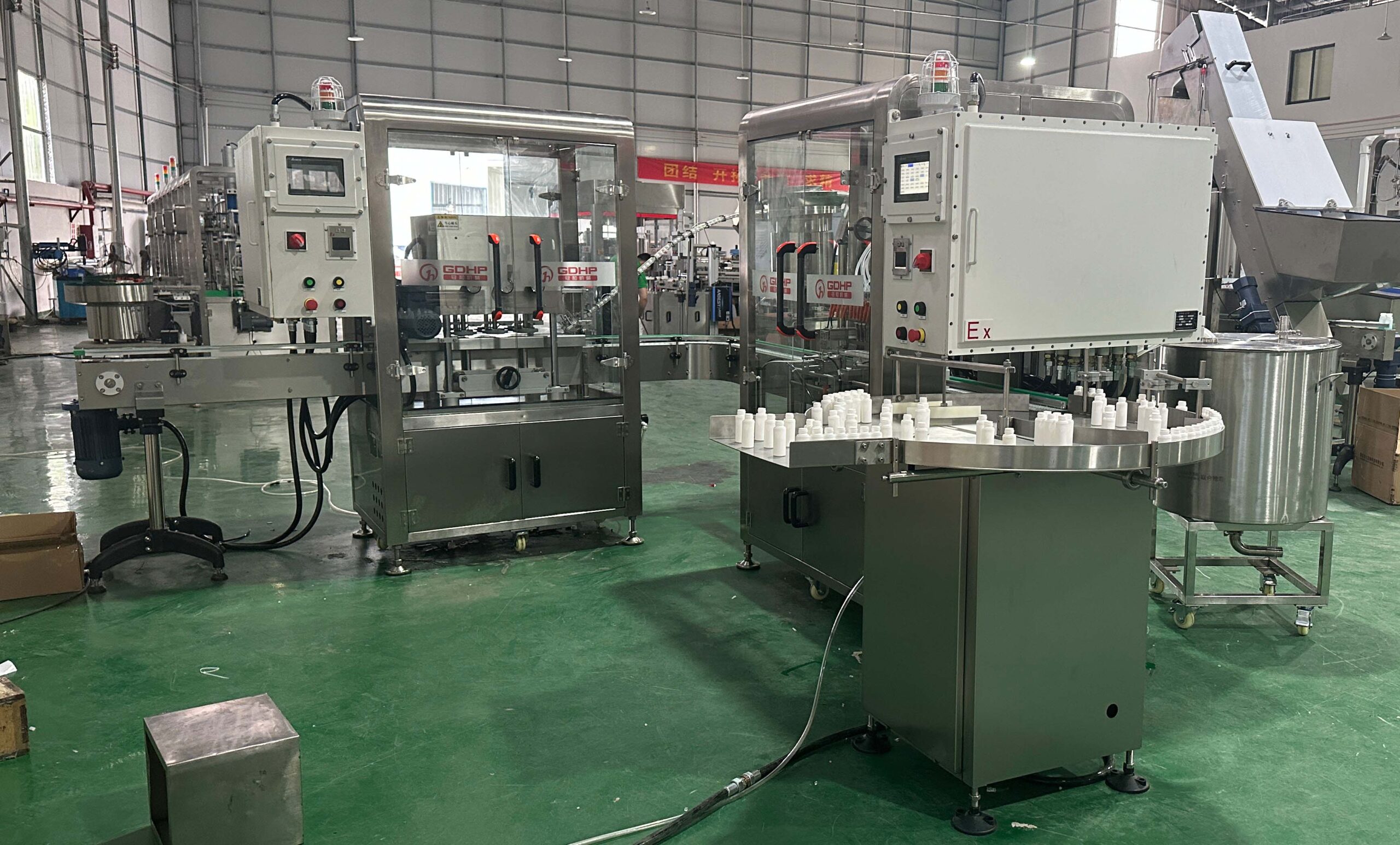
An explosion-proof (Ex) production line is a high-safety filling system specifically engineered for flammable, explosive, and volatile liquids such as ethanol, isopropyl alcohol (IPA), and kerosene. The core objective is to achieve complete electrical isolation from hazardous environments.
The line is fully equipped with industrial-grade explosion-proof electrical cabinets and motors. By utilizing advanced physical isolation technology, electrical components are “decoupled” from ambient flammable gases, effectively eliminating the risk of fires or explosions triggered by electrical sparks. Furthermore, addressing the industry-wide challenge of static electricity generated by high-speed friction during filling, the line incorporates specialized anti-static pneumatic hoses. These ensure real-time charge dissipation, preventing any possibility of static discharge near volatile vapors.
The machine’s chassis is constructed from high-strength stainless steel and reinforced with thickened explosion-proof tempered glass. This not only provides superior corrosion resistance and a professional aesthetic but also serves as a robust physical safety barrier for operators in the event of an emergency—creating a comprehensive safety loop from active prevention to passive protection.
1. Client Background
Based in East China, this large-scale manufacturing facility manages a heavy production load to meet supply chain demands. Their product portfolio is diverse, primarily focusing on small-format disinfectants ranging from 30ml to 100ml (including 60ml and 80ml SKUs). These compact sizes are highly popular in the consumer market due to their portability and convenience for personal protection.
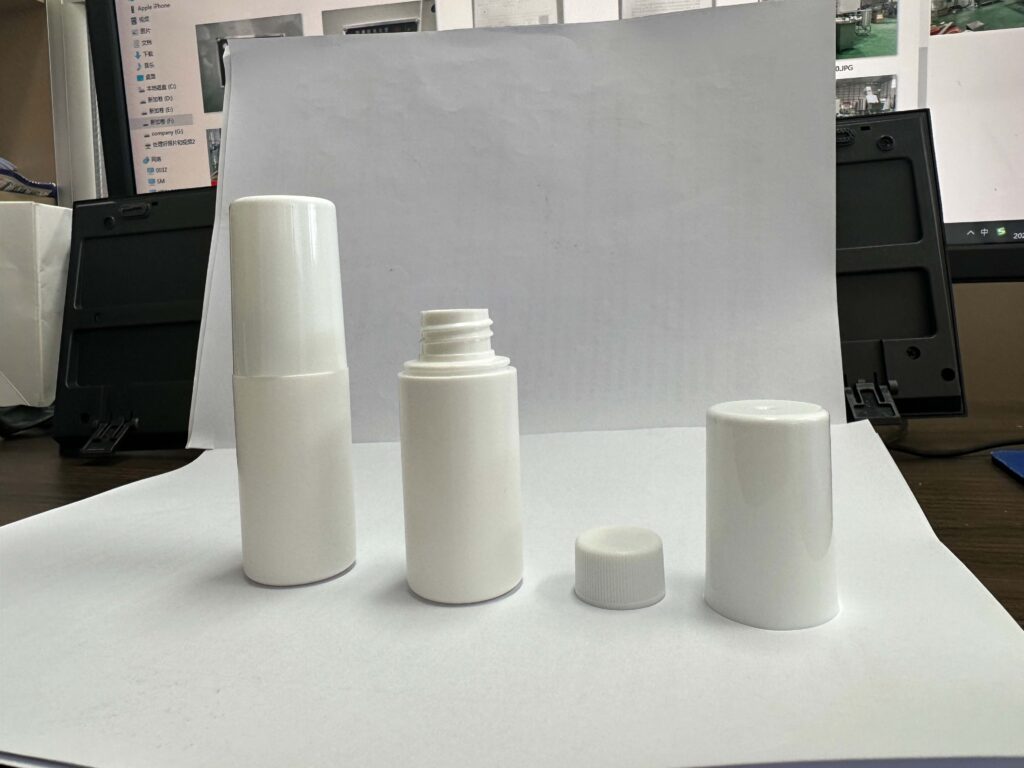
However, from a mechanical engineering perspective, high market demand brings technical hurdles. Small-volume containers require extreme filling precision. Moreover, because these bottles are lightweight, they are prone to tipping or crushing during high-speed conveyance. Most critically, the high concentration of volatile ethanol makes the workshop more than just a factory—it is a precision environment where static electricity, sparks, and vapor concentration must be strictly controlled.
Prior to the upgrade, the client’s existing line operated at 60 BPM. While sufficient for past orders, this traditional, semi-automated setup became a bottleneck as market demand exploded. The 60 BPM output meant that high overhead costs—factory rent, labor, and energy—were being amortized over too few units, leading to diminishing marginal returns.
2. Core Pain Points: The Dual Challenge of Efficiency and Safety
During deep-dive discussions with the facility’s production manager, I identified three pain points. These aren’t just isolated issues; they are interconnected bottlenecks that have been stifling the company’s growth.
The Productivity Gap: Why 100 BPM is the "Must-Have" Threshold
For this enterprise, scaling throughput from 60 BPM to 100 BPM isn’t just a numbers game—it is the “bottom line” for survival.
In today’s manufacturing landscape, economies of scale are the foundation of staying competitive. The existing 60 BPM line was essentially a “gas-guzzler”—it required the same number of operators and consumed nearly the same amount of electricity as a faster line, but with far less output. Breaking the 100 BPM barrier means a 66% increase in efficiency without adding a single square foot of floor space or hiring additional staff. This leap significantly amortizes fixed costs per bottle, providing a much-needed “pricing buffer” in fierce market price wars. Without this upgrade, they risked losing high-volume orders to competitors with higher levels of automation.
The Safety Red Line: Stringent Ex-Proof Requirements for Volatile Materials
This was the most critical concern during my site audit. The “volatile temper” of disinfectant raw materials—primarily Ethanol and Isopropyl Alcohol (IPA)—means the workshop air is constantly laden with invisible flammable vapors.
The client’s legacy line showed signs of “patchwork” safety—many motors were retrofitted with basic enclosures, and sensors lacked rigorous explosion-proof (Ex) certification. While mechanical heat and static buildup were manageable at 60 BPM, jumping to 100 BPM changes the physics. At higher speeds, mechanical friction increases and the risk of electrostatic discharge grows exponentially. Without a system-wide, integrated explosion-proof design, even a microscopic spark could trigger a catastrophic event. This was a risk the company simply couldn’t take, and it was their primary hesitation regarding any speed-up proposal.
Quality Risks: Eliminating "Missing Foil" in High-Speed Cycles
At high speeds, the human eye is no longer a reliable QC tool. The client reported that their current reliance on manual inspection led to occasional induction sealing failures—either loose foils or bottles missing the aluminum liner entirely.
For disinfectants, a perfect foil seal isn’t just about preventing leaks; it’s about preventing the active ingredients from evaporating. If a compromised bottle reaches the end consumer, the product may have lost its potency, leading to more than just financial loss—it’s a potential “brand killer.” At 60 BPM, staff could barely keep up; at 100 BPM, with nearly 1.7 bottles flying past every second, manual monitoring becomes impossible. The client desperately needed an “unbiased” automated inspection system to ensure every single unit leaving the dock is 100% compliant.
The following is a simple comparison between the client’s current production status and their desired objectives:
| Project Aspect | Current Status | Desired Goal | Core Challenge |
|---|---|---|---|
| Output Speed | 60 bottles/minute | 100 bottles/minute | Achieving a 66.7% increase |
| Explosion Safety | Partially explosion-proof, blind spots exist | Full-line explosion-proof certification | Comprehensive upgrade of motors and electrical components Quality Control |
| Quality Control | Manual inspection; risk of missed defects | 100% automated rejection of non-conforming products | Precise detection during high-speed operation |
| Reliance on Manpower | High; requires multiple operators | Highly automated; reduced headcount for increased efficiency | Seamless integration of bottle feeding, filling, and capping |
When I stood in their production workshop, watching that aging machine struggle to keep up, it hit me: this isn’t just a sales contract. It’s a commitment rooted in rigorous engineering logic. We weren’t just delivering a collection of stainless steel components; we were providing the peace of mind that comes with knowing you can sleep soundly even as your production speeds up.
Faced with a series of stubborn pain points, we didn’t just throw high-end specs at the problem. Instead, we went back to the fundamentals of mechanical logic and fluid dynamics to design a tailor-made “Explosion-Proof Automated Closed-Loop Solution.”
As an engineer, I’ve always held one principle: equipment isn’t better just because it’s expensive—it’s better when it truly “understands” the material. For disinfectants containing flammable and explosive ingredients, our core strategy focused on “Ignition Source Isolation” and “Maximum Compatibility.”
3. How to Use the GDHP Explosion-Proof Filling Production Line to Solve Problems
To leap from 60 to 100 bottles per minute (BPM), we did more than just crank up the frequency inverter. We completely re-engineered the “rhythm” of the entire production line.
Stainless Steel Rotary Explosion-Proof Bottle Unscrambler: Ensuring a Safe and Orderly Entry
On the old 60 BPM line, the client relied on 1–2 workers to manually position bottles constantly. This wasn’t just inefficient—it was a safety hazard. Frequent movement within an explosion-proof zone is a risk in itself; static electricity from synthetic clothing or friction from shoe soles can easily become an ignition source.
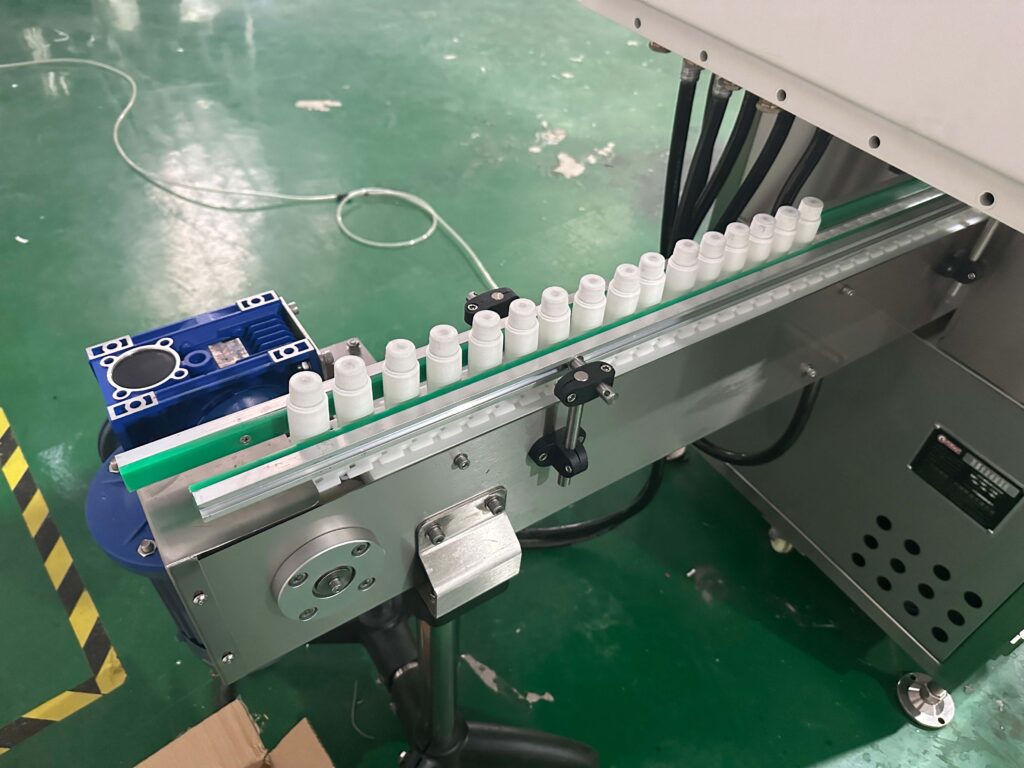
Our Rotary Bottle Unscrambler takes bulk bottles and, after a quick manual orientation, disperses and aligns them into a steady, upright stream onto the conveyor belt.
Superior Physical Explosion-Proofing: This machine is equipped with a custom-engineered explosion-proof motor. Unlike standard enclosed motors, ours features reinforced housing strength and specialized flameproof joints. Even if an internal short circuit occurs, any resulting spark is physically contained within the housing, preventing it from igniting external ethanol vapors.
Minimizing Human Intervention: Operators only need to periodically load bulk bottles into the high-capacity turntable. This allows personnel to stay clear of the core filling zone, significantly reducing the risk of injury in the event of an accident.
12-Head Peristaltic Pump Explosion-Proof Filling Machine: The Optimal Choice for Hazardous Liquids
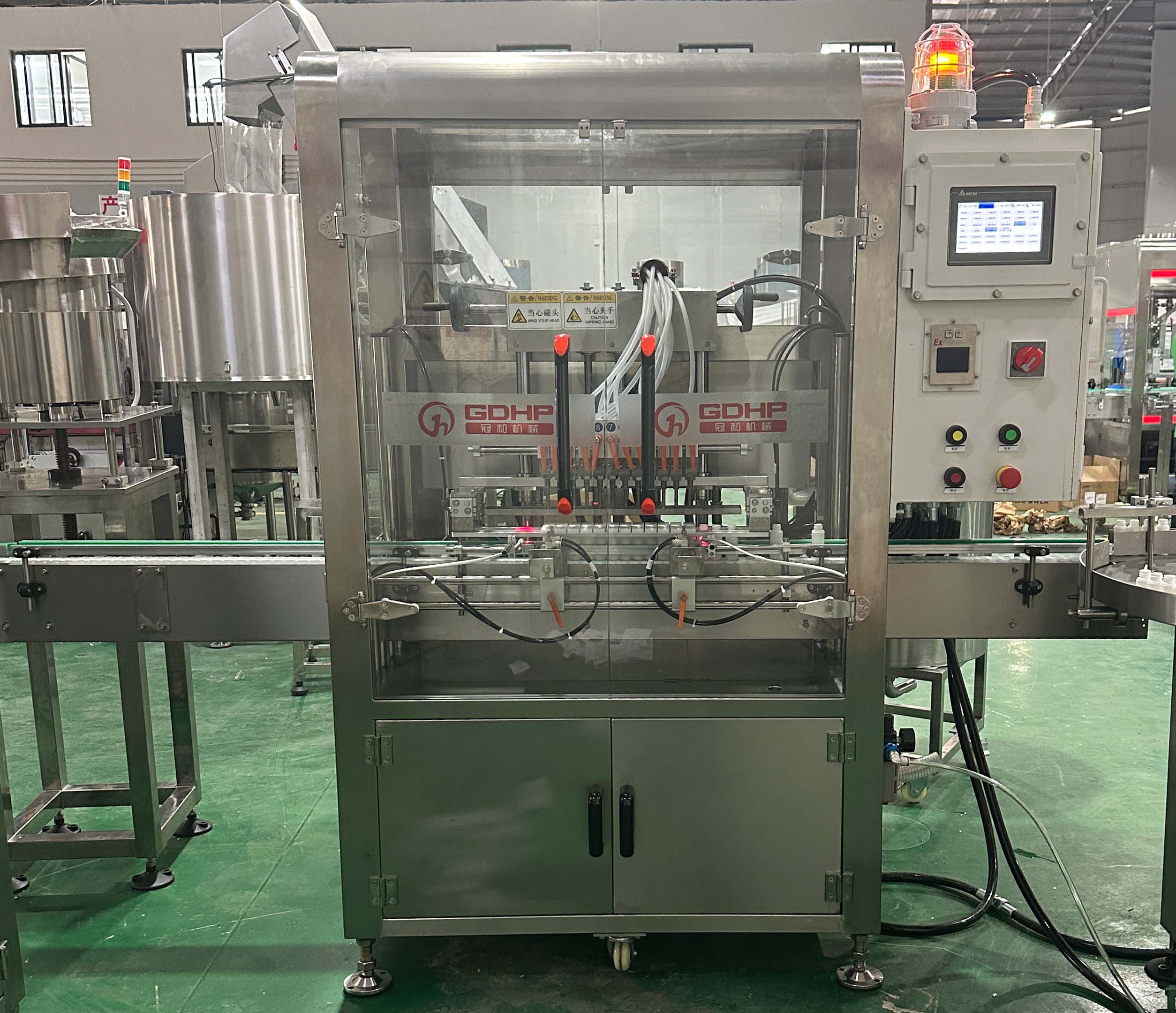
This is the heart of the solution. When handling alcohol-based disinfectants, I insisted on using peristaltic pumps filling machine rather than traditional piston pumps.
The Technical Trade-off: Residue vs. Easy Cleaning
Traditional piston pumps rely on the reciprocating motion of a piston ring against a cylinder wall to measure volume. At high speeds, the mechanical friction generates significant heat—which, for low-flashpoint disinfectants, is like rubbing a match next to a powder keg.
The logic of a peristaltic pump is entirely different: the product only touches the medical-grade silicone tubing. The liquid is “squeezed” forward by rollers without ever contacting moving mechanical parts. This “totally enclosed” path not only eliminates oxidation risks from stagnant material but also completely eradicates the possibility of fire caused by mechanical friction.
Using 12-Head Disinfectant Filling Machine
To consistently hit the 100 BPM (bottles per minute) benchmark, we designed a system where 12 filling heads work in perfect synchronization.
From a mathematical standpoint 100 / 12≈ 8.33(bottles/min), when the total output is 100 BPM, the load on each individual filling head is significantly reduced. This engineered redundancy ensures that every pump head operates at a lower RPM (revolutions per minute), which translates to higher accuracy and less wear and tear. Through our PLC (Programmable Logic Controller) system, we can fine-tune the filling speed of every single channel. For the 30ml to 100ml volume range you mentioned, there’s no need for manual recalibration—simply select the “Recipe” on the touchscreen, and the servo system automatically adjusts the pump rotations instantly.
Full-Machine Explosion-Proof Customization: A Total Safety Loop
Safety isn’t a feature; it’s a foundation.
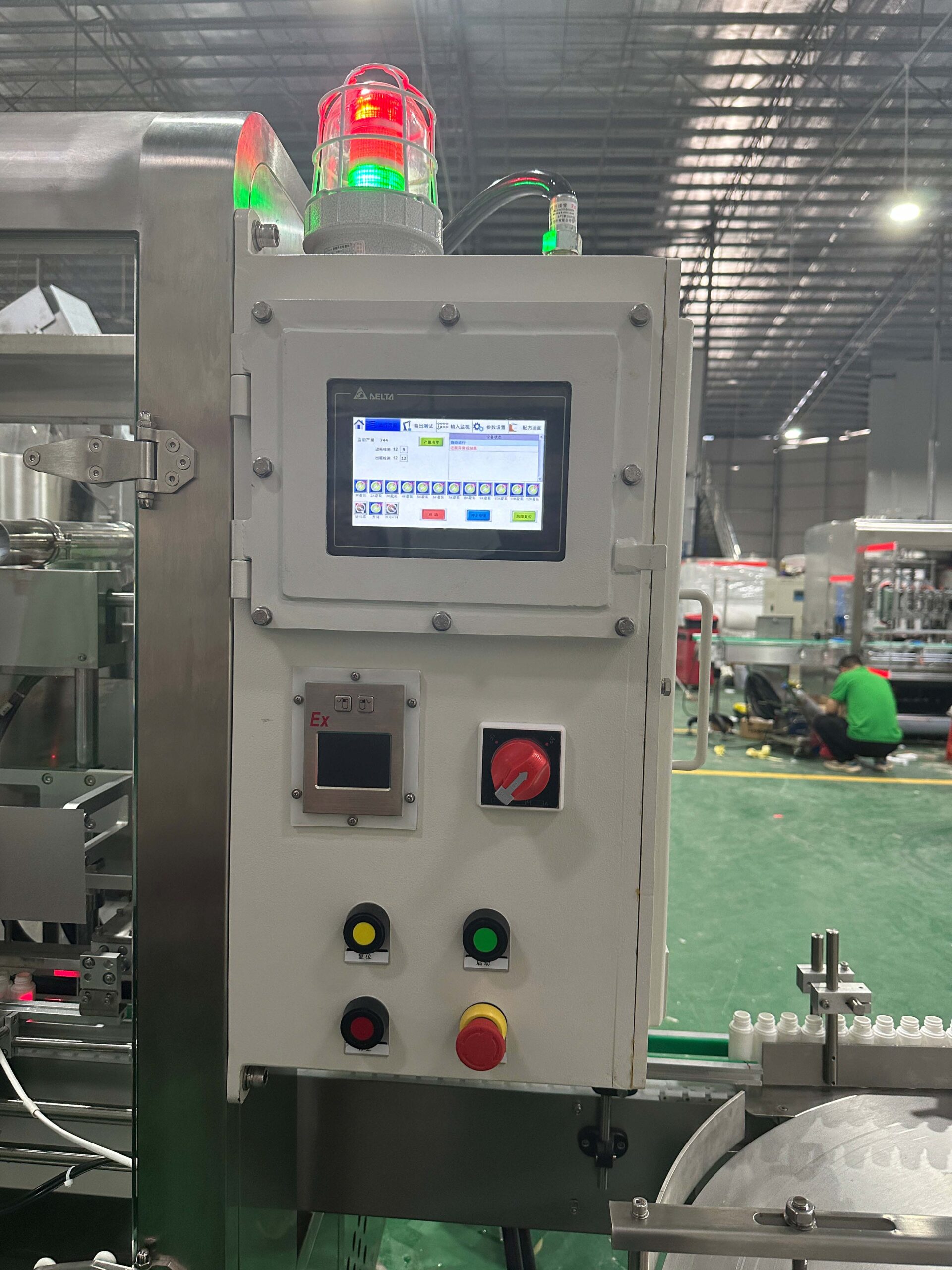
Electrical Isolation: The machine is fully equipped with industrial-grade explosion-proof cabinets and motors. By using physical isolation technology, we ensure that electrical operations are completely “decoupled” from the flammable external environment, eliminating spark hazards at the source.
Static Mitigation: We use high-performance anti-static pneumatic tubing to solve a common industry pain point: static electricity generated by high-speed air friction. This removes any possibility of a static discharge coming into contact with the disinfectant.
Physical Shielding: Finally, the chassis is constructed from high-strength stainless steel paired with thickened tempered glass. This isn’t just for aesthetics or corrosion resistance—it serves as a rugged physical barrier, providing the ultimate line of defense for your operators in the most extreme scenarios.
High-Speed Automatic "Pick-and-Place" Explosion-Proof Capping Machine
Once precision filling is complete, the next challenge is sealing the bottles securely without damaging the caps.
The feature I’m most proud of is this machine’s “Universal Versatility.” To solve the headache of handling multiple bottle sizes (30ml to 100ml), we utilized a design that mimics the dexterity of human hand movements.
Tool-less Changeover Logic: Many traditional cappers require a different mold or “chuck” for every cap size, leading to at least two hours of downtime for adjustment. Our high-speed capper is different; by simply adjusting the capping head height and gripping torque, it becomes compatible with various cap types—no extra parts required.
Controlled “Pick-and-Place” Rhythm: The sorting device pre-positions the cap onto the bottle mouth before it enters the tightening zone. This two-step “pick-and-place” method ensures that even at 100 BPM, you won’t see skewed, loose, or cross-threaded caps.
Integrated "No-Foil" Rejection System
Even if the preceding processes are flawless, as an engineer, I always build in “fault tolerance.” The No-Foil Rejection System acts as the sentinel of your production line. Utilizing electromagnetic induction, it monitors every single bottle as it passes through the induction sealer.
Rigorous Automated Monitoring: The moment the sensor detects a bottle missing its aluminum foil seal, a pneumatic pusher acts instantly, precisely diverting the defective product into a separate rejection bin.
Protecting Your Brand Integrity: While this step doesn’t directly increase output, it protects your company’s lifeline: its reputation. In a high-speed environment, this sensor replaces the “tired human eye,” ensuring Zero-Defect Delivery with a fatigue-free digital watchman.
To help you gain a more intuitive understanding of the integration logic behind this solution, I have compiled the following table:
| Core Component | Key Technical Attributes | Direct Contribution to Pain Points |
|---|---|---|
| Rotary Bottle Feeder | Explosion-proof Motor | Replaces manual bottle placement, physically isolating potential spark hazards. |
| 12-Head Peristaltic Pump | Fully Enclosed Filling with Medical-Grade Silicone Tubing | Generates zero frictional heat; enables one-touch switching between 30ml and 100ml filling volumes. |
| High-Speed Capping Machine | Mimics Human Hand Motion & Requires No Part Changeovers | Boosts packaging efficiency by 66% while maintaining compatibility across multiple bottle sizes |
| Non-Foil Rejection System | Electromagnetic Induction Detection + Pneumatic Rejection | Completely prevents unsealed products from entering the market |
To me, this solution is more than just a collection of machines—it is a multi-station “Symphony of Motion.” Every movement and every transition has been precisely calculated to ensure that even volatile materials like disinfectants remain fully disciplined and “tamed” during high-speed flow.
During the commissioning phase, when the entire line steadily broke the 100 BPM barrier for the first time, I stood in the workshop listening to the subtle, rhythmic pulse of the peristaltic pumps. In that moment, I truly felt the charm of mechanical engineering. This wasn’t just a collection of numbers; it was a profound reshaping of production logic.
4. Maximizing Production Efficiency
jThree months after the solution went live, we conducted a follow-up visit. The workshop supervisor shook my hand and told me that his biggest surprise wasn’t just the speed, but the “Total Control” and peace of mind he now felt.
For another example of custom filling-line engineering for unusual products and containers, see how a gear-pump system handles unstable whisky bottles and multiple cap types.
Data-Driven Results: Capacity Increase and Cost Optimization
By introducing a fully automated explosion-proof line, the client’s production efficiency underwent a qualitative leap. To better illustrate the business value of this upgrade, we have summarized the following data comparison:
| Evaluation Metric | Pre-Upgrade (Old Production Line) | Post-Upgrade (New Explosion-Proof Automated Line) | Benefit Improvement |
|---|---|---|---|
| Average Output | 60 bottles/minute | 100 bottles/minute | 66.7% Increase in Capacity |
| Per-Shift Staffing | 5–6 personnel (including bottle placement and cap sorting) | 1–2 personnel (required only for material replenishment and monitoring) | 70% Reduction in Labor Costs |
| Product Pass Rate | Approx. 98% (affected by human inspection fatigue) | >99.9% (automated monitoring) | Significant Reduction in After-Sales Risks |
| Product Changeover Time | 20–180 minutes | 15–20 minutes | Substantial Enhancement of Production Flexibility |
Long-Term Value: Reducing Human Error and Enhancing Safety Compliance
As an engineer, I place the highest value on “invisible safety assets”—the benefits that go beyond the raw data.
The Leap from “Manual Oversight” to “Engineered Safety”: In the past, safety relied heavily on worker experience and strict adherence to protocols. Now, every stage—from bottle feeding to final sealing—is under the rigorous monitoring of an explosion-proof electronic control system. This level of intrinsic physical safety gives the company total confidence and a solid regulatory foundation when facing strict inspections from fire and safety authorities.
Automated Protection for Brand Reputation: The “No-Foil” Rejection System has become the “star” of the factory floor. Acting as a tireless sentinel, it has intercepted thousands of potential minor defects over the past three months, ensuring that every bottle of disinfectant reaching the consumer is flawless. This relentless pursuit of quality transforms into deep brand trust with every perfect product delivered.
Resilience Against Market Volatility: During peak flu seasons or public health surges, market demand often explodes. The successful implementation of this system provides the client with rapid scalability. Even if they need to increase speeds or add new bottle specifications in the future, the modular design and smart “recipe” memory functions allow for smooth, low-cost upgrades.
As I left the client’s disinfectant filling machine line, watching crate after crate of perfectly sealed, precisely filled disinfectant move off the conveyor belt to be shipped nationwide, I realized the essence of our work: we use the precision of technology to quiet the anxieties of production, and to uphold that “Safety Promise” to public health.
Is this solution right for you?
FAQ
How is this production line defined as "Full-Line Explosion-Proof"?
It is not just a simple protective cover; it is a high-safety system designed to isolate electrical operations from hazardous environments.
Hardware Isolation: The line is equipped with industrial-grade explosion-proof electrical boxes and motors.
Physical Decoupling: We use advanced physical isolation technology to ensure that electrical components are completely “decoupled” from external flammable gases, eliminating fire hazards at the source.
Structural Barrier: The outer shell is made of high-strength stainless steel and thickened explosion-proof tempered glass to provide a physical safety barrier in extreme cases.
How does the explosion-proof filling line handle static electricity during the filling of alcohol-based liquids?
Static electricity is a major risk when handling volatile liquids like ethanol or isopropanol.
Anti-Static Engineering: We use high-performance anti-static air pipes to ensure that charges generated by high-speed gas friction are exported in real-time.
Prevention: This design eliminates any possibility of static discharge coming into contact with volatile vapors.
Why are peristaltic pumps used instead of traditional piston pumps?
For low-flashpoint disinfectants, peristaltic pumps offer superior safety and hygiene.
Zero Friction Heat: Material only contacts medical-grade silicone tubing; there is no mechanical friction between moving parts, which avoids heat generation.
Contamination-Free: The “closed-loop” path prevents material oxidation and simplifies the cleaning process between batches.
How is the 100 BPM speed achieved without compromising accuracy?
We utilize a “12-head collaborative” design to manage the workload.
Redundancy Logic: To maintain a total output of $100 \text{ bpm}$ (bottles per minute), the load on each individual filling head is kept low.
Load Calculation:
100/12 ≈ 8.33 bottles/min per headPrecision Control: This allows each pump to operate at low speeds for high-precision filling, managed by a PLC programmable control system.
Does the explosion-proof filling line support multiple bottle sizes, such as 30ml to 100ml?
Yes, the system is designed for high flexibility to handle the diverse product matrices common in the disinfectant industry.
Recipe Management: Users can switch between 30ml and 100ml specifications by simply calling up a “memory recipe” on the touch screen.
Servo Adjustment: The servo system automatically adjusts the peristaltic pump rotations without the need for manual recalibration.
How much can the changeover downtime be reduced?
Efficiency is gained through modular design and intelligent settings.
Time Savings: Traditional lines often require 120–180 minutes for a full specification changeover.
Optimization: The GDHP system reduces this transition time to just 20 minutes, significantly increasing flexible production capacity.
How do you prevent "missing foil" defects in high-speed production?
At $100 \text{ bpm}$, manual inspection is impossible, so we integrated an automated “sentry”.
Detection: The induction foil detection machine uses electromagnetic induction to monitor every bottle passing through the sealer.
Rejection: If a missing foil is detected, a pneumatic pusher immediately removes the bottle into a reject bin, ensuring zero-defect shipments.
What kind of labor savings can a factory expect?
By moving from semi-automated to fully automated explosion-proof systems, the labor requirement drops sharply.
Crew Reduction: A typical manual or old line requires 5–6 people for bottle arrangement and capping.
Current Metrics: The new line requires only 1–2 people for material feeding and general supervision, optimizing labor costs by 70%.
What is the safety benefit of the automatic bottle feeder?
The stainless steel disc bottle feeder does more than just organize bottles.
Personnel Safety: It allows workers to stay away from the core filling zone, where gas concentrations are highest.
Static Risk Mitigation: By reducing the need for staff to move around the hazardous zone, risks from static electricity on clothing or footwear are minimized.
What is the long-term ROI of this system for a manufacturer?
Beyond the 66.7% increase in output, the value lies in “invisible assets”.
Compliance: The full explosion-proof certification provides solid grounding for safety inspections by fire and health authorities.
Brand Security: Automated rejection of faulty products protects the brand’s reputation from the fallout of leaking or ineffective products.
Scalability: The modular design allows for smooth upgrades or further speed increases as market demand grows.