Opens in a new tab

Antigen Reagent Filling and Foil Sealing: A Double-Ear Tube Case

John senior engineer and founder
mia@gdhpmachine.com

A reagent tube can look straightforward until it has to move through an automatic machine. Its body must remain supported, its opening must reach the filling position, and its rim must meet the sealing tool. Add two projecting ears, and the same container presents a different handling problem.

This GDHP project brought those requirements into one sequence: vibratory tube sorting, adjustable piston filling, automatic film pulling and cutting, foil sealing, and finished-tube discharge. The distinctive engineering story lies in the relationship between tube shape, liquid availability, and film placement. A dose and a seal depend on what happens before their own stations begin.

The Starting Point: A Tube Shape That Influences the Whole Line

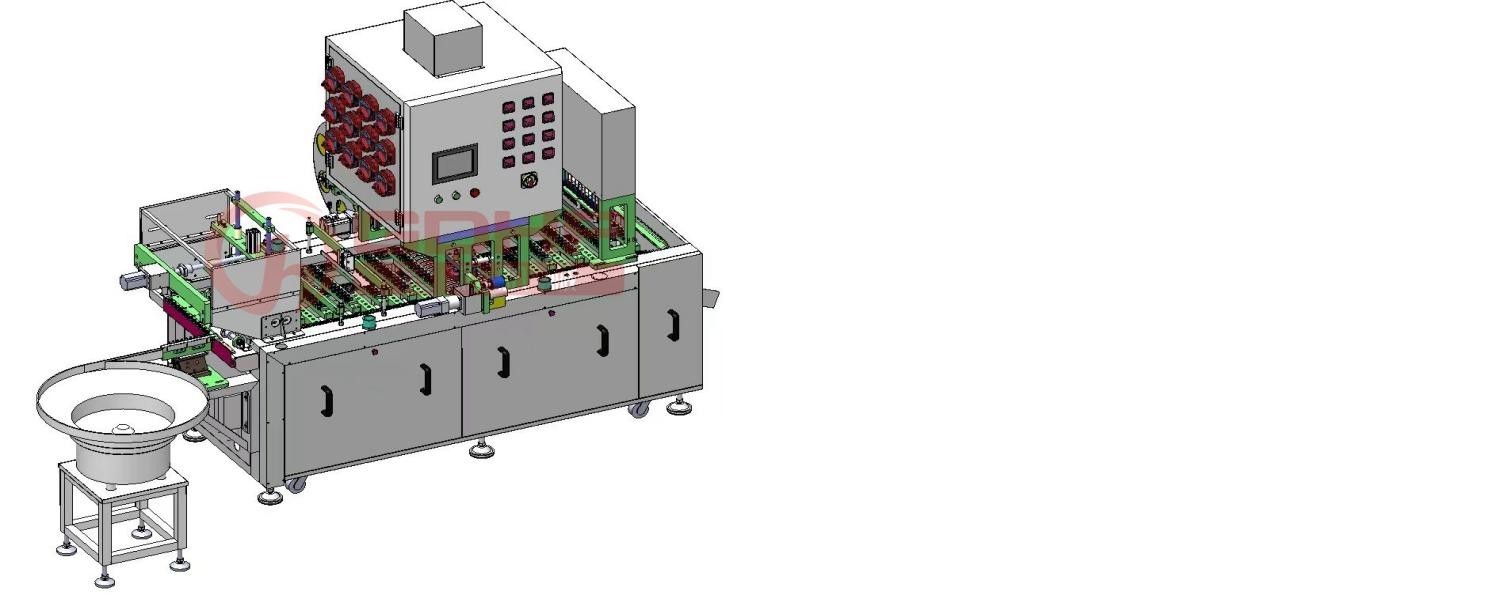
The configuration began with loose tubes loaded into a vibratory bowl. Automatic sorting then presents the tubes to the filling and sealing sequence. For a double-ear container, the outline around the mouth matters as much as the diameter of the body.

The ears can change where a tube contacts a guide and how adjacent tubes sit together. Clearance that is adequate for a plain tube may be unsuitable for an ear-shaped projection. At the same time, simply widening a guide can leave the body with too much freedom to move.

This gives the application a clear design priority: support the tube while preserving clearance around its projecting features. The bowl outlet, transfer guides, sample-specific tooling, and working positions need to be considered together. Stable presentation at the filler also gives the film station a more predictable opening to cover.

Design illustration of a vibratory-fed antigen reagent filling and foil sealing machine
Project design illustration showing the bowl-fed machine arrangement. Tooling and final layout depend on the approved container and film samples.

Why the Supplied Tube Sample Became the Design Reference

The infeed configuration was specified around one supplied tube format. The main machine was described as suitable for a defined family of earless, single-ear, and double-ear containers, while the tooling was to be made around the supplied samples.

That distinction matters when planning production. A platform that accommodates several tube styles still needs the appropriate infeed and tooling for each approved format. Body diameter alone does not describe the ear clearance, mouth position, support height, or sealing surface.

The useful starting package is therefore the actual tube and its intended sealing film. Together they define what must be held, where liquid must enter, and which surface the sealing tool must contact.

Project featureConfiguration in this caseWhy it matters for double-ear tubes
Tube feedingLoose tubes loaded into a vibratory bowl, followed by automatic sortingThe container must reach the working position in a repeatable orientation
Infeed and toolingInfeed based on one supplied format; tooling made around tube and film samplesEar clearance, support, and opening position are specific to the package
Liquid dosingPiston pump with an adjustable filling quantityThe dosing arrangement must suit the reagent and selected quantity
Liquid availabilityPresence detection specified across 12 liquid pathsA commanded filling cycle and an available liquid supply are different conditions
Film preparationAutomatic film pulling and cutting with settable lengthThe prepared film must cover the intended sealing area
Package closureAutomatic sealing followed by finished-tube dischargeTube presentation and film placement meet at the closing station

A Capacity Figure Needs Its Container Format Attached

The project specification separates containers with ears from an earless format. It lists a reference design range of 4,000-5,000 tubes per hour for single- and double-ear tubes and 7,000-8,000 tubes per hour for earless tubes. 

Container conditionReference design rangeWhat can change the usable rate
Single-ear or double-ear tube4,000-5,000 tubes/hourEar clearance, tube stability, liquid refill, film registration, and sealing dwell
Earless tube7,000-8,000 tubes/hourTube presentation, liquid properties, film behavior, and downstream handling

The distinction is useful because it prevents a catalogue figure from being detached from the package. For a double-ear reagent tube, the lower reference range reflects the additional presentation and sealing conditions that need to be reviewed during sample trials.

The Detail Beyond the Pump: Monitoring 12 Liquid Paths

An adjustable piston pump is the dosing component specified for this project. Its role is to meter the reagent, with the working quantity adjusted for the application. The piston, seals, tubing, and outlet still need to suit the liquid and the intended cleaning method.

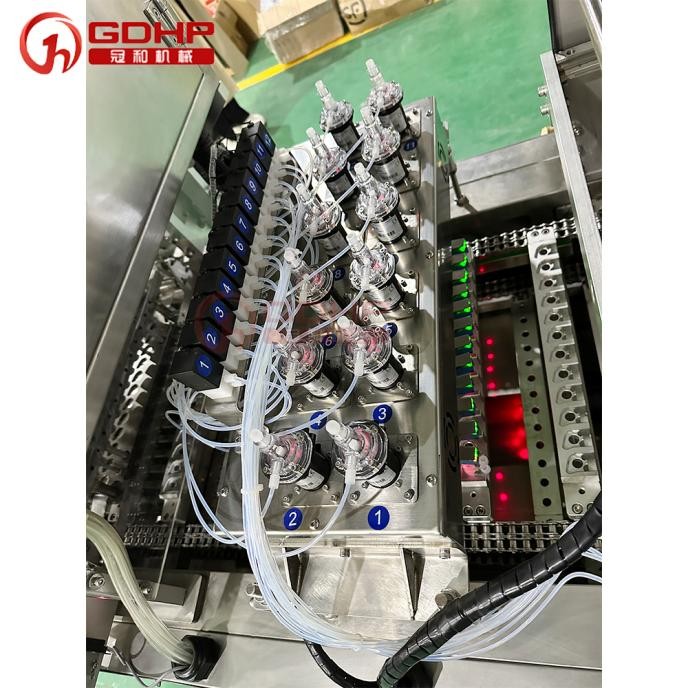
The more distinctive detail is the specified liquid-presence detection across 12 paths. This adds a supply question to the dosing question: is liquid available in the path when a fill is requested?

Consider a tube correctly positioned beneath the nozzle while its supply path contains no liquid. Tube detection alone cannot establish that a dose is available. Conversely, liquid in the path does not establish that a tube is ready to receive it. The configuration addresses these different conditions through liquid-presence monitoring and a specified no-tube-no-fill function.

Presence detection has a defined role. It does not measure the quantity delivered into each tube, and it does not assess the finished seal. Filling quantity and package integrity remain separate characteristics. Keeping those functions distinct makes the control arrangement easier to understand.

Equipment reference showing the reagent dosing assemblies and connected liquid paths
Equipment reference from the project material showing dosing assemblies and connected tubing. This view illustrates the liquid-path arrangement; it is not a fill-accuracy test record.

For related equipment options, see the antigen reagent monoblock filling system. Container and reagent samples determine the configuration for a particular application.

From a Liquid Dose to a Film Positioned Over the Opening

After filling, the sequence moves to automatic film preparation and sealing. The film mechanism pulls and cuts the material, with the cutting length available as a setting. The film support arrangement also includes axial adjustment.

Those details connect directly to the tube. Film length determines how much material is prepared, while lateral alignment determines where that material meets the mouth. The tooling must bring them together over the intended sealing surface.

For this application, the projecting ears add another reason to review the package as a whole. Their position relative to the rim can influence tooling access and the space available around the opening. A film choice should therefore be assessed with the actual tube, including its rim and projections.

Tube support, film position, heat, pressure, and contact time contribute to the sealing process. A centered piece of film makes coverage visible; suitable material compatibility and sealing conditions establish the bond. Appearance alone cannot establish leak integrity.

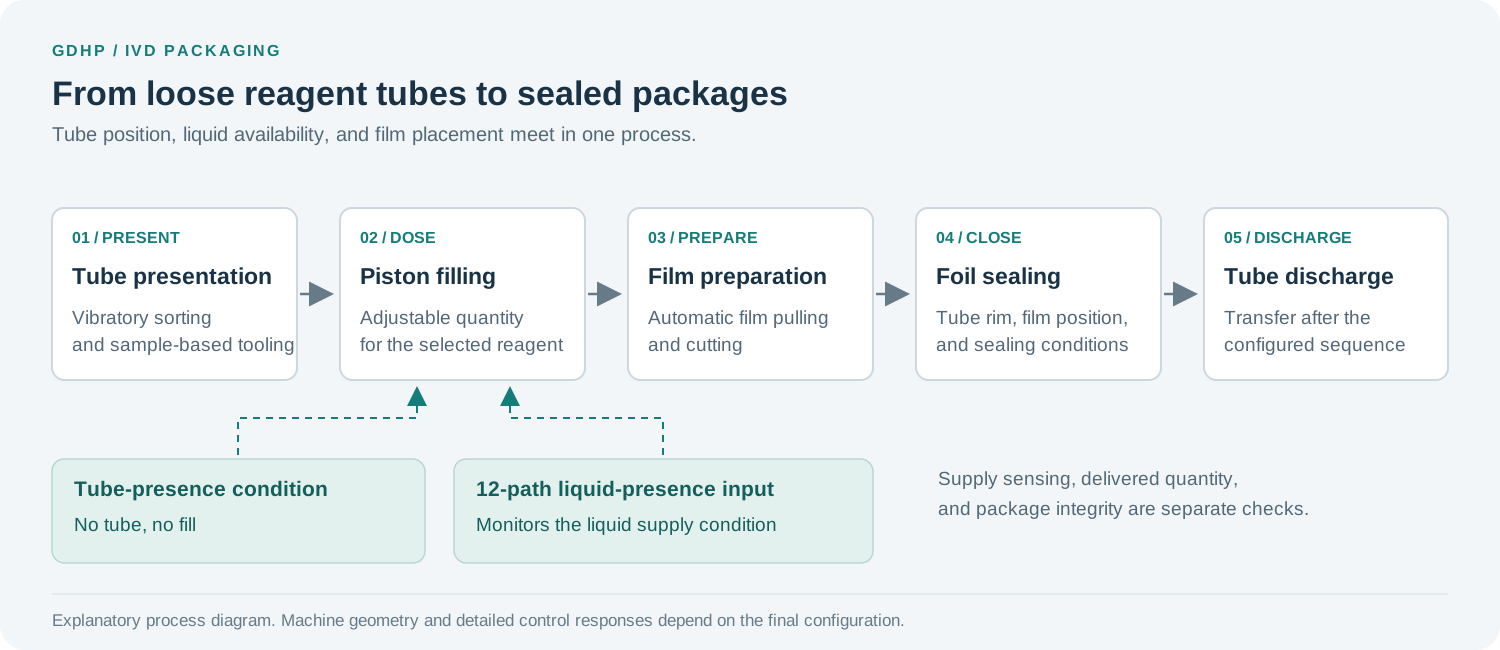
Process diagram linking tube presentation, piston filling, film cutting, foil sealing and discharge, with a separate liquid-presence input
Explanatory process diagram based on the configured sequence. The liquid-presence input describes supply monitoring, not automatic measurement of filled volume.

The related foil and film sealing systems overview explains other closure arrangements. The sample tube and film determine which sealing approach belongs in a specific line.

What This Project Brings Together

The operator loads loose tubes into the bowl, and the configured machine links sorting, dosing, film preparation, sealing, and discharge. That linked sequence is the central feature of the project.

Its engineering value is clearest at the interfaces. The infeed establishes the tube position expected by the filler. The liquid-path checks address supply availability alongside tube presence. Film preparation then provides the cover that the sealing tool must place over the opening.

For a buyer considering a similar antigen reagent filling and foil sealing machine, these connections deserve attention alongside the pump specification. A discussion of the complete package reveals requirements that a filling-volume figure cannot capture: ear clearance, tube support, film registration, seal compatibility, and the distinction between sensing supply and measuring a finished dose.

Questions About Similar Reagent Tube Projects

Can one machine handle earless, single-ear, and double-ear tubes?

The platform in this project was described around a defined family of these shapes, with the infeed specified for one supplied format. Additional formats need their own review of feeding, tooling, and sealing requirements.

Why include liquid-presence detection if the machine already detects tubes?

Tube presence indicates that a container is available. Liquid-presence detection addresses whether the monitored supply path contains liquid. Neither signal independently establishes the quantity delivered into the tube.

What should be supplied for an engineering review?

Provide tube samples or drawings showing the body, rim, and ears; reagent properties and required dose; film samples and roll information; cleaning requirements; and the intended downstream packaging steps. These inputs allow the machine to be considered as a connected process.

Plan Your Tube Filling and Sealing Configuration

Start with the package you need to produce: the tube, the reagent, and the sealing film. Use those samples to define the infeed, dosing arrangement, supply monitoring, film preparation, and closure method. For double-ear reagent tubes, that shared package reference gives every station the same design starting point.

Have questions? Reach out to us, and we will provide you with a perfect solution.

Build Your Custom Solution

Your information is secure - we respect your privacy and will only use these details to contact you.

Build Your Custom Solution