How to Fix Powder Filling Machine Clogs: A Practical Guide
Learn how to diagnose and prevent powder filling machine clogs caused by moisture, bridging, static, dust and auger settings—with safe,…
September 5, 2026


Hello, I am a senior engineer and founder at GDHP. With 23 years of technical expertise in the filling and packaging industry, we provide more than just equipment—we are dedicated to delivering high-stability, high-efficiency, and fully customized turnkey solutions for your business.
If you are planning to upgrade your production line or set up a new packaging facility, deciding between a Vertical Form-Fill-Seal Machine (VFFS) and a Horizontal Form-Fill-Seal Machine (HFFS) machine is the critical technical decision you will make. From my engineering experience on the factory floor, making the wrong choice here does not just cause minor inconveniences; it leads to extensive material waste, severe product damage, and expensive daily downtime(Mold Change, Machine Maintenance, and Machine Cleaning). I have witnessed production managers try to force a product into the wrong machine type to save initial equipment costs(about $1300), only to lose those financial savings within the first month of continuous operation due to inefficiencies.
As a packaging engineer, I know that factory environments are difficult. The physical characteristics of your product (such as liquids, powders, pastes, granules, and solids), the layout of your plant (Venue Size), and your long-term packaging goals must all align with the mechanical capabilities of the equipment. Let us examine the exact engineering mechanics behind these two systems so you understand exactly what you are investing in.
| Your Production Situation | Recommended Machine Choice |
|---|---|
| Powders, granules, or free-flowing liquids | VFFS/HFFS |
| Fragile, easily broken, or irregular products | HFFS |
| Priority on high-speed output and low initial cost | VFFS |
| Priority on precise filling or medical-grade products | HFFS |
To understand why certain products fail on specific machines, we must look at the mechanical structure and the physical process of forming, filling, and sealing the packaging material. Both machines use flat rolls of flexible packaging film (such as PET/AL/PE), but they manipulate that film in entirely different spatial orientations and apply different forces to your product.
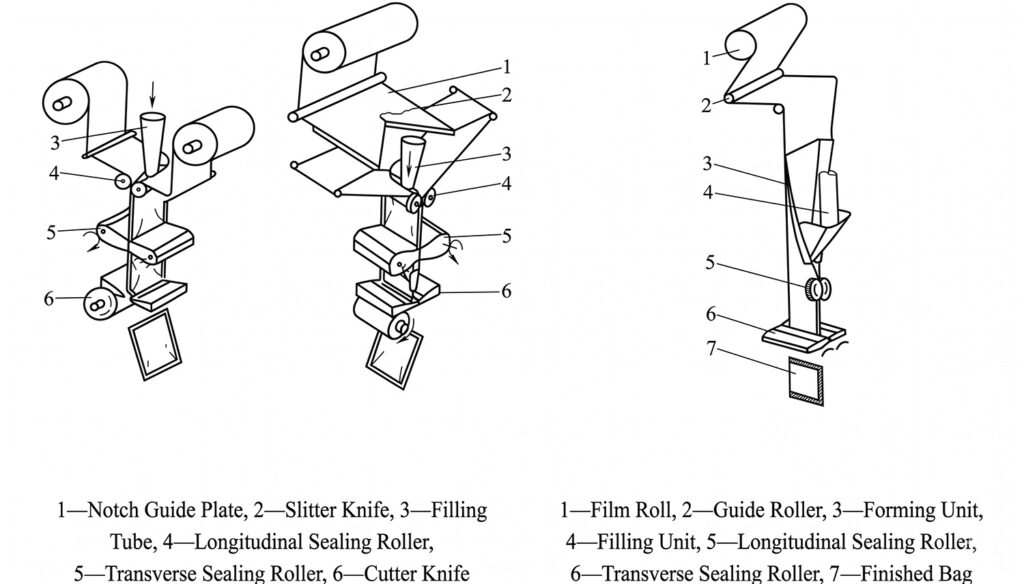
First, the Vertical Form-Fill-Seal (VFFS) machine utilizes flexible roll stock to create soft pouches. Packaging material of a specific width is conveyed via a series of rollers to a “forming collar,” where it is folded into a bag shape. The speed at which the packaging material travels through the machine is precisely controlled (Controlled via PLC module). Next, the product is dispensed into the bag through a filling tube. Finally, a cutting mechanism seals and separates the bags; depending on the specific packaging material used, this mechanism may operate via mechanical cutting or heated elements. At this point, the finished package is complete.
Applicable Scope and Advantages: Absolute reliance on gravity makes VFFS machines exceptionally efficient. They represent the optimal choice for packaging fast-flowing, highly fluid products (with an absolute viscosity of less than 6,000 cP). Whether packaging ground coffee, granulated sugar, or even liquid sauces, gravity instantly conveys the product into the bag. The vertical physical configuration requires a smaller footprint (GHDP’s VFFS machines, for instance, occupy a minimum floor area of just 700 mm x 300 mm). Making them ideally suited for facilities with limited space.
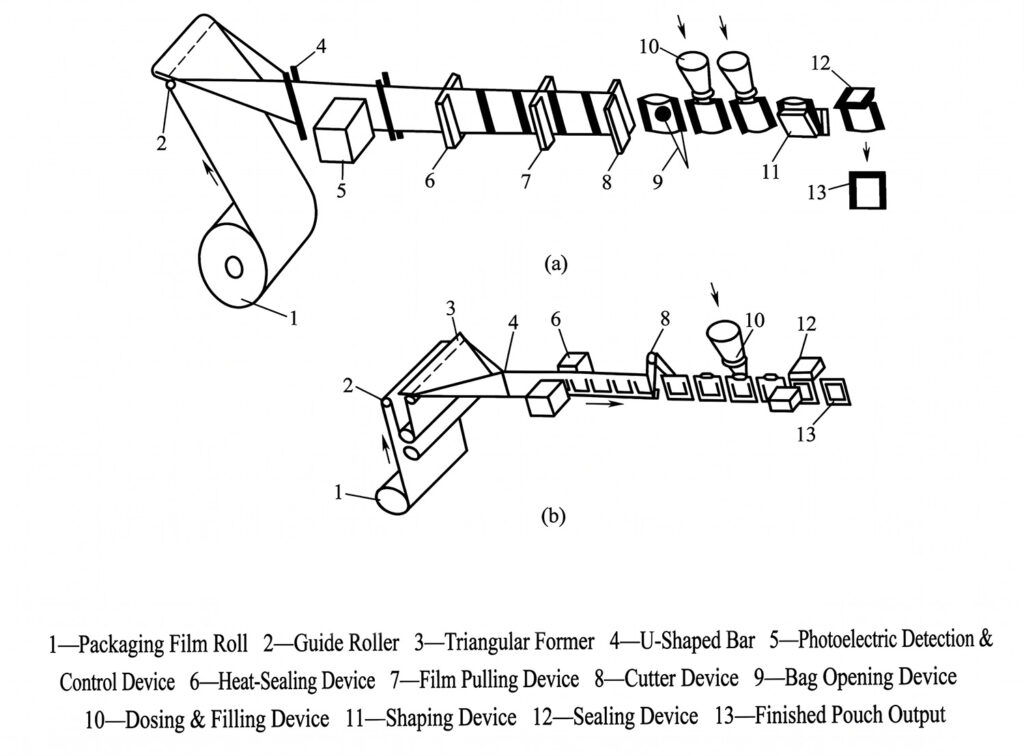
This Horizontal Form-Fill-Seal machine utilizes a forming device to fold the packaging material into a U-shaped strip. An optical system (Utilizes laser recognition or image recognition). is responsible for identifying positioning marks on the packaging film; subsequently, a heat-sealing unit processes the U-shaped film strip, completing the formation of the pouch by sealing its lateral edges. The formed pouch is then conveyed to the filling station, where a pouch-gripping mechanism holds the pouch open to facilitate product filling. Finally,The sealing unit seals the top opening of the bag body using heat sealing. This constitutes the complete operating principle of a Horizontal Form-Fill-Seal (HFFS) machine.
Applicable Scope and Advantages: HFFS machines provide unparalleled protection for delicate, structured, or easily damaged items. If you are packaging fragile electronics, pharmaceutical, or complex cosmetics items, the horizontal mechanism guarantees the product remains completely intact during the entire packaging cycle. Furthermore, HFFS equipment supports highly complex packaging formats. HFFS can easily handle multi-pack items (e.g., products connected in series), uniquely shaped pouches with die-cuts(Conical Bags, Forked Bags), and products that require a highly precise physical orientation inside the package.
If your current production line is struggling with product breakage, or if you are looking to introduce a new, delicate item that requires premium presentation, reaching out to consult with a packaging machine manufacturer about an system is often the most reliable engineering solution to ensure product integrity.
From mechanical standpoint, VFFS machines are structurally designed for high-velocity output. Because they utilize continuous gravity to drop the product directly into the forming tube, GDHP’s standard VFFS equipment easily achieves production rates of 40 to 120 bags per minute. In contrast, HFFS machines operate at a much more deliberate pace. They typically output between 30 to 85 bags per minute because the mechanical process of horizontally advancing the film, opening the pouch, inserting the product, and applying the seals requires multiple, discrete robotic steps.
Businesses need to consider both the current required output and future output of their products. For example, if the machine’s maximum capacity is 60 bags/minute, ensure that the final output does not exceed this specification. It is imperative to ensure that it can maintain a stable output even when operating at its theoretical maximum speed.
Consumer market preferences are constantly shifting; consequently, your packaging production line must possess sufficient mechanical flexibility to adapt to these changes. Vertical Form-Fill-Seal (VFFS) equipment inherently faces certain limitations regarding the packaging formats it can produce. It excels at the high-volume production of standard sealed bag (typically sealed on two or three sides). If your products are commodities (such as barley, coffee and granulated sugar). And a standard, utilitarian packaging format suffices to meet your needs, then VFFS equipment represents a highly practical and cost-effective choice.
However, if your business strategy focuses on creating premium retail shelf appeal—for products such as medical wipes or premium cosmetics—then Horizontal Form-Fill-Seal (HFFS) equipment is your optimal choice. HFFS machinery is better suited to seamlessly handle pillow pouches and stand-up pouches; it can integrate robust, durable zipper-style reclosable features, incorporate plastic spouts for liquid products, and even utilize die-cutting technology to mold packaging film into customized, distinct shapes that perfectly align with your brand image.
Material giveaway—putting slightly more product into a bag than the legal label states to avoid underfilling—is a silent profit killer on any production line. VFFS systems are generally accurate(GDHP often utilizing servo-driven piston filling or multihead weigher). However, Based on our calculations, when processing viscous liquids (such as honey at low temperatures), a “stringing” phenomenon may occur at the filling nozzle, resulting in slight weight fluctuations of ±2% between individual packages.
HFFS systems offer a distinct mechanical advantage regarding precision filling. Because the pouch moves horizontally and remains securely held open at specific stationary filling stations, engineers can integrate highly precise auger fillers, positive displacement pumps, or multi-head weighers with secondary precision top-up mechanisms. For industries dealing with high-value goods like pharmaceuticals (e.g., bagged cold remedies or synthetic herbal medicines), specialized chemical catalysts, or premium cosmetics, the rigorous filling control provided by HFFS guarantees that you are not losing thousands of dollars a month in product giveaway.
Facility layout is a physical engineering constraint that buyers frequently ignore until the equipment is already sitting on the loading dock. I have personally supervised installations where an expensive packaging machine had to sit idle for weeks because the factory floor lacked the necessary physical dimensions, requiring structural modifications to the building itself.
You must evaluate your spatial limitations realistically before signing a purchase order:
Machine TypePrimary Space RequirementSecondary Facility Considerations VFFS (Vertical)Requires high ceiling clearance.Demands heavy-duty overhead steel platforms to support multi-head weighers and operators. HFFS (Horizontal)Requires extensive linear floor space.Demands wide lateral aisles along the entire machine length for film roll replacement and maintenance access.
| Feature | VFFS | HFFS |
|---|---|---|
| Speed | 40–120 bags/min | 30–85 bags/min |
| Bag Types | excels at the high-volume 2-side seal, 3-side seal, 4-side seal | better suited to Pillow bag, Stand-up pouch, Gusseted bag |
| Filling Accuracy | Precise (Minimal loss for viscous products) | Precise |
| Space Requirements | Requires vertical space | Requires horizontal space |
If you are currently evaluating your factory layout and feel uncertain about which structural footprint your facility can accommodate safely, I encourage you to consult with equipment engineers early in the process. We frequently assist plant managers by mapping out 3D spatial models to ensure your new packaging machine integrates seamlessly into your existing workflow without causing logistical roadblocks.
Regarding Vertical and Horizontal Form-Fill-Seal (FFS) machines, there are several misconceptions that can easily confuse buyers. Therefore, today we will explore the truth behind some of these common misunderstandings.
The decision between a Vertical Form-Fill-Seal and a Horizontal Form-Fill-Seal packaging machine ultimately comes down to matching mechanical physics with your business objectives. Choose VFFS for maximum speed, cost efficiency, and straightforward packaging of free-flowing goods. Choose HFFS for unparalleled product protection, high-precision filling, and complex, premium packaging formats. The most expensive packaging machine is not the one with the highest price tag; it is the machine that fails to integrate smoothly with your daily production reality. At GDHP, we offer more than just VFFS or HFFS packaging systems; we offer a commitment to efficiency. Our equipment is widely used in the food, pharmaceutical, and consumer goods industries, designed for high efficiency, ultra-stable performance, and highly flexible packaging options. Over 23+ years of manufacturing experience and global export expertise. Allow us to better understand the standards and pain points of different markets. We refuse to use templates; instead, we tailor a complete turnkey packaging solution to your specific product, bag type, and industry standards. With no middlemen adding layers of markups, we insist on direct factory pricing, ensuring every penny you spend is well spent.
For the full product-fit, premade-pouch, material, cost, and ROI decision framework, use our FFS packaging machine buying guide.
Choosing a packaging machine is essentially choosing a partner who can go the distance with you. Understanding these facts helps you make wiser decisions. At GDHP, we are ready to provide you with the most professional and supportive service.
Not sure which machine fits your needs?
Contact us today to get a customized solution and quotation.
VFFS: These are structurally designed for high-velocity output, typically achieving rates of 40 to 120 bags per minute due to the continuous gravity drop.
HFFS: These operate at a more deliberate pace, typically outputting between 30 to 85 bags per minute because the process involves multiple discrete robotic steps like opening and gripping the pouch.
VFFS: These require a smaller floor footprint (some as small as 700 mm x 300 mm) but demand high ceiling clearance and heavy-duty overhead platforms for weighers.
HFFS: These require extensive linear floor space and wide lateral aisles for maintenance access and film roll replacement.
Yes. A common misconception is that HFFS machines are exclusively for solid items like wet wipes. In reality, HFFS machines are equally suitable for liquids, powders, and granules.
HFFS is the superior choice for delicate items like electronics or complex bakery goods because products are placed gently into the pouch rather than dropped.
Ignoring physical engineering constraints is a frequent error. Failure to perform precise laser measurements of the factory floor can result in equipment that cannot be installed or operated properly upon arrival.
GDHP offers over 23 years of manufacturing experience and provides tailored, turnkey packaging solutions rather than generic templates.
We provide direct factory pricing without middleman markups, ensuring every penny of your investment is well spent.
Fragile or Irregular Items: HFFS is the recommended choice as its horizontal mechanism provides unparalleled protection for delicate, structured, or easily damaged items like electronics or pharmaceuticals.
Free-Flowing Goods: VFFS is optimal for fast-flowing liquids, powders, and granules (with viscosity less than 12,000 cP) because gravity conveys the product instantly.