



Irregular IVD Reagent Production Solution Case Study: IVD Integrated Filling and Capping

Hello, I am a Senior Engineer at GDHP. With 23 years of technical expertise in the filling and packaging industry, we provide more than just equipment—we are dedicated to delivering high-stability, high-efficiency, and fully customized turnkey solutions for your business.
Table of Contents
1. Special Requirements for Filling Odd-Shaped Bottles in the IVD Sector
Our client is a well-established player in the biomedical and laboratory medicine industry, specializing in biochemical reagents for hospital diagnostic equipment. To ensure their reagents are perfectly compatible with existing clinical analyzers, they utilize highly specialized packaging—specifically odd-shaped (irregular) bottles. While this design meets the specific sampling needs of medical devices, it presents significant hurdles for automated production lines.
In terms of production metrics, the client set stringent standards. Their product line primarily covers a filling range of 10ml to 60ml. In biochemical testing, the precision of the reagent ratio directly impacts the accuracy of diagnostic results. Therefore, they mandated that the filling tolerance for 15ml reagents must be within ±0.4ml, while the 60ml reagents must not exceed a ±0.7ml deviation.
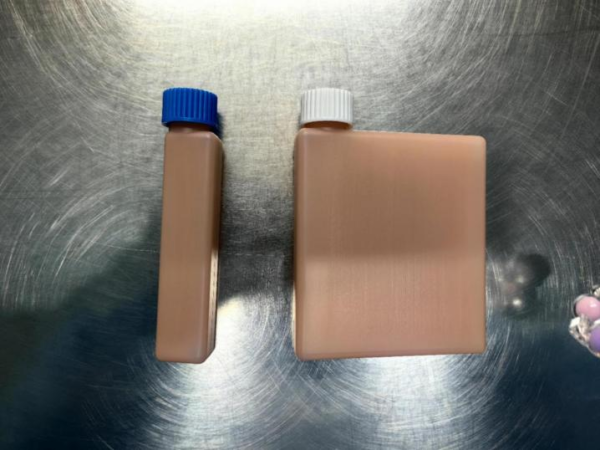
Beyond precision, throughput is a critical consideration. Driven by high hospital demand, the client required a capacity of over 3,000 bottles per hour (BPH) for 15ml specifications, and 1,800–2,400 BPH for the 60ml size. Furthermore, due to limited floor space in their facility, the client sought a compact IVD filling and capping system. This machine needed to integrate filling, cap sorting, cap placement, and tightening into a single unit to minimize the equipment’s footprint. Their envisioned workflow starts with manual bottle loading, followed by peristaltic pump precision filling, automated capping, and finally, a quality inspection where a robotic arm discharges the finished products.
| Key Technical Specifications | 15ml Specification Requirements | 60ml Specification Requirements |
|---|---|---|
| Permissible Filling Error | ≤ 0.4 ml | ≤ 0.7 ml |
| Production Capacity (Bottles/Hour) | > 3000 | 1800–2400 |
| Bottle Type | Irregular-shaped Bottles | Irregular-shaped Bottles |
2. Key Pain Points in IVD Integrated Filling and Capping
Throughout our consultations, the anxiety of the production managers was palpable. While the biochemical reagent industry is often seen as high-margin, the reality is that product waste and soaring labor costs can quickly erode profits. Before implementing our IVD Integrated Filling and Capping, the client faced three core challenges:
Instability of Odd-Shaped Bottles on Standard Conveyors
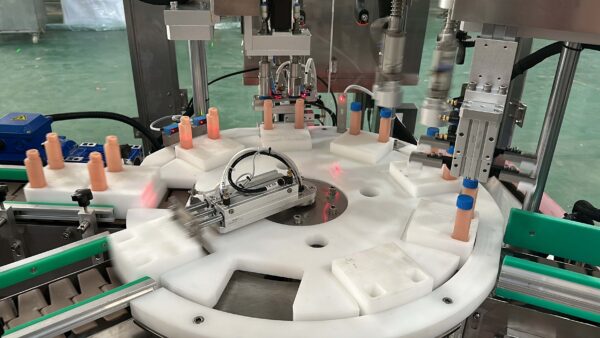
This was the client’s biggest headache. To fit specific diagnostic equipment, these bottles often have an off-center center of gravity or irregular bases. On standard flat-top conveyors, they are prone to tipping, wobbling, or causing jams. A single tipped bottle doesn’t just waste expensive reagents; it contaminates the entire line, causes costly downtime, and can even damage the filling nozzles. The client’s previous experience with “generic” machines failed because the lack of specialized stabilization meant the bottles weren’t centered correctly, preventing the filling needles from entering the neck accurately and leading to high reject rates.
The Conflict Between Strict Precision and High-Speed Control
With a 15ml fill volume, a 0.4ml tolerance means a precision requirement of roughly ±2.6%. Maintaining this accuracy while running at 3,000 bottles per hour is extremely difficult. Traditional pneumatic or piston pumps often struggle with biochemical reagents, posing cleaning challenges and issues like air bubbles or dripping (tail-off), which lead to precision drift. The client noted that their old equipment suffered from significant fluctuations during startup and shutdown, failing to meet the rigorous concentration standards required for clinical diagnostics. This wasn’t just a technical glitch; it was a threat to their quality reputation.
Fragmented Processes and Floor Space Constraints
The client’s original setup relied on multiple standalone units. This “patchwork” approach not only consumed massive amounts of GMP cleanroom floor space (which carries incredibly high overhead) but also created bottlenecks between stages. They desperately needed a highly integrated solution—a system that could consolidate every process into a compact footprint with centralized PLC-driven control.
As an engineer, I fully recognize the “Triple Crown” challenge: the demand for high precision, high throughput, and a small footprint. In the medical field, even a minor automation flaw can escalate into a major production incident. Solving these pain points isn’t just about speed; it’s about helping clients establish a traceable, highly reliable standard for automated production.
3. Solution: IVD Bottle Integrated Filling and Capping Tailored for Industry Pain Points
After a deep dive into the client’s dual challenges of bottle stability and filling precision, it became clear that a traditional inline filling line simply wouldn’t cut it for such a demanding task. To achieve the required throughput of over 3,000 BPH (bottles per hour) while maintaining an ultra-low error rate, we decided to break away from the conventional approach.
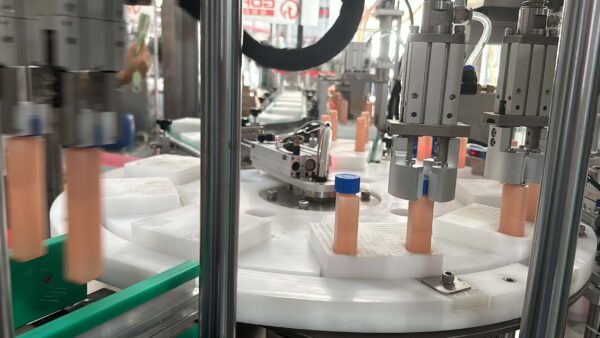
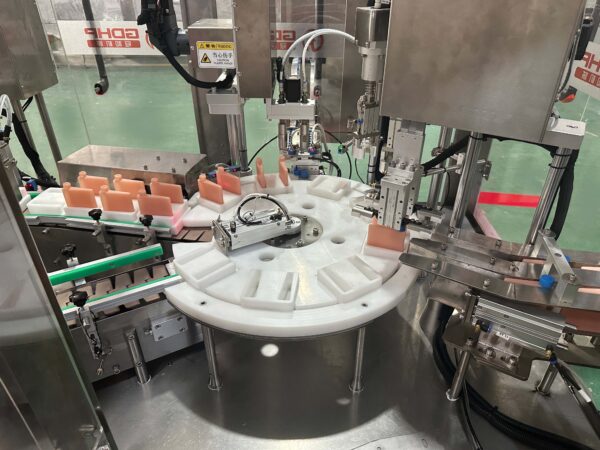
We implemented a highly integrated puck circulation system. The core design philosophy here is “Standardizing the Variable”—using standardized pucks to carry and stabilize ever-changing, odd-shaped bottles.
Solving Bottle Compatibility with Custom Pucks & Recirculating Conveyors
The competitive edge of this solution lies in its unique mechanical movement. We moved away from standard flat-top conveyors, which often cause tipping, and instead utilized a puck-based recirculating system.
Restructured Physical Stability: In practice, operators simply insert the irregular bottles into custom-engineered pucks. These pucks act as a rock-solid base, securely holding bottles with uneven centers of gravity. This “puck-centric” mindset is the most reliable path for handling complex packaging, as it effectively transforms external irregularity into internal standardization.
Guaranteed Precision Displacement: The pucks, now holding the bottles, are fed into an intermittent rotary indexer. Here, they move through dedicated stations for filling, cap placement, and torque sealing. This design completely eliminates the common “jitter” or tipping associated with high-speed movement, ensuring perfect alignment at every single station.
Optimized Changeover Costs: To meet the client’s need for multi-product production, the puck-based format makes changeovers incredibly fast and easy. Operators only need to swap out the pucks rather than re-adjusting the entire machine’s architecture.
Integration of High-Precision Peristaltic Pumps & PLC Motion Control
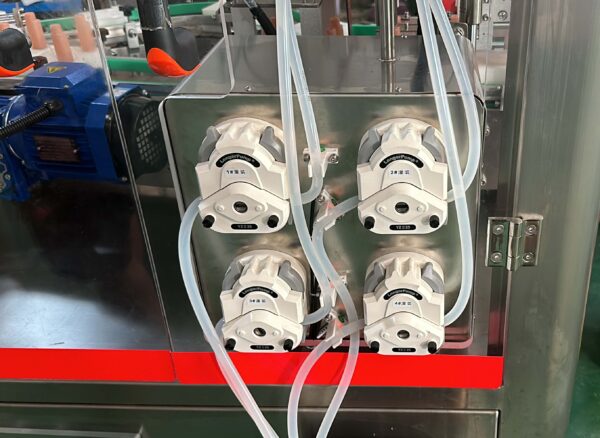
To tackle the most sensitive issue—filling accuracy—we integrated a high-precision peristaltic pump system. For small-dose (10–60ml), high-value biochemical reagents, peristaltic pumps offer unparalleled advantages:
| Technical Features | Solution Advantages | Practical Value for the Customer |
|---|---|---|
| Material Contact Surfaces | Medical-grade silicone tubing and PP/PTFE filling heads | Eliminates metal contamination and meets the high-purity requirements for biochemical reagents |
| Filling Adjustment Logic | PLC program-based control with one-touch adjustment via touchscreen | Offers a wide filling adjustment range, high precision, and extremely simple operation |
| Anti-Foaming Strategy | Optimized needle lifting logic utilizing a "fast-then-slow" control sequence | Effectively eliminates bubbles and prevents secondary errors caused by reagent dripping |
To meet the high standards of a ±0.4ml tolerance for 15ml and ±0.7ml for 60ml, we implemented sophisticated compensation control for the peristaltic pumps’ rotational speed and displacement via the PLC program. This meticulous attention to detail is exactly how our Filling and Capping Monoblock maintains surgical precision even at high production speeds.
Servo-Driven Capping & Intelligent Error Detection
The capping process is another technological highlight. To meet the client’s strict requirements for torque consistency, we utilized servo-driven capping technology, replacing traditional mechanical friction methods.
Digital Torque Control: Servo motors allow for precise control over the tightening force of every single cap. Torque values are adjustable in real-time via the HMI (Touchscreen), ensuring 100% consistency in cap tightness across the entire batch.
Smart Sensing & Error Correction: The system monitors resistance during the capping cycle through current feedback. If the system detects a missing or crooked cap, the automatic reject/stop mechanism is instantly triggered.
Closed-Loop Production Security: This automated error-correction capability significantly reduces the risk of defective products reaching the next stage. In my view, the true value of this odd-shaped bottle monoblock lies in its ability to “sense” errors and mitigate loss just like a human operator would—but with much higher reliability.
Compact Integrated Design & Premium Material Selection
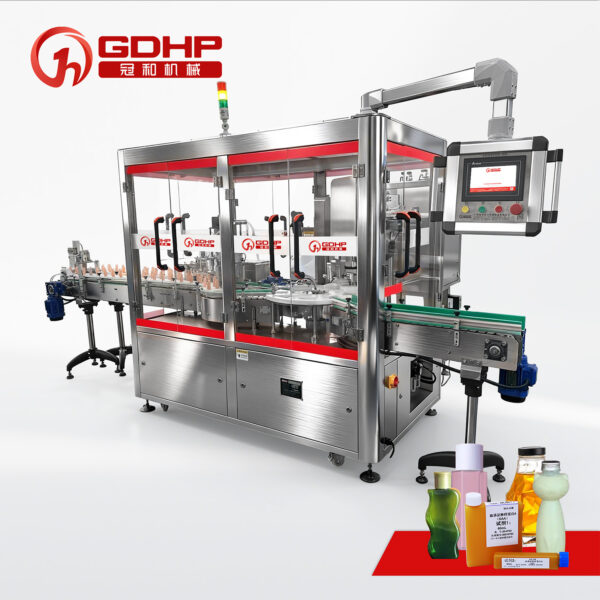
To integrate such complex functionality within a limited floor space, this system features a space-saving, compact monoblock design. From automated cap sorting and placement to the final robotic discharge, the entire workflow is housed on a single, streamlined chassis.
Regarding materials, we prioritize both durability and industrial standards. All stainless steel components are crafted from high-grade SS304, offering an aesthetic finish and superior corrosion resistance capable of withstanding long-term exposure to biochemical laboratory environments. This design not only minimizes the equipment footprint to the extreme but also slashes material transfer times between stages.
Finally, finished products are accurately retrieved by a robotic arm, while the empty pucks automatically return to the manual loading station via the recirculating conveyor, forming a high-efficiency, closed-loop production chain. The success of this project proves once again that deep custom-engineered solutions are the optimal answer to the unique production hurdles found in the biomedical sector.
4. Final Results and Key Outcomes for the Client
Three months after this Biochemical Integrated Filling and Capping was commissioned in the client’s cleanroom, we conducted an in-depth follow-up. As designers, there is no substitute for the satisfaction of seeing theoretical logic transform into the rhythmic, high-speed pulse of an active production line. The most immediate impact was reflected in the hard data: throughput for 15ml reagents stabilized at 3,200 BPH, while the 60ml size reached a peak of 2,200 BPH, both significantly exceeding the client’s initial expectations.
This boost in efficiency was no accident. By adopting the puck-based circulation mode, this system has completely eliminated the frequent downtime previously caused by bottle tipping. According to the client’s production supervisor, they previously required at least two dedicated employees per shift just to stabilize bottles and clean up spilled reagents. Now, the entire line requires only one operator for bottle loading and another for occasional cap replenishment, drastically reducing labor intensity.
More importantly, filling precision has seen a quantum leap in stability. Quality control reports show that the 15ml filling variance is consistently held between 0.2ml and 0.3ml—well below the client’s “red-line” limit of 0.4ml. This has resulted in a 15% reduction in reagent waste. For high-value diagnostic reagents, this efficiency translates directly into a healthier bottom line.
In terms of space utilization, the integrated design has proven to be a game-changer. What previously required two separate machines connected by meters of conveyor belt is now condensed into a compact footprint of less than 4 square meters. By reclaiming this valuable cleanroom space, the client was able to install an additional R&D packaging line for new products, effectively doubling their total production value per square foot.
| Project Specifications | 15ml Format Performance | 60ml Format Performance |
|---|---|---|
| Designed Production Capacity | 3000+ bottles/hour | 1800–2400 bottles/hour |
| Actual Operating Capacity | Stable at 3200 bottles/hour | Reached 2200 bottles/hour |
| Filling Precision Control | Error: 0.2–0.3 ml (Superior to 0.4 ml standard) | Error: 0.5–0.6 ml (Superior to 0.7 ml standard) |
Furthermore, the user-centric design has earned high praise from the operators. By utilizing medical-grade silicone tubing and PP/PTFE (Teflon) for all product contact parts (wetted parts), the daily end-of-shift cleaning cycle has been slashed from two hours to just 40 minutes. This easy-to-clean, tool-less disassembly design not only ensures full GMP compliance but also ensures that equipment maintenance is no longer a bottleneck for the production team. Watching the robotic arm precisely pick and place the finished products while the pucks recirculate seamlessly to the starting position, it’s clear that a truly superior automation solution—like this Biochemical Reagent Monoblock—must balance a high-tech core with ultimate operational simplicity.
The transition to automation in the life sciences industry is a marathon of precision. Through the successful implementation of this integrated system, we have once again proven the power of combining custom-engineered pucks with high-precision servo control.
If you are currently facing challenges with odd-shaped bottle positioning, inconsistent filling accuracy, or limited cleanroom floor space, our engineering team is ready to design a bespoke solution tailored to your specific needs.
Contact us today for a technical consultation or to schedule a trial run with your sample bottles. Let’s build a high-efficiency, fully compliant IVD integrated filling and capping production line together.
Is this solution right for you?
FAQ
How many different bottle specifications can this integrated IVD integrated filling and capping machine accommodate?
How is the long-term stability of the peristaltic pump filling system's accuracy guaranteed?
By utilizing PLC displacement control and high-precision stepper drives—combined with medical-grade silicone tubing—we can consistently maintain the filling error for 15ml volumes within a tolerance of ±0.4ml over the long term.
How does the IVD integrated filling and capping machine handle issues such as crooked caps or missing caps during the capping process?
The equipment features an integrated detection mechanism that triggers an emergency stop in the event of a missing or crooked cap. If the servo system detects any abnormal torque, it immediately triggers an alarm and halts operations to allow for corrective action.
Do the materials used in this integrated filling and capping machine comply with pharmaceutical industry standards?
Yes. The entire machine casing is constructed from 304 stainless steel, while all parts that come into contact with the product are made from medical-grade silicone, PP (polypropylene), or PTFE (Teflon), ensuring full compliance with hygiene and sanitation requirements.
What is the actual production speed for 60ml bottles?
During actual operation, the stable production output for 60ml bottles ranges between 1,800 and 2,400 bottles per hour.
Does the IVD integrated filling and capping require highly skilled operators?
No. The machine features a user-friendly HMI touchscreen interface where all operating parameters can be set digitally; a standard operator can quickly master its operation after undergoing brief training.
Does the integrated design make maintenance more difficult?
Not at all. Despite its compact design, we have modularized all critical components, making the disassembly and replacement of parts—as well as routine cleaning and maintenance—extremely convenient.
Is it possible to add an automatic bottle-loading function to further reduce manual labor requirements?
Although the specific configuration shown here utilizes manual bottle loading, the system includes reserved interfaces that allow for a future upgrade to an automatic bottle-loading module, should your subsequent operational needs require it.