
Perfume sólido vs. líquido: como escolher o perfeito?
Perfume sólido vs. líquido: qual é melhor? Descubra as principais diferenças em longevidade, portabilidade e intensidade para encontrar o seu perfeito…
maio 22, 2026

A salad dressing line may need to pack thin vinaigrettes, creamy emulsions, or recipes with visible herbs and spices. Each product places different demands on its container, closure, and filling equipment.
If those choices are made separately, a package that looks right on the shelf may still be difficult to fill, seal, ship, or dispense. Leaks, oxidation, messy bottle necks, and slow changeovers are risks to evaluate, not outcomes that any one container or machine can automatically prevent.
This guide keeps the focus on the original decisions: container types (jar, pouch, etc.), material trade-offs, packaging machinery, and line selection. Use the comparisons to create a shortlist, then confirm it with the actual recipe, package, and production conditions.
Salad dressing packaging is the coordinated combination of a container, closure, barrier materials, and filling and sealing process used to protect, transport, and dispense a condiment. Thin vinaigrettes, creamy emulsions, and dressings containing seeds or herbs differ significantly in flow behavior, shear sensitivity, particle handling requirements, and emulsion stability, so the same package or machine configuration will not suit every recipe.
At a practical level, the pack has to limit unwanted exposure to oxygen, light, moisture, and outside contamination (Bacterial infection, chemical contamination); let consumers pour, squeeze, spoon, or portion the product; and run reliably through filling, closing, labeling, and shipping.
Product protection: Oil, vinegar, citrus, colorants, and flavor ingredients (black pepper, garlic, basil, etc) respond differently to oxygen, light, and packaging contact. Match the full package to the recipe and intended storage conditions instead of treating “acidic” or “oil-based” as a complete material specification.
Viscosity and particulate handling: A free-flowing dressing and a thick formula with seeds or herbs need different dispensing openings and filling paths. The container opening (Narrow-Neck, Squeeze, Wide-Mouth, etc) matters to the consumer, while the smallest passage in the filler matters to the production line.
Hygienic containment and dispensing: A compatible closure and clean sealing surface help protect the opening and reduce leakage. A dispensing orifice, flip-top valve, screw cap, or pouch fitment should be checked with the actual dressing so it pours or squeezes cleanly without clogging or excessive drips.
The equipment configuration should follow the chemical and mechanical needs of the recipe and its preferred salad dressing bottle, jar, sachet, or pouch. The selected container affects more than appearance: it also determines how products are presented, held, indexed, filled, capped, and labeled on the line.
As a professional manufacturer of filling machines, we build automated lines around the practical demands of different package styles. Salad dressings vary drastically in viscosity and oil content, meaning the right salad dressing container must balance brand display, product stability, and clean dispensing.
Squeeze bottles are a common option for creamy dressings such as ranch, Caesar, and thousand island. Top-down or inverted bottles can keep product near a valve or nozzle for dispensing, while standard ergonomic bottles can make a thicker product easier to grip and control. For production, confirm that the bottle can be presented consistently to the filler and capper and that the nozzle leaves the neck clean enough for closure.

Narrow-neck glass and PET bottles are common options for pourable vinaigrettes, Italian dressings, and oil-and-vinegar blends. Glass provides a strong gas and moisture barrier through the container body and is generally chemically stable, but it is heavier and can break in handling or transit. PET offers visibility with less weight (easy to carry) and lower breakage risk. For either format, consider the cap, liner, light exposure, and intended storage conditions as part of the finished package.
On the filling line, the neck and bottle opening affect nozzle clearance, cutoff, and indexing. A positive-displacement filler may suit some thicker or variable products; other products may be handled by a different dosing method. A diving nozzle can help control splashing or foaming in a particular setup.

Wide-mouth jars make spooning easier and can be considered for thick dressings with larger inclusions, such as blue cheese dressing, vegetables, or herbs. The wider opening helps at the consumer end, but particles still have to pass through the hopper, pump, valves, and nozzle without being crushed or blocked. Equipped with heavy-duty piston dosing units that transfer particulate-rich fluids without crushing solid inclusions.

Spouted stand-up pouches offer a flexible alternative to rigid bottles for pourable dressings, refills, or selected food-service formats. Uses significantly less plastic than rigid bottles, ships flat before filling, and empties completely to reduce food waste. A pouch can reduce material use or shipping volume in some designs, integrated screw spouts provide secure resealing and easy pouring.
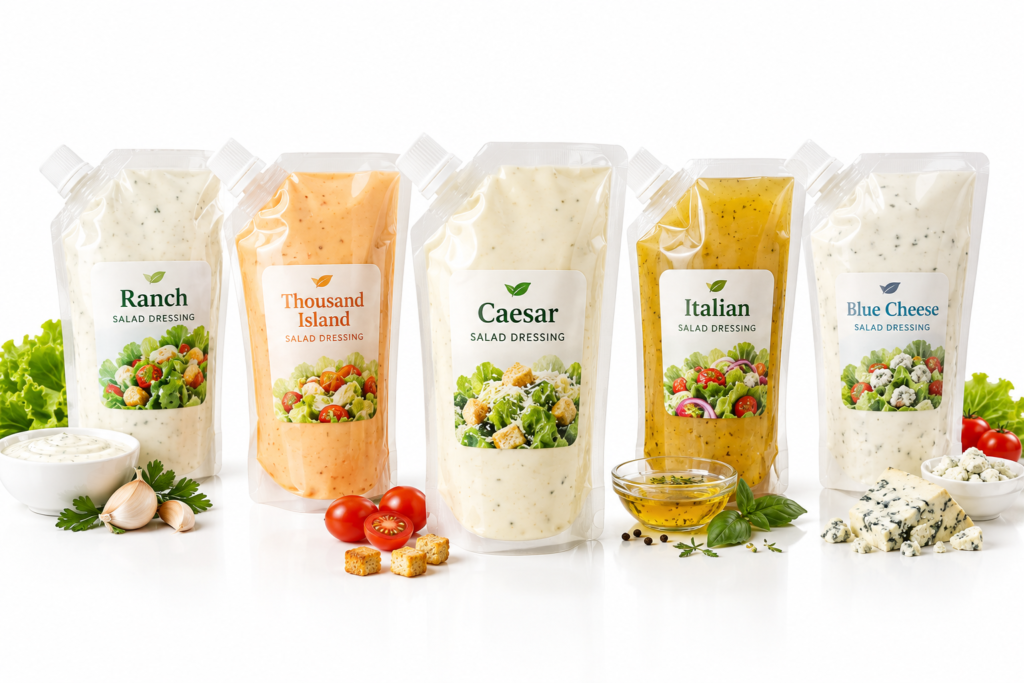
Sachets and stick packs provide portion control for quick-service restaurants, takeaway orders, and meal kits. (Indeed, trends show pacotes de temperos para salada de uso único e amostras de pacote are rising in demand.) Multi-layer film may be selected to limit light and oxygen exposure. Sealed 3-side or 4-side flat foil or film packets containing 15 ml to 50 ml of dressing. The dressing must dose cleanly, and the film seal area must remain free of product. A vertical form-fill-seal (VFFS) line may suit rollstock sachets, while the number of lanes and achievable output depend on the actual product (Mayonnaise, Caesar Dressing, etc), film, and sealing window.

cURL Too many subrequests by single Worker invocation. To configure this limit, refer to https://developers.cloudflare.com/workers/wrangler/configuration/#limits.
| Formato do recipiente | cURL Too many subrequests by single Worker invocation. To configure this limit, refer to https://developers.cloudflare.com/workers/wrangler/configuration/#limits | cURL Too many subrequests by single Worker invocation. To configure this limit, refer to https://developers.cloudflare.com/workers/wrangler/configuration/#limits | cURL Too many subrequests by single Worker invocation. To configure this limit, refer to https://developers.cloudflare.com/workers/wrangler/configuration/#limits | cURL Too many subrequests by single Worker invocation. To configure this limit, refer to https://developers.cloudflare.com/workers/wrangler/configuration/#limits |
|---|---|---|---|---|
| cURL Too many subrequests by single Worker invocation. To configure this limit, refer to https://developers.cloudflare.com/workers/wrangler/configuration/#limits | cURL Too many subrequests by single Worker invocation. To configure this limit, refer to https://developers.cloudflare.com/workers/wrangler/configuration/#limits | cURL Too many subrequests by single Worker invocation. To configure this limit, refer to https://developers.cloudflare.com/workers/wrangler/configuration/#limits | cURL Too many subrequests by single Worker invocation. To configure this limit, refer to https://developers.cloudflare.com/workers/wrangler/configuration/#limits | cURL Too many subrequests by single Worker invocation. To configure this limit, refer to https://developers.cloudflare.com/workers/wrangler/configuration/#limits |
| cURL Too many subrequests by single Worker invocation. To configure this limit, refer to https://developers.cloudflare.com/workers/wrangler/configuration/#limits | cURL Too many subrequests by single Worker invocation. To configure this limit, refer to https://developers.cloudflare.com/workers/wrangler/configuration/#limits | cURL Too many subrequests by single Worker invocation. To configure this limit, refer to https://developers.cloudflare.com/workers/wrangler/configuration/#limits | cURL Too many subrequests by single Worker invocation. To configure this limit, refer to https://developers.cloudflare.com/workers/wrangler/configuration/#limits | cURL Too many subrequests by single Worker invocation. To configure this limit, refer to https://developers.cloudflare.com/workers/wrangler/configuration/#limits |
| cURL Too many subrequests by single Worker invocation. To configure this limit, refer to https://developers.cloudflare.com/workers/wrangler/configuration/#limits | cURL Too many subrequests by single Worker invocation. To configure this limit, refer to https://developers.cloudflare.com/workers/wrangler/configuration/#limits | cURL Too many subrequests by single Worker invocation. To configure this limit, refer to https://developers.cloudflare.com/workers/wrangler/configuration/#limits | cURL Too many subrequests by single Worker invocation. To configure this limit, refer to https://developers.cloudflare.com/workers/wrangler/configuration/#limits | cURL Too many subrequests by single Worker invocation. To configure this limit, refer to https://developers.cloudflare.com/workers/wrangler/configuration/#limits |
| cURL Too many subrequests by single Worker invocation. To configure this limit, refer to https://developers.cloudflare.com/workers/wrangler/configuration/#limits | cURL Too many subrequests by single Worker invocation. To configure this limit, refer to https://developers.cloudflare.com/workers/wrangler/configuration/#limits | cURL Too many subrequests by single Worker invocation. To configure this limit, refer to https://developers.cloudflare.com/workers/wrangler/configuration/#limits | cURL Too many subrequests by single Worker invocation. To configure this limit, refer to https://developers.cloudflare.com/workers/wrangler/configuration/#limits | cURL Too many subrequests by single Worker invocation. To configure this limit, refer to https://developers.cloudflare.com/workers/wrangler/configuration/#limits |
| cURL Too many subrequests by single Worker invocation. To configure this limit, refer to https://developers.cloudflare.com/workers/wrangler/configuration/#limits | cURL Too many subrequests by single Worker invocation. To configure this limit, refer to https://developers.cloudflare.com/workers/wrangler/configuration/#limits | cURL Too many subrequests by single Worker invocation. To configure this limit, refer to https://developers.cloudflare.com/workers/wrangler/configuration/#limits | cURL Too many subrequests by single Worker invocation. To configure this limit, refer to https://developers.cloudflare.com/workers/wrangler/configuration/#limits | cURL Too many subrequests by single Worker invocation. To configure this limit, refer to https://developers.cloudflare.com/workers/wrangler/configuration/#limits |
cURL Too many subrequests by single Worker invocation. To configure this limit, refer to https://developers.cloudflare.com/workers/wrangler/configuration/#limits cURL Too many subrequests by single Worker invocation. To configure this limit, refer to https://developers.cloudflare.com/workers/wrangler/configuration/#limits.
cURL Too many subrequests by single Worker invocation. To configure this limit, refer to https://developers.cloudflare.com/workers/wrangler/configuration/#limits cURL Too many subrequests by single Worker invocation. To configure this limit, refer to https://developers.cloudflare.com/workers/wrangler/configuration/#limits.
cURL Too many subrequests by single Worker invocation. To configure this limit, refer to https://developers.cloudflare.com/workers/wrangler/configuration/#limits cURL Too many subrequests by single Worker invocation. To configure this limit, refer to https://developers.cloudflare.com/workers/wrangler/configuration/#limits.
cURL Too many subrequests by single Worker invocation. To configure this limit, refer to https://developers.cloudflare.com/workers/wrangler/configuration/#limits.
cURL Too many subrequests by single Worker invocation. To configure this limit, refer to https://developers.cloudflare.com/workers/wrangler/configuration/#limits.
cURL Too many subrequests by single Worker invocation. To configure this limit, refer to https://developers.cloudflare.com/workers/wrangler/configuration/#limits.
cURL Too many subrequests by single Worker invocation. To configure this limit, refer to https://developers.cloudflare.com/workers/wrangler/configuration/#limits.
Pacotes flexíveis combinam camadas para oferecer imprimibilidade, resistência mecânica, desempenho de barreira e vedação a quente. PET/AL/PE e PET/EVOH/PE são exemplos de estruturas para discutir com um fornecedor de embalagem, não especificações universais. O foil de alumínio pode fornecer uma barreira forte à luz e aos gases; EVOH pode oferecer desempenho de barreira ao oxigênio em uma estrutura transparente. O filme completo, a espessura da camada, o selante e o encaixe determinam o desempenho do pouch final.
A camada interna de selagem, muitas vezes uma camada à base de polietileno, deve formar uma selagem confiável nas condições de operação da linha. Ela não elimina vazamentos de emenda por si só. Ao comparar estruturas flexíveis, peça dados de taxa de transmissão de oxigênio (OTR) e taxa de transmissão de vapor d'água (WVTR) com método de teste, temperatura, umidade e espessura. Essas medições de material não são um resultado de vida útil para o pacote preenchido; avalie o pacote selado final com o adesivo.
| Material | Força chave | Formato para avaliação | Proteção e limitação |
|---|---|---|---|
| Vidro | Barreira corporal forte e estabilização química | Para garrafas e potes | Fechamento e exposição à luz ainda importam; mais pesado e quebrável |
| PET | Claridade e menor peso da embalagem | Garrafas e potes de venda a varejo claros | A barreira varia conforme a construção; verifique com o produto e o fechamento |
| HDPE | Durabilidade e opções de garrafas squeeze opacas | Garrafas squeeze | Compatibility and squeeze behavior depend on grade and design |
| Multi-layer film | Layered barrier, print, and seal functions | Sachets, stick packs, and spouted pouches | Performance depends on the complete structure and seal; recycling varies |
The container body is only one part of the seal. Induction foil liners can add a tamper-evident layer and help protect the opening when the liner, container finish, and induction process are compatible. They do not automatically guarantee shelf life or an airtight seal. Product on the neck, incorrect setup, or a mismatch between closure and container can compromise sealing.
Polypropylene caps are used in flip-top and screw-cap designs, but cap material alone does not establish compatibility with an oily or acidic dressing. Confirm the cap, liner, neck finish, torque, sealing method, and intended use together, then perform leakage and distribution checks. For additional context on lid and seal choices during transport, see our guide to embalagem de molho para vendas online.
For products sold in the EU, the European Commission’s food-contact materials overview explains that materials placed on the EU market must comply with Regulation (EC) No 1935/2004, good manufacturing practice requirements, and applicable material-specific rules.
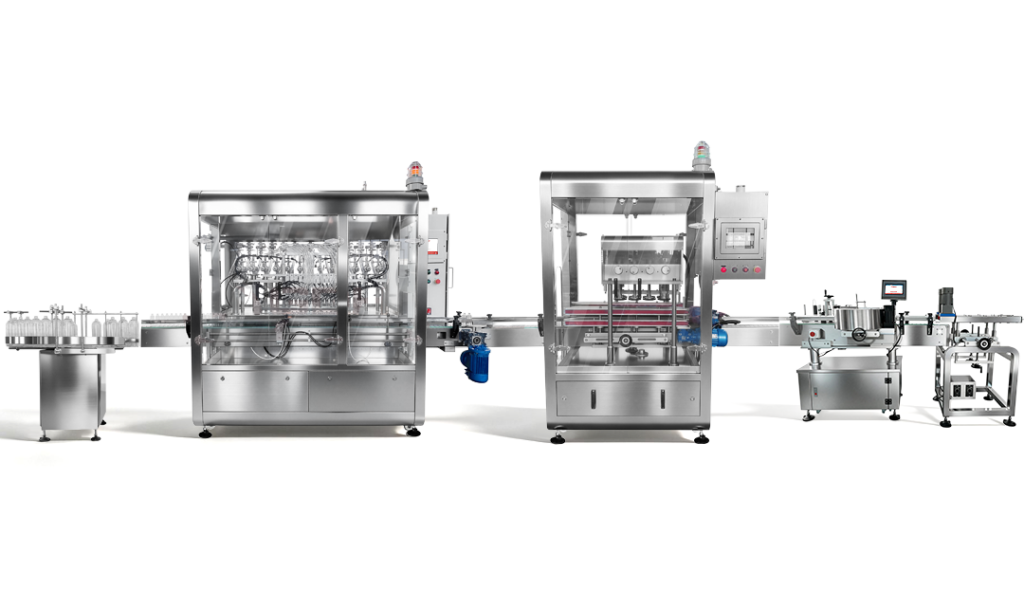
Automated machinery moves dressing from the batch process into market-ready bottles, jars, pouches, or sachets. The product’s viscosity, temperature, foam behavior, and inclusions affect dosing, while the package determines how it is presented, filled, capped, sealed, and labeled.
Piston filling systems are one option to evaluate for thick dressings and recipes containing seeds or herbs because positive displacement moves a defined volume through the product path. The valve, passage, and nozzle still need to accommodate the largest inclusion and preserve the product’s desired texture. Servo-driven controls (Precisely control the number of rotations of the gear) can make target adjustments and recipe changeovers easier.
Anti-drip and diving nozzles help reduce foam, splashing, strings, or neck contamination in selected applications. Choose the design and cutoff based on the container depth, product flow, and package opening. Define whether the target dose is measured by volume or mass and how it will be checked; the two are not interchangeable when product density or temperature changes.
Spindle or chuck cappers (twist-on or snap) can apply closures to compatible bottle or jar formats, but the useful cap torque depends on the container, closure, and liner. Induction sealing can be added where the package design and sealing process support it. Specify the cap and seal process together, keep the rim or neck free of product, and verify seal integrity during product-and-package trials.
Labeling equipment may apply front-and-back labels, wraparound labels, or shrink sleeves according to container shape and presentation needs. Label handling should be considered with the bottle orientation and downstream conveyor. Rotary premade-pouch systems can handle a pouch and fitment sequence, while multilane VFFS systems form sachets from rollstock.
Food-contact parts, seals, hoses, and pumps should be compatible with the dressing and the plant’s cleaning chemistry and temperature. Contact parts built from SUS316L stainless steel resist the acidic nature of vinegar and citrus bases.
Clean-in-place (CIP) can be useful when the machine is designed for it and the cleaning procedure is verified for the actual product and soil. Integrated Clean-in-Place (CIP) systems allow thorough washdowns between shifts, keeping downtime low and production lines running at consistent output speeds.
Packaging choices continue to evolve, but a new format or material is not automatically a better fit. Evaluate each option against product protection, consumer handling, operational requirements, and the collection systems available in the target market.
Inverted squeeze bottles with dispensing valves, spouted pouches, and portion-controlled sachets address different use cases. A valve may help keep a cap area cleaner when the dressing and valve are compatible; a spouted pouch can support pouring or refilling; and sachets provide defined portions for food service.
Brands may evaluate post-consumer recycled (PCR) PET or HDPE, lighter bottle preforms, or mono-material pouch structures. Each option has to meet the applicable food-contact requirements and still provide the barrier, strength, and seal performance required by the dressing. Furthermore, under high-speed filling conditions, it reduces the amount of plastic in the bottle while maintaining the stability of the sidewalls. Moving flexible packaging toward fully recyclable PE/PE or PP/PP film structures with barrier layers to replace unrecyclable multi-material foils.
cURL Too many subrequests by single Worker invocation. To configure this limit, refer to https://developers.cloudflare.com/workers/wrangler/configuration/#limits.
cURL Too many subrequests by single Worker invocation. To configure this limit, refer to https://developers.cloudflare.com/workers/wrangler/configuration/#limits.
cURL Too many subrequests by single Worker invocation. To configure this limit, refer to https://developers.cloudflare.com/workers/wrangler/configuration/#limits
cURL Too many subrequests by single Worker invocation. To configure this limit, refer to https://developers.cloudflare.com/workers/wrangler/configuration/#limits
| cURL Too many subrequests by single Worker invocation. To configure this limit, refer to https://developers.cloudflare.com/workers/wrangler/configuration/#limits | Tipo de recipiente | cURL Too many subrequests by single Worker invocation. To configure this limit, refer to https://developers.cloudflare.com/workers/wrangler/configuration/#limits | cURL Too many subrequests by single Worker invocation. To configure this limit, refer to https://developers.cloudflare.com/workers/wrangler/configuration/#limits |
|---|---|---|---|
| cURL Too many subrequests by single Worker invocation. To configure this limit, refer to https://developers.cloudflare.com/workers/wrangler/configuration/#limits | cURL Too many subrequests by single Worker invocation. To configure this limit, refer to https://developers.cloudflare.com/workers/wrangler/configuration/#limits | cURL Too many subrequests by single Worker invocation. To configure this limit, refer to https://developers.cloudflare.com/workers/wrangler/configuration/#limits | cURL Too many subrequests by single Worker invocation. To configure this limit, refer to https://developers.cloudflare.com/workers/wrangler/configuration/#limits |
| cURL Too many subrequests by single Worker invocation. To configure this limit, refer to https://developers.cloudflare.com/workers/wrangler/configuration/#limits | Squeeze bottle / Inverted bottle | Piston pump with pneumatic shut-off | Flip-top dispensing cap |
| Particulate Dressings (Italian) | Wide-mouth glass or PET jar | Rotary-valve piston filler | Lug cap or screw cap |
| Portion-Control Servings | Multi-layer barrier sachet / pouch | Multilane liquid filler or rotary pouch machine | Heat seal / fitment capper |
Your target output dictates your level of line automation:
Selecting a salad dressing package means balancing recipe behavior, material and closure performance, consumer use, market requirements, and operational fit. A glass pour bottle, squeeze bottle, jar, pouch, or portion pack may each be appropriate under different conditions. Shelf life and production performance should be confirmed for the finished product-package-machine combination.
Viscosity management: Select a dosing method and product path that handle the dressing at its actual filling temperature, including any particles, without unacceptable foam, blockage, or texture change.
Hygienic operation: Specify compatible product-contact materials and a cleaning method that can be verified for the equipment and recipe. Do not use stainless-steel grade or the presence of CIP as a substitute for reviewing the full product path.
Line flexibility: Plan for bottle geometries, closure types, pouch formats, change parts, and cleaning between SKUs. A modular line can support changeovers only when the product path and downstream handling are designed for the formats involved.
For a machine proposal, prepare the recipe or representative product sample, viscosity or flow information at filling temperature, particle dimensions, container and closure samples, target dose, destination markets, cleaning method, and required output. GDHP’s filling-machine range e nosso prático filling machine selection guide are useful next steps when reviewing equipment options.